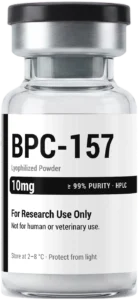
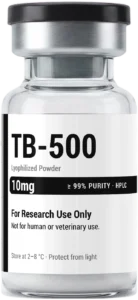
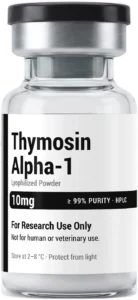
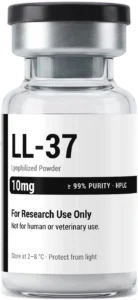
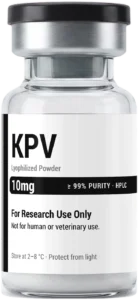
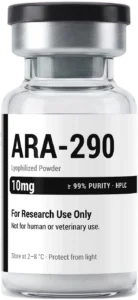
The largest group in our range and the most heavily published. Research here centres on how peptides influence the sequence of events that follows tissue injury: inflammatory signalling, fibroblast recruitment, extracellular matrix deposition and the angiogenesis that supports new tissue.
BPC-157 and TB-500 dominate the literature and are frequently studied together, which is why the pre-blended vial exists. Around them sit the immune-adjacent compounds – Thymosin Alpha-1 for T-cell work, LL-37 as the only human cathelicidin, and KPV for inflammatory pathway signalling without the pigmentation activity of its parent hormone.
The repair sequence
Tissue repair is not a single event but an ordered cascade, and most study designs target one stage of it. The inflammatory phase recruits immune cells to the injury site; the proliferative phase brings fibroblasts and new vasculature; the remodelling phase reorganises deposited collagen into something closer to the original tissue architecture. A compound that accelerates one phase does not necessarily improve the outcome of the next, which is why comparative work across the whole sequence is more informative than a single endpoint.
Why BPC-157 and TB-500 appear together
The two compounds act through different mechanisms. BPC-157 is associated with angiogenesis and growth-factor signalling; TB-500 binds actin and features in cell migration work. Because the mechanisms are complementary rather than overlapping, study designs that use both can observe more of the repair sequence within one experimental system. Our pre-blended vial fixes the ratio at 5mg + 5mg so it stays identical batch to batch.
The immune-adjacent compounds
Thymosin Alpha-1, LL-37, KPV and ARA-290 sit at the intersection of immunity and repair. LL-37 carries a rare dual profile: direct antimicrobial action alongside host cell signalling, which is why it appears in both infection and wound repair research. KPV retains the anti-inflammatory signalling of alpha-MSH without the pigmentation activity, making it a clean tool for inflammatory pathway work. ARA-290 isolates erythropoietin’s tissue-protective signalling from its haematopoietic effects, which is precisely why it was developed.
The KLOW and GLOW blends
Where single-compound research isolates one pathway, the multi-compound blends let a study observe collagen synthesis, cell migration and inflammatory signalling within one experimental system. Both contain GHK-Cu, so the reconstituted solution takes on the characteristic blue tint of the copper complex, and purity is reported per component on the Certificate of Analysis.
Research Use Only. Everything on this page is written for laboratory and analytical contexts. Nothing here is dosing guidance, medical advice, or a suggestion of human or veterinary use.