
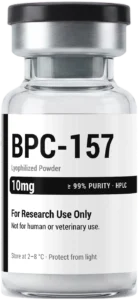
The interest around BPC-157 is not really based on one single effect. Researchers have investigated it across several biological systems, including connective tissue, the gastrointestinal tract, blood vessels and the nervous system. Much of this work has produced intriguing findings in animal and laboratory models. The important distinction, though, is that promising experimental results are not the same thing as established human efficacy.
That distinction matters with BPC-157 because its development as a therapeutic compound remains at an early stage.
What is BPC-157?
BPC-157 stands for Body Protection Compound-157. This is a synthetic peptide made up of 15 amino acids and was studied specifically during the preclinical stages of investigation.
The peptide has been examined in efforts to model tissue injury, inflammation, vascular dysfunction, and gastrointestinal injury. Proposed biological effects include changes in nitric oxide signalling, angiogenesis, inflammatory pathways and processes involved in tissue repair. More recent laboratory work has also examined how BPC-157 may influence vascular regeneration at a molecular level. A 2026 research article describes a collaboration between FBXO22 and BACH1 implicated in the activity of endothelial cells and tube formation in experimental models.
These findings help explain why BPC-157 continues to appear in regenerative medicine research. They do not, on their own, establish how the peptide would behave in people.
Why researchers are interested in it
A large part of the BPC-157 literature concerns tissue repair.
Animal studies have investigated muscle, tendon, ligament, bone and gastrointestinal tissues, with researchers looking at outcomes such as collagen formation, vascular responses, inflammatory signalling and restoration of damaged tissue. Recent reviews continue to describe these findings as encouraging but also point out how much of the available evidence comes from preclinical models rather than well-controlled human trials.
The vascular side of the research is particularly interesting. Angiogenesis, essentially the formation of new blood vessels, is an important part of tissue repair. Experimental research suggests BPC-157 may influence this process, while other studies have looked at its relationship with nitric oxide pathways and endothelial function.
There is also research into gastrointestinal effects, which fits with the peptide’s historical association with gastric tissue. Other experimental work has considered possible effects on inflammation, pain pathways and microcirculation.
It is therefore more useful to think of BPC-157 as a compound being investigated across several biological pathways rather than as a peptide with one clearly established purpose.
BPC-157 and tissue repair research
Tissue repair is probably the area that has generated the most attention.
Preclinical studies have reported changes in wound healing, tendon and ligament repair, muscle injury and bone-related models. Proposed mechanisms include effects on fibroblast activity, collagen production, blood-vessel formation and inflammatory signalling. A recent review covering regenerative peptides similarly describes BPC-157 as a compound with substantial preclinical interest but limited clinical validation.
The gap between these two stages of research is worth keeping in view. An effect seen in a rat tendon injury model, for example, cannot simply be transferred to a human injury. Differences in metabolism, dosing, delivery, injury severity and study design can all change the result.
For that reason, BPC-157 research is better understood as an area of investigation rather than evidence of a confirmed regenerative treatment.
What do human studies tell us?
In this context, the available evidence is significantly less robust.
Human research exists, but it is limited. Recent reviews describe small pilot studies involving areas such as musculoskeletal pain, interstitial cystitis and intravenous administration. These studies have not yet provided the type of large, controlled clinical evidence normally needed to establish efficacy and long-term safety.
A 2026 review of BPC-157 as a candidate for drug development noted various unresolved issues, including formulation, pharmacokinetics, evidence for dosing, and the fact that Phase II clinical development has not yet been completed. The review also noted that the available clinical data come from small studies and do not represent a standardised pharmaceutical development programme.
Therefore, while human research is beginning to appear, it remains too limited to draw broad conclusions about effectiveness.
Safety and research limitations
Safety is another area where caution is needed.
The US FDA has stated that there is limited safety information for BPC-157 in the proposed routes of administration it has reviewed. It has also highlighted potential concerns around immunogenicity, peptide-related impurities and characterisation of the active pharmaceutical ingredient.
This does not mean that every experimental exposure will produce harm. It means that the available evidence is not strong enough to properly define the risks, particularly with repeated or long-term use.
There are also practical research problems. Different studies may use different formulations, routes of administration and experimental conditions. Without consistent pharmaceutical preparation and pharmacokinetic data, comparing results across studies can be difficult.
BPC-157 in sports research
BPC-157 is also relevant to sports science because of the interest in recovery and tissue repair. However, its regulatory position is important.
The World Anti-Doping Agency lists BPC-157 under the S0 category for non-approved substances, meaning it is prohibited at all times under the World Anti-Doping Code.
That makes its status particularly relevant when reviewing peptide research in an athletic setting.
Where does BPC-157 research stand?
BPC-157 has an unusually broad preclinical research profile for a peptide that has not progressed into an established therapeutic product. Studies continue to explore its possible roles in vascular biology, tissue repair, inflammation, gastrointestinal research and other areas.
The interesting part is the biological activity reported across these models. The unresolved part is translation.
At present, the evidence does not provide a validated clinical dosing framework or enough high-quality human data to establish BPC-157 as a proven treatment. Recent literature continues to identify the same basic challenge: moving from encouraging laboratory and animal findings to properly controlled human research.
For research purposes, BPC-157 is therefore best viewed as an investigational peptide with a growing preclinical evidence base and significant unanswered questions around formulation, pharmacokinetics, safety and clinical effectiveness.
When evaluating BPC-157 research, it is essential to keep the distinction between experimental observations and clinical demonstrations at the forefront.
Published batch records
Every batch of BPC-157 we have sold, each with its published Certificate of Analysis.
Research Use Only. BPC-157 is supplied strictly for laboratory research. Nothing on this page is dosing guidance, medical advice, or a suggestion of human or veterinary use.