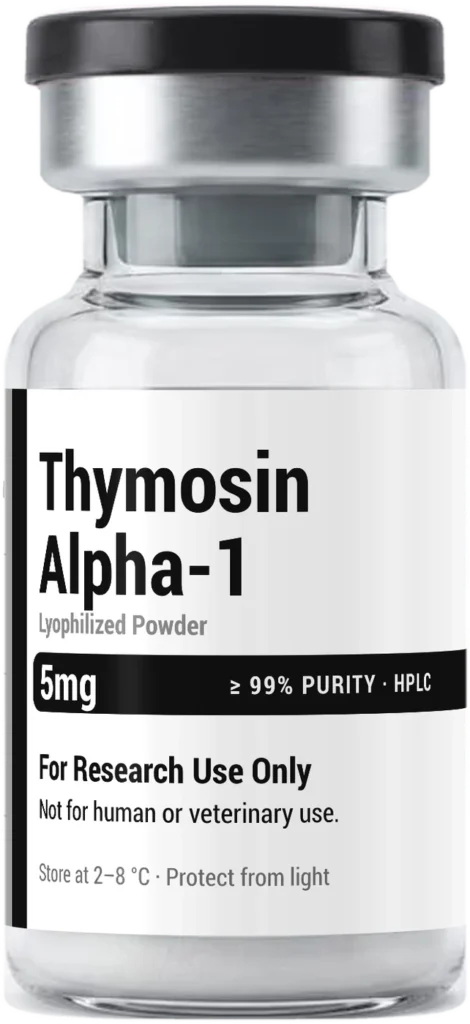
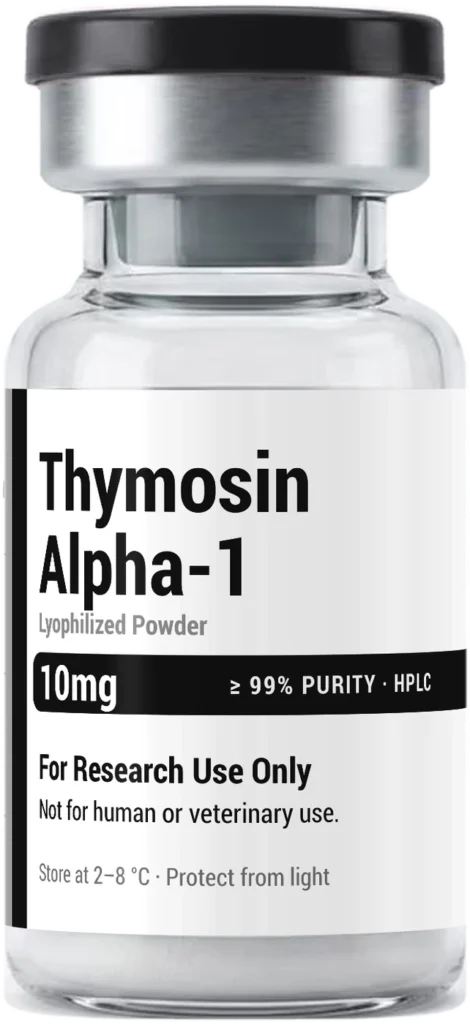
Vial label design and print may vary between batches. Product specifications remain unchanged.
At a glance
Strength
10mg per vial
Form
Lyophilised powder
Purity
≥ 99% (HPLC)
CAS number
62304-98-7
Molecular weight
3108.3 g/mol
Certificate of Analysis
Batch TA-10-32 · Prime Peptides UK
Tissue & repair
Thymosin Alpha-1
Synthetic research peptide · 10mg · CAS 62304-98-7
£39.95 In stock · ready to shipper vial · £4.00 per mg
Choose strengthPrice per vial
Thymosin Alpha-1 10mg is coming soon. It goes on sale as soon as its batch certificate is published - every vial we sell has a matching CoA.
Bank transferBitcoin Encrypted checkout · card details are never taken on this site
Multi-item discount. Add any 2 items for 4% off the whole order, 7% at 3, 10% at 4. Applied automatically at checkout.
Free
Free lab add-on. Bacteriostatic water is included with every peptide order at no extra cost.
Lab essentials tap to add to this order
RUOResearch Use Only. Not for human or veterinary use. By purchasing you confirm you are a qualified researcher and accept responsibility for safe, lawful handling.
Same-day dispatch
Orders before 3:00 PM leave the same working day, tracked, in plain packaging. Free UK delivery over £200.
Secure payment
Bank transfer or Bitcoin over an encrypted checkout. No card details are stored or handled on this site.
Batch tested
Every batch is HPLC and mass spectrometry tested, and its certificate is published before it ships.
Thymosin Alpha-1 10mg≥99% HPLC · In stock
£39.95
Compound Overview
What Is Thymosin Alpha-1 10mg?
Thymosin Alpha-1 10mg is a research format that is used in a laboratory setting to perform a controlled scientific investigation and contains 10mg of peptide material. This 28-amino-acid peptide is also referred to in the literature as Tα1, and is of interest due to its association with immune signalling and activity of various immune-cell populations. The 10mg presentation allows researchers to have a defined amount for laboratory study protocols in which further amounts of material are needed, or where repeated analytical work is required. This product is intended for research only and NOT for human consumption.
Thymosin Alpha-1 (Tα1) is a naturally occurring peptide known to be thymic-related. It was first found in thymus tissue and is made of 28 amino-acid residues. Scientific literature refers to it as the N-terminal region of prothymosin alpha, and its interaction with various innate and adaptive immune signalling components has been studied.
The Thymosin Alpha-1 10mg format specifies the total amount of research peptide that is provided in the vial. It is not a recommended dose, treatment schedule or indication for administration.
When planning assays, allocating samples and designing assays with multiple analytical steps, the quantity of material matters for laboratory teams. A research format may then be chosen when the laboratory procedure requires only a 10 mg quantity of the material. This will vary, depending on the experimental protocol set up by the research organisation.
Thymosin Alpha-1 10mg supplied by Prime Peptides UK is positioned solely as a laboratory research material rather than a medicinal or consumer product.
Sizes & Prices
Thymosin Alpha-1 sizes and prices
Each size is supplied from its own tested batch with its own Certificate of Analysis. The size is the amount of research material in the vial; larger vials cost less per mg.
Size
Price
Per mg
Batch certificate
Choose
5mg
£24.95
£4.99
TA-05-32
10mg
£39.95
£4.00
TA-10-32
Technical Data
Thymosin Alpha-1 Product Specifications
Technical Specification Sheet
THYMOSIN ALPHA-1 · RUO
Product Name
Thymosin Alpha-1
Compound
Thymosin Alpha-1 / Tα1
Alternative scientific name
Thymalfasin
Strength
5mg, 10mg per vial
Peptide length
28 amino-acid residues
Approximate molecular weight
3,108 Da
Format
Lyophilised research peptide
Classification
Research peptide / investigational compound
Testing documentation
Batch-specific analytical documentation where provided
COA
Certificate of Analysis available for the applicable batch
Intended purpose
Laboratory and scientific research only
Human use
Not intended for human consumption or self-administration
Published scientific literature characterises Tα1 as an N-terminal acetylated peptide containing 28 amino acids with a molecular weight of approximately 3,108 Da.
The Science
Scientific Background Behind Tα1 Research
The studies of Tα1 were based on previous investigations of biologically active factors related to the thymus. It was discovered and described during research in the 1970s and has been the subject of laboratory, preclinical and clinical research.
Immune regulation is a key area of scientific interest. The interactions of T cells, dendritic cells, macrophages, natural killer cells and other aspects of immune activity have been studied in experimental literature. The study of signalling involving Toll-like receptors and the downstream molecular pathways has also been explored.
Possible TLR-related signalling such as NF-κB, IRF3 and other signalling components were described in the reviews. These observations have been used to examine the possible communication between innate and adaptive immune responses that may be mediated by Tα1.
These results need to be interpreted properly. Data generated by cell systems, animal models and certain clinical conditions does not always translate to therapeutic results. Therefore, it should be regarded as research material (not a proven therapeutic use in the UK) for a laboratory product like Thymosin Alpha-1 peptide 10mg.
Laboratory Focus
Why Tα1 Continues to Attract Laboratory Interest
One reason Tα1 remains scientifically intriguing is that its reported biological activity is not limited to one isolated signalling pathway. Researchers have investigated how the peptide interacts with several cellular populations and signalling networks involved in immune regulation.
Immune Modulation
Published studies have examined dendritic-cell activity, T-cell responses, cytokine signalling and Toll-like receptor pathways. Other experimental work has explored macrophage and natural killer cell activity and the relationship between Tα1 and communication between innate and adaptive immune mechanisms.
Receptor Signalling
This breadth makes the compound relevant to several types of experimental designs, from mechanistic cell studies to broader investigations of immune signalling.
Interpreting Results
However, the existence of scientific research should not be interpreted as proof that a research peptide is suitable for personal use. Evidence varies considerably according to study design, experimental system, population and endpoint. Researchers evaluating Tα1 should therefore examine the original methodology and evidence rather than extrapolating individual findings beyond their scientific context.
Product Format
Why Choose a 10mg Research Format?
10mg
Nominal Research Quantity
The defining characteristic of this product page is the 10mg quantity of Thymosin Alpha-1 research material contained in each vial.
Research peptides may be offered in several quantities because laboratories do not all work at the same experimental scale. A small exploratory project, for example, may have different material requirements from a project involving repeated assays, multiple sample groups or several analytical stages.
A 10mg vial provides a clearly identified quantity that can be incorporated into laboratory inventory and experimental planning. Researchers may consider factors including the number of planned assays, analytical requirements, sample allocation, replication strategy and the overall scale of the project when determining material requirements.
The 10mg designation should not be interpreted as meaning that this format is more potent, effective or appropriate than a lower-strength vial. It simply describes the amount supplied. Prime Peptides UK does not provide human dosing, cycle or administration recommendations for this research product.
Verification
Analytical Testing, Identity and Batch Documentation
The number on the vial is just one component of product identification when sourcing a specialised peptide like Thymosin Alpha-1 (10 mg UK). Analytical information with the batch should also be taken into consideration.
Batch-Specific CoA
Peptide analysis can be used to determine the purity of the chromatographies using high-performance liquid chromatography (HPLC) and to obtain further information on the identity of the peptides using complementary analytical techniques. A Certificate of Analysis is not a marketing ploy; it must be read in the light of the particular methods and results reported.
Documentation & Transparency
For the analytical information to go along with the material being supplied, batch documentation is especially beneficial. The researchers must verify the identifier (compound name, batch or lot reference, analytical method and reported results).
Identity vs Purity
Prime Peptides UK supplies relevant product-testing data and batch-specific COA documentation for researchers to assess all available analytical data before using the material in research. Unless backed by the appropriate batch documentation, no purity % should be assumed.
Handling
Storage and Handling in a Research Environment
Laboratory Research
Peptide material should be managed according to the storage information supplied with the product and the laboratory's established standard operating procedures.
Environmental Conditions
Until required for research, the vial should remain correctly identified and protected from inappropriate environmental exposure. Temperature, moisture, light and repeated handling can all be relevant considerations for peptide stability, depending on the material and its format.
Contamination Control
Laboratories should maintain suitable inventory records and minimise opportunities for contamination or sample misidentification. Where a supplier provides batch-specific storage instructions, these should take precedence over generic guidance.
Reconstitution Practice
This information concerns laboratory material management only. It is not a protocol for preparing 10 mg of Thymosin Alpha-1 10mg for injection, administration or any form of personal use.
UK scientists screening a peptide supply should consider more than the product name and the appearance of the vials. When looking at laboratory materials, it is crucial that they are clear, analytical, traceable, and research-only positioned.
Before ordering Thymosin Alpha-1 in the UK, researchers should check what documentation comes with the batch and whether its analytical results can be matched to the material ordered. The evaluation should also cover the packaging, the storage instructions and clear, reliable labelling.
Commercial availability does not imply regulation. The MHRA provides information services on medicines containing UK product documentation and marketing authorisation information that is relevant to them.
Prime Peptides UK is a supplier of the 10mg Tα1 format for laboratory and scientific research, with UK dispatch and research-focused product information.
Analytical Records
Batch certificates for Thymosin Alpha-1
Every order ships with the CoA matched to its batch number, and the analytical records
are published here - open the certificate before you order, or cross-check the one in
your parcel.
What exactly does the 10mg on a Thymosin Alpha-1 vial represent?
The 10mg figure describes the quantity of peptide research material supplied in the vial. It is a product specification used for identification, inventory management and laboratory planning. It does not constitute a recommended dose and should never be interpreted as instructions for administration to a person or animal.
Why might a laboratory select the 10mg Tα1 format instead of 5mg?
Laboratory material requirements differ between projects. Researchers may require different quantities depending on the number of experiments, assay design, replication, analytical work and overall study scale. The 10mg format simply provides a different quantity of research material. It does not imply greater effectiveness or superiority over a 5mg format.
Is Thymosin Alpha-1 10mg a medicine in the UK?
This Prime Peptides UK product is sold as a research material and is not presented as a UK-licensed medicine. Researchers should distinguish between published investigations involving thymosin alpha-1 or thymalfasin and the regulatory status of a particular commercial research product. The availability of scientific publications does not turn a research peptide into an authorised medicine.
Which areas of Tα1 biology have been investigated?
Scientific literature has examined Tα1 in relation to T cells, dendritic cells, macrophages, natural killer cells, cytokine activity and Toll-like receptor-associated signalling. Reviews describe research spanning both innate and adaptive immune mechanisms. Findings vary according to the experimental model and should not be converted into unsupported claims about human outcomes.
What should I look for in the COA for a 10mg research vial?
Check whether the Certificate of Analysis can be associated with the relevant product and batch. Useful information can include compound identification, batch or lot details, analytical methods and reported analytical results. Where HPLC or another technique is listed, researchers should consider what that specific test establishes rather than assuming one method confirms every aspect of product quality.
Can the 10mg format be used to calculate a personal dosing schedule?
No. The 10mg is a designation of the amount of research material in the vial, and not a recommended dose. This product is solely supplied for controlled laboratory and scientific research. There is no dosing, injection, cycling, self-administration or therapeutic instruction provided by Prime Peptides UK.
PG
Medically & Scientifically Reviewed By
Dr. Priyanka Goel
Scientific & Medical Content Reviewer
Reviews research content against current published literature and UK regulatory guidance, ensuring compound information is accurate, referenced and presented for research use only.
Thymosin Alpha-1 10mg is only supplied for laboratory research purposes. This product is not intended for sale to or use by humans. The information on this site relating to scientific information is meant to provide a description of the compound and its research background only and is not intended to imply medical advice, guidance to treatment or evidence that this research product is an authorised medicine.