
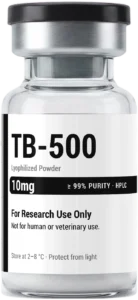
Research on full-length thymosin beta-4 has produced findings in wound healing and tissue repair, including studies involving skin, corneal tissue and other repair processes. TB-500 itself has a much smaller research base. So while the two are closely related, results from Tβ4 studies should not automatically be presented as proof of what TB-500 does in humans.
What is TB-500?
TB-500 is commonly identified as an N-acetylated fragment of thymosin beta-4. The substance is often described as Ac-LKKTETQ, a seven-amino-acid sequence corresponding to the N-terminal region of the full-length peptide. The US Food and Drug Administration has also described TB-500-related substances as the seven-amino-acid peptide N-acetyl-LKKTETQ.
That detail matters when reading peptide research. Full-length thymosin beta-4 contains 43 amino acids, whereas TB-500 is a much shorter fragment. Some of the biological interest comes from the LKKTET region, which is associated with actin binding. Actin is involved in cell structure and movement, making this pathway relevant to research into cell migration and tissue repair.
The wider thymosin beta-4 literature has looked at processes including angiogenesis, inflammation, cell migration and extracellular matrix organisation. These mechanisms have helped make the peptide family interesting to researchers studying how damaged tissue responds after injury.
Why is TB-500 studied?
A large part of the interest comes from the biology of thymosin beta-4.
When tissue is injured, repair involves a number of overlapping processes rather than one single reaction. Cells need to move into the damaged area, inflammation has to be controlled, new blood vessels may form and structural proteins such as collagen need to be organised. Research involving full-length Tβ4 has suggested that the peptide can influence several of these processes.
For example, early animal research found that thymosin beta-4 increased re-epithelialisation, collagen deposition and angiogenesis in full-thickness skin wounds. The same work also observed increased keratinocyte migration, providing a possible explanation for some of the wound-healing effects seen in the model.
Later research continued to investigate the repair process. In animal models, Tβ4 has been associated with changes in inflammatory signalling, cell migration and connective tissue organisation. Studies have also explored its potential role in corneal repair and other forms of tissue injury.
This is the scientific background behind much of the interest in TB-500. However, this does not mean TB-500 is a proven injury treatment or that Tβ4 research results can be applied to the fragment.
TB-500 and wound-healing research
Wound healing is probably the most commonly discussed research area connected with TB-500 and thymosin beta-4.
There is a reasonable body of preclinical research on full-length Tβ4. Studies have reported effects in animal models involving skin wounds, burns and other damaged tissues. A review of the field also describes possible roles for Tβ4 in angiogenesis, inflammation, apoptosis and tissue regeneration.
Some human research has investigated full-length thymosin beta-4 in wound-related settings. A 2012 review reported phase 2 clinical trials involving stasis ulcers and pressure ulcers, with faster healing reported among patients whose wounds healed. These studies are relevant to the broader Tβ4 research story, but they should not be treated as clinical evidence for TB-500 specifically.
That distinction is worth keeping in mind when comparing research products. A shorter synthetic fragment does not automatically reproduce a mechanism observed with a naturally occurring protein.
What does the evidence actually show?
The evidence is mixed in terms of how confidently TB-500 itself can be discussed.
Thymosin beta-4 has attracted considerable scientific interest, especially in the area of tissue repair and regeneration. But the direct evidence for TB-500 is much more scant. In the FDA’s 2026 review of substances related to TB-500, the agency cited a lack of data on human exposure to drug products containing the thymosin beta-4 fragment LKKTETQ. It also raised open issues on immunogenicity, aggregation and peptide-related impurities.
There is another useful point from recent research. An FDA advisory document noted that an in-vitro study using TB-500 at 50 μg/mL did not promote wound closure in cultured fibroblasts subjected to a scratch assay. The same document stated that it had found no published non-clinical in vivo studies directly assessing TB-500 on wounds.
So the sensible way to read the current literature is that it has not been proven whether TB-500 is effective or whether it accelerates healing. Rather, the direct evidence remains limited, and there is still a sizeable gap between the established Tβ4 literature and the evidence specifically available for TB-500.
Research considerations
TB-500 is also relevant to sports research. The World Anti-Doping Agency (WADA) lists thymosin-β4 and its derivatives, including TB-500, under prohibited growth factors and growth factor modulators in its 2026 Prohibited List.
For laboratory work, another consideration is peptide identity. Names such as “TB-500”, “thymosin beta-4 fragment” and “thymosin beta-4” are sometimes used loosely online. They should not be assumed to refer to identical materials. Sequence, terminal modifications, purity and analytical characterisation can all affect how a research peptide is defined.
For that reason, research involving TB-500 is best considered in terms of the actual material being studied rather than relying only on the name on a product label.
Where TB-500 research stands
TB-500 sits in an interesting but still developing area of peptide research. Its relationship with thymosin beta-4 gives it a clear biological rationale for investigation, particularly in areas involving cell movement, tissue repair and inflammatory responses.
At the same time, the strongest evidence often cited in discussions of TB-500 comes from studies of full-length thymosin beta-4 rather than TB-500 itself. That difference should remain front and centre when reviewing the literature.
For researchers, the main opportunity is therefore not to assume a finished answer but to look more closely at the peptide sequence, experimental model, dose, route, endpoints and quality of the material used. Those details can make a substantial difference when comparing findings between studies.
TB-500 remains a research compound rather than an established human treatment, and current evidence does not provide enough direct human data to draw firm conclusions about its safety or therapeutic effectiveness.
Published batch records
Every batch of TB-500 we have sold, each with its published Certificate of Analysis.
Research Use Only. TB-500 is supplied strictly for laboratory research. Nothing on this page is dosing guidance, medical advice, or a suggestion of human or veterinary use.