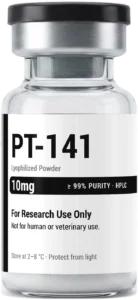
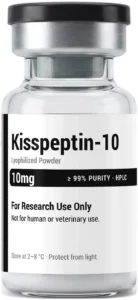
This area covers PT-141 and Kisspeptin-10. Melanotan-2, the compound PT-141 is derived from, is listed under Melanogenesis Research and is discussed here for comparison.
Melanotan-2 and PT-141 form one of the cleanest structure-activity pairs available to researchers: near-identical cyclic peptides differing only at the C-terminus, where an amide becomes a free acid. That single change shifts receptor preference and moves the research focus from pigmentation to central nervous system pathways.
One modification, two research profiles
Melanotan-2 is a cyclic lactam analogue of alpha-melanocyte stimulating hormone developed at the University of Arizona. Its non-selective melanocortin receptor activity makes it a staple of pigmentation pathway research and of receptor selectivity comparisons.
PT-141 (bremelanotide) is an active metabolite of Melanotan-2 with a free acid C-terminus in place of the amide. That shift moves receptor preference toward MC4R and relocates the research focus to central nervous system pathways. Because the two molecules are otherwise structurally almost identical, the pair is a textbook model for how a terminal modification alters receptor selectivity – which is why they are so often studied side by side rather than in isolation.
Both carry cyclic lactam structures, which gives them noticeably better stability than linear peptides of comparable length.
Upstream of the reproductive cascade
Kisspeptin-10 belongs to a different mechanism entirely. It is the shortest active fragment of the kisspeptin family, products of the KISS1 gene, and it sits at the top of the reproductive hormone cascade where it triggers GnRH release. That position makes it the standard tool for studying the reproductive axis from its origin rather than mid-chain, and it appears in GnRH release assays, KISS1R receptor binding studies and puberty-onset research paradigms.
It has a short plasma half-life, so reconstituting immediately before use is preferable where the protocol allows.
Research Use Only. Nothing on this page is dosing guidance, medical advice, or a suggestion of human or veterinary use.