
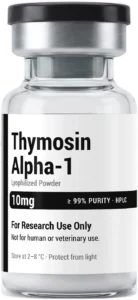
It is a 28-amino-acid peptide originally identified as a product associated with the thymus. A synthetic version has been developed for research and clinical use in some countries, where it is also known as thymalfasin. Research into the peptide goes back several decades, so there is a fairly large body of literature behind it. At the same time, the evidence is not uniform across every area being investigated, which is worth keeping in mind when looking at claims surrounding Tα1.
What makes Thymosin Alpha-1 interesting?
The main point of interest is its proposed role as an immunomodulator.
Tα1 has been studied for its ability to activate the immune system and influence immune activity based on surrounding biological conditions. “Studies have examined effects on T cells, dendritic cells, natural killer cells and other aspects of innate and adaptive immunity.”
One area that has received particular attention is the interaction between Tα1 and dendritic cells. Studies have linked the peptide with Toll-like receptor signalling and downstream immune pathways involved in cytokine production. This has led researchers to investigate whether Tα1 could help alter an immune response that has become suppressed or poorly regulated.
That distinction matters. The research is not simply about making the immune system “stronger”. But it’s more complex; it’s about communication between immune cell populations; it’s about communication between different populations of immune cells and the signals that direct their behaviour.
T-cell and immune signalling research
T-cell activity is another recurring theme in Tα1 research.
Earlier work suggested that the peptide could influence T-cell differentiation and function, while later research examined its effects on broader immune-cell behaviour. Some studies have reported that Tα1 exposure leads to changes in immune markers, especially in situations where immune function is already compromised.
Scientists have also looked into how Tα1 changes the way cytokines send signals. Cytokines act as communication molecules between cells, and changes in their production can have entirely unique consequences depending on the disease model and the wider immune environment.
This is one reason Tα1 continues to attract interest in conditions involving immune dysfunction. The peptide is being studied less as a conventional single-target compound and more as a biological regulator capable of influencing several connected pathways.
Areas being investigated
Thymosin Alpha-1 has been examined across a surprisingly broad range of research.
In infectious disease research, investigators have looked at whether immune modulation with Tα1 can influence outcomes in patients whose immune responses are impaired. Sepsis has been one notable area of investigation, with several clinical trials and meta-analyses examining mortality and immune markers. Results have not been completely consistent, and reviews have highlighted limitations in study quality, sample size and trial design.
The peptide has also been investigated in viral infections, including hepatitis and COVID-19. During the COVID-19 pandemic, researchers were particularly interested in whether Tα1 could influence immune dysfunction and excessive inflammatory signalling. Laboratory research has reported effects on inflammatory gene expression and immune-cell activity, although findings from experimental work should not automatically be interpreted as proof of clinical benefit.
Cancer research is another developing area. Tα1 has been investigated as an immunomodulatory compound alongside conventional cancer treatments and, more recently, immune checkpoint inhibitors. Researchers are interested in whether changing the tumour immune environment could influence how effectively immune-based treatments work. This remains an active area rather than a settled conclusion.
What does the clinical research show?
There is more human research on Tα1 than its relatively niche reputation might suggest. A 2024 review examined more than 30 clinical trials involving over 11,000 participants across several areas of research. That review discussed applications involving infections, cancer and immune-related conditions, while also noting the need to interpret the evidence within the limitations of individual studies.
Research in sepsis illustrates the wider picture particularly well. Earlier systematic reviews reported potentially favourable outcomes but also pointed out concerns about study quality and relatively small participant numbers. Recent meta-analytic work has continued to explore the question, indicating that earlier studies have not closed the subject.
There is also continuing clinical research in liver disease. A recent randomised controlled trial investigated Tα1 in people with hepatitis B virus-related acute-on-chronic liver failure, focusing not only on clinical outcomes but also on changes in immune-cell populations and inflammatory markers.
Tα1 has a substantial research history, but the strength of the evidence varies significantly depending on the specific condition, study design, and outcome considered.
Safety and research considerations
Safety is another reason Tα1 remains of interest. Published clinical literature has generally described a favourable tolerability profile, although that does not mean the peptide is free from adverse effects or suitable for every situation.
Research compounds should also be considered separately from approved medicines. Availability, regulatory status and permitted uses can differ between countries. A peptide being investigated in clinical studies does not automatically mean that every proposed use has been established or authorised.
For laboratory research, factors such as peptide identity, purity, storage conditions and experimental design can all affect results. These details become particularly important when comparing findings between different studies.
Where Tα1 research is heading
Current interest is moving beyond the basic question of whether thymosin alpha-1 changes immune activity. Researchers are increasingly looking at how, when and in which biological settings those changes may matter.
Cancer immunotherapy is one example, particularly research combining Tα1 with immune checkpoint inhibitors. Other work is looking at immune restoration during severe infections and inflammatory diseases. There is also growing interest in understanding the peptide’s effects at a molecular level, since its precise mechanism has not been reduced to one simple receptor or pathway.
That leaves Tα1 in an interesting position within peptide research. It has decades of experimental and clinical literature behind it, but there are still unanswered questions about mechanism, patient selection and the situations in which its immune-modulating effects may be most relevant.
For researchers, that combination of established evidence and unresolved biology is arguably what makes Thymosin Alpha-1 worth studying.
Published batch records
Every batch of Thymosin Alpha-1 we have sold, each with its published Certificate of Analysis.
Research Use Only. Thymosin Alpha-1 is supplied strictly for laboratory research. Nothing on this page is dosing guidance, medical advice, or a suggestion of human or veterinary use.