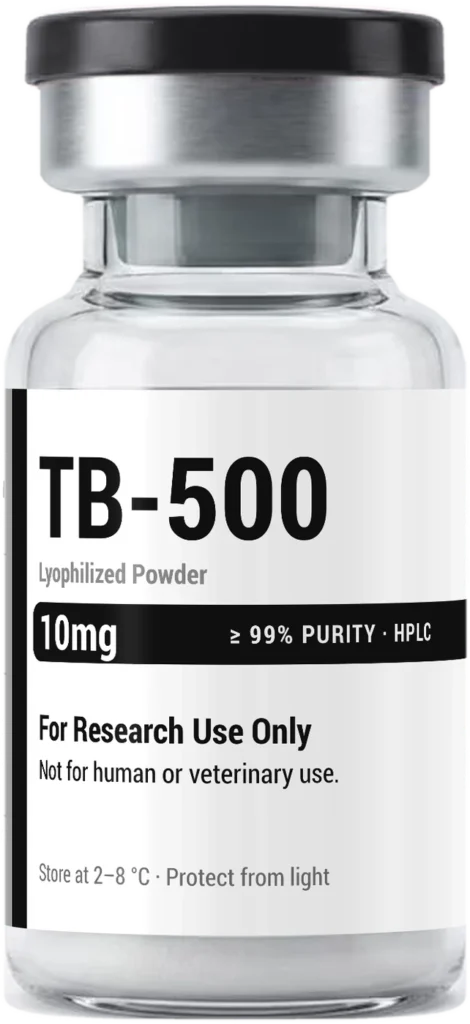
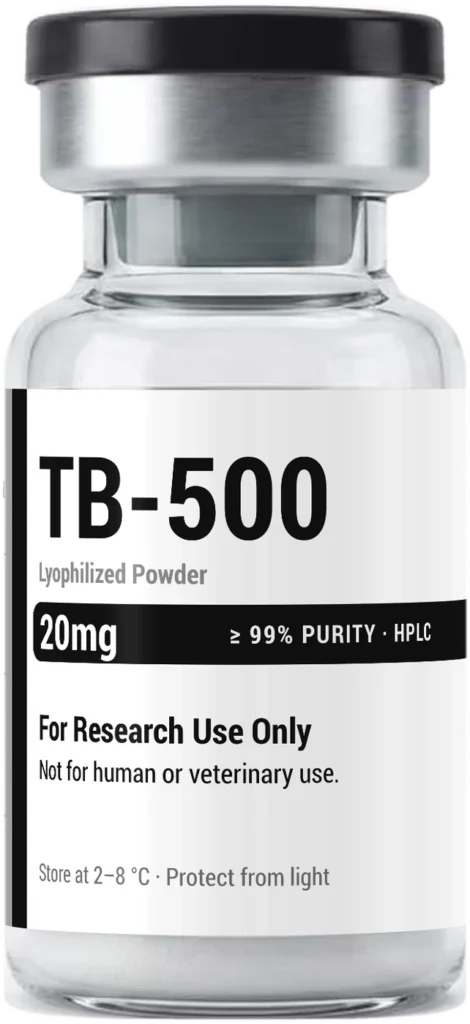
Vial label design and print may vary between batches. Product specifications remain unchanged.
At a glance
Strength
10mg per vial
Form
Lyophilised powder
Purity
≥ 99% (HPLC)
CAS number
77591-33-4
Molecular weight
4963.4 g/mol
Certificate of Analysis
Batch TB-10-30 · Prime Peptides UK
Tissue & repair
TB-500
Synthetic research peptide · 10mg · CAS 77591-33-4
£24.95 In stock · ready to shipper vial · £2.50 per mg
Choose strengthPrice per vial
TB-500 10mg is coming soon. It goes on sale as soon as its batch certificate is published - every vial we sell has a matching CoA.
Bank transferBitcoin Encrypted checkout · card details are never taken on this site
Multi-item discount. Add any 2 items for 4% off the whole order, 7% at 3, 10% at 4. Applied automatically at checkout.
Part of a stack. TB-500 is in the Recovery & Repair Stack (BPC-157 10mg · TB-500 10mg · KPV 10mg).
Free
Free lab add-on. Bacteriostatic water is included with every peptide order at no extra cost.
Lab essentials tap to add to this order
RUOResearch Use Only. Not for human or veterinary use. By purchasing you confirm you are a qualified researcher and accept responsibility for safe, lawful handling.
Same-day dispatch
Orders before 3:00 PM leave the same working day, tracked, in plain packaging. Free UK delivery over £200.
Secure payment
Bank transfer or Bitcoin over an encrypted checkout. No card details are stored or handled on this site.
Batch tested
Every batch is HPLC and mass spectrometry tested, and its certificate is published before it ships.
TB-500 10mg≥99% HPLC · In stock
£24.95
Compound Overview
What Is TB-500 10mg?
TB-500 10mg is a Peptide Research Product, which is a synthetic peptide used for the purposes of research and controlled laboratory use. Scientific interest has been attracted to the studies on the actin-binding region of thymosin beta-4 (Tβ4), an endogenous protein involved in a number of cellular processes including migration and cytoskeletal structure. The 10mg designation is not a dosage recommendation but instead indicates the amount of research material provided. This product is only provided for qualified laboratory research and is not sold for human or veterinary use.
TB-500 is a peptide molecule derived from the synthetic research of a biologically active part of thymosin beta-4. Analytical research published has identified TB-500 preparations that contain an N-terminally acetylated peptide corresponding to the LKKTETQ sequence of Tβ4. This area has been of interest to scientists due to the association with actin binding and cellular migration.
The thymosin beta-4 peptide is a naturally occurring 43-amino-acid peptide, which is widely distributed in mammalian tissues. Importantly, there is no direct equivalence between the length of the thymosin beta-4 and its potency for its biological actions, so TB-500 cannot simply be identified as the same thing as long thymosin beta-4. The exact identity and sequence of the product that is being supplied must be determined by the researcher using the appropriate product documentation and batch Certificate of Analysis.
For a TB-500 10mg research product, 10mg describes the total nominal quantity of peptide material provided in the container. It does not indicate an appropriate experimental concentration or biological dose. Those parameters depend on independently designed laboratory protocols.
Sizes & Prices
TB-500 sizes and prices
Each size is supplied from its own tested batch with its own Certificate of Analysis. The size is the amount of research material in the vial; larger vials cost less per mg.
Size
Price
Per mg
Batch certificate
Choose
10mg
£24.95
£2.50
TB-10-30
20mg
£39.95
£2.00
TB-20-30
Technical Data
TB-500 Product Specifications
Technical Specification Sheet
TB-500 · RUO
Product
TB-500
Strength
10mg, 20mg per vial
Product category
Synthetic research peptide
Format
Laboratory research material
Quantity
10mg, 20mg per vial
Testing documentation
Refer to batch-specific analytical documentation
Certificate of Analysis
Batch-specific Certificate of Analysis with every batch
Intended purpose
Laboratory and scientific research only
Human use
Not intended for human consumption or administration
Storage
Follow product label, COA and supplier storage documentation
Researchers should use the batch documentation accompanying the product as the primary source for identity, analytical results and storage requirements rather than assuming specifications from other TB-500 products.
The Science
Scientific Background of TB-500
The biological properties of thymosin beta-4 and its biologically active peptides constitute much of the scientific background to TB-500. Tβ4 is an actin sequestering peptide involved in the binding with G-actin, which is relevant to the study of cytoskeletal dynamics and cellular movements.
The amino-acid sequence LKKTETQ, which represents residues 17–23 of thymosin beta-4, is a region that has been studied frequently. This actin-binding motif has been linked to various cellular functions. Studies investigating TB-500 have found an N-terminally acetylated version of this sequence, to distinguish TB-500 studies from those investigating the whole molecule of Tβ4.
Experimental literature has investigated thymosin beta-4 or its fragments in relation to endothelial-cell behaviour, cell migration, engagements related to angiogenesis, and models of tissue response. The results come from laboratory, animal (and other) preclinical studies.
Research Context
Therefore, they are the observations made while testing a research product of this type and should not be taken as proof that a TB-500 research product has definite therapeutic effects in humans.
Laboratory Focus
Why Is TB-500 Studied in Laboratory Research?
TB-500-related research is particularly relevant to scientists examining how short peptide sequences interact with cellular structures and signalling processes.
Cellular Studies
One important area is actin biology. Actin contributes to cell structure, movement and numerous intracellular processes. The LKKTETQ region associated with TB-500 has been investigated because it corresponds to the central actin-binding domain of thymosin beta-4.
Tissue Repair Models
Researchers have also explored Tβ4-related sequences in experimental models concerned with cell migration. Movement of cells is relevant to many areas of biological research, including developmental biology, tissue modelling and cellular response studies.
Cellular Studies
Angiogenesis is another subject represented in the literature. Experimental work has investigated how the actin-binding region of Tβ4 influences endothelial-cell migration, adhesion and vessel-forming behaviour.
Interpreting Results
Other studies have examined inflammatory signalling and experimental tissue-response models. However, results involving full-length thymosin beta-4 cannot automatically be attributed to every synthetic fragment or commercial material labelled TB-500. Compound identity, experimental model and methodology all matter when interpreting results.
Product Format
What the 10mg Research Format Means
10mg
Nominal Research Quantity
The 10mg format provides a defined quantity of TB-500 research material within a single product unit. This strength designation is primarily useful for laboratory procurement, inventory management and experimental planning.
The amounts needed will vary based on the nature of their work. A project with several analytical runs, repeat experiments or several laboratory assays may have different material requirements than a simple preliminary research.
The presence of 10mg in the product name does not establish an experimental concentration and should never be interpreted as a human or animal dosage recommendation.
TB-500 10mg UK items should be assessed for material needs by their validated laboratory methods, institutional procedures and approved experimental design. Recording the product strength alongside its batch number and analytical documentation can also support traceability when material is used across multiple research stages.
Verification
Quality Testing, Identity and Certificate of Analysis
Consideration of analytical documentation is important when ordering synthetic peptides for research. The name of the product is not enough to establish identity or analytical quality.
Batch-Specific CoA
The Certificate of Analysis (COA) should be considered with regard to the batch supplied. The documentation can vary from product identification, batch details, analytical methodology and reported purity data.
HPLC Analysis
The most widely used method for peptide analysis to evaluate chromatographic purity is high-performance liquid chromatography (HPLC). Other analytical methods such as mass spectrometry can also be used to study the identity of molecules. These techniques are different in terms of information they provide; they should not be considered mutually replaceable.
Documentation & Transparency
Batch traceability also needs to be considered. When the TB-500 10mg product is linked with the documentation and batch number, it helps researchers to keep their lab records clear.
All purity percentages and/or testing claims must be presented on the batch documentation, not from general claims on a website.
Handling
Storage and Laboratory Handling
Labelling & Traceability
Peptide research materials should be stored according to the conditions specified on the product label, supplier documentation and relevant batch information. Storage requirements can vary according to the exact material and product format.
Environmental Conditions
Researchers should generally protect laboratory peptide materials from avoidable moisture, excessive light, contamination and inappropriate temperature exposure. Containers should remain clearly labelled so that the product identity, strength and batch can be traced throughout storage.
Documentation First
Laboratories should incorporate TB-500 into their established sample-management procedures and applicable standard operating procedures (SOPs). Where the product-specific documentation provides particular storage conditions, those instructions should take precedence over generic peptide-storage guidance.
Reconstitution Practice
This information concerns laboratory material management only and is not preparation or administration guidance.
The researchers should consider the supporting documents as well as the headline product name when comparing TB-500 10mg UK research products.
Some useful points to consider are clear identification of the compound, a statement of materials quantity, batch numbering, information regarding analytical testing and availability of COA/transparent material storage requirements. Packaging should be able to keep the material and accompanying documentation identifiable after delivery.
UK-based researchers seeking to buy TB 500 10mg for bona fide lab research should ensure that the supplier makes it clear that it is supplying research materials and not intended for use as medicines or supplements.
This is particularly important as the language of TB-500 can be used in different ways. If the identity or sequence of the peptide(s) is known, consulting the documented peptide identity or sequence can aid a laboratory to understand exactly what material is being received and if it is appropriate for the planned analytical work.
Analytical Records
Batch certificates for TB-500
Every order ships with the CoA matched to its batch number, and the analytical records
are published here - open the certificate before you order, or cross-check the one in
your parcel.
Not necessarily. Thymosin beta-4 is a naturally occurring 43-amino-acid peptide. Published analytical studies of TB-500 have identified a synthetic N-terminally acetylated fragment associated with the LKKTETQ actin-binding region of Tβ4. Researchers should therefore verify the exact identity of a particular TB-500 product through its specifications and batch documentation rather than assuming it is full-length thymosin beta-4.
What does 10mg mean on a TB-500 product?
The 10mg designation describes the nominal quantity of research peptide material supplied in the product unit. It is a product-strength and inventory specification. It is not a recommended human dose, administration amount or experimental concentration.
Why might a laboratory select a 10mg research format?
Material requirements can differ according to experimental scale, number of assays, replicate requirements, analytical methodology and the overall study design. A 10mg format provides a particular quantity for laboratory planning without implying that it is preferable to another strength.
What should be checked on a TB-500 Certificate of Analysis?
Researchers should check that the COA corresponds to the batch supplied. Relevant information may include product identification, batch or lot number, analytical methods and reported test results. Where HPLC or mass-spectrometric data are provided, researchers should consider what each method demonstrates rather than relying solely on a headline purity figure.
What areas of TB-500-related research have been investigated?
Research associated with thymosin beta-4 and its active regions has included actin interactions, cell migration, endothelial-cell behaviour, angiogenesis-related pathways and experimental tissue-response models. Much of this evidence is preclinical, and findings concerning full-length Tβ4 cannot automatically be attributed to every TB-500 preparation.
Is TB-500 10mg approved for human use in the UK?
This is a product labelled as TB-500 (10mg) not for medical use in humans, but for research use only in a laboratory. It is not meant to be interpreted or promoted as an MHRA authorised treatment. It is important to remember the difference between medicines that are regulated for administration to patients and laboratory research products purchased by researchers or purchasers.
PG
Medically & Scientifically Reviewed By
Dr. Priyanka Goel
Scientific & Medical Content Reviewer
Reviews research content against current published literature and UK regulatory guidance, ensuring compound information is accurate, referenced and presented for research use only.
TB-500 10mg is only available as a laboratory research material for scientific and analytical purposes. It is not intended for human, veterinary, diagnostic, preventative or therapeutic use in humans. The experimental information concerning thymosin beta-4, peptide fragments or pre-clinical models is not a substantiation of clinical proven benefits of this product. The content is educational and product based and is not intended to be medical advice.