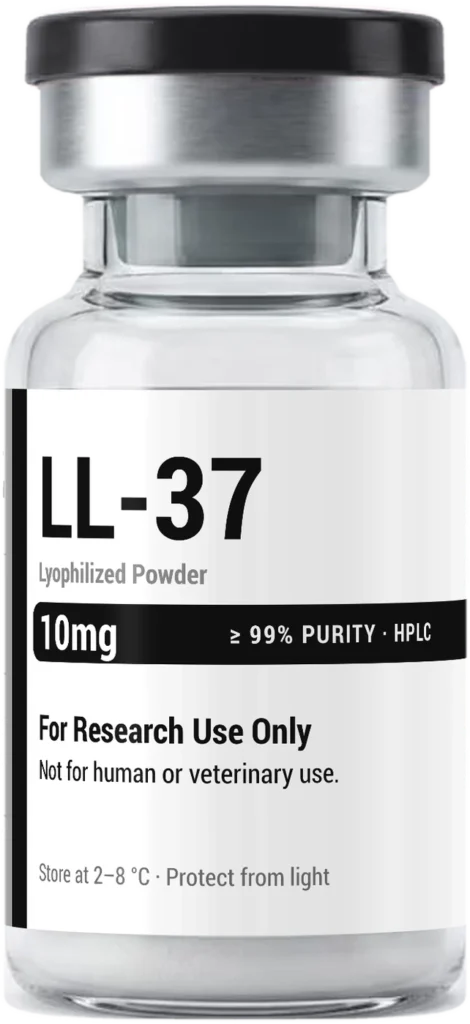
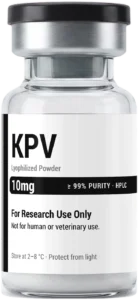
Vial label design and print may vary between batches. Product specifications remain unchanged.
At a glance
Strength
10mg per vial
Form
Lyophilised powder
Purity
≥ 99% (HPLC)
CAS number
154947-66-7
Molecular weight
4493.3 g/mol
Certificate of Analysis
Batch LL-10-19 · Prime Peptides UK
Tissue & repair
LL-37
Synthetic research peptide · 10mg · CAS 154947-66-7
£49.95 In stock · ready to shipper vial · £5.00 per mg
LL-37 10mg is coming soon. It goes on sale as soon as its batch certificate is published - every vial we sell has a matching CoA.
Bank transferBitcoin Encrypted checkout · card details are never taken on this site
Multi-item discount. Add any 2 items for 4% off the whole order, 7% at 3, 10% at 4. Applied automatically at checkout.
Free
Free lab add-on. Bacteriostatic water is included with every peptide order at no extra cost.
Lab essentials tap to add to this order
RUOResearch Use Only. Not for human or veterinary use. By purchasing you confirm you are a qualified researcher and accept responsibility for safe, lawful handling.
Same-day dispatch
Orders before 3:00 PM leave the same working day, tracked, in plain packaging. Free UK delivery over £200.
Secure payment
Bank transfer or Bitcoin over an encrypted checkout. No card details are stored or handled on this site.
Batch tested
Every batch is HPLC and mass spectrometry tested, and its certificate is published before it ships.
LL-37 10mg≥99% HPLC · In stock
£49.95
Compound Overview
What Is LL-37 10mg?
LL-37 10mg is a laboratory research product of the human cathelicidin derived peptide LL-37, which has been researched for its contribution to innate immunity and host-defence biology. The 10mg presentation affords a pre-defined amount of peptide material for well-controlled experimental and analytical studies. The research that has focused on LL-37 has included peptide–membrane interactions, immune signalling, microbial models and cellular responses. This product is provided in the UK as a research compound only and it is not intended for human consumption, therapeutic use or self-administration.
LL-37 is a naturally occurring human peptide belonging to the cathelicidin family of host-defence peptides. It is produced from the precursor protein hCAP18 (human cationic antimicrobial protein 18), which is encoded by the CAMP gene. Proteolytic processing of hCAP18 releases the biologically active LL-37 peptide.
The name LL-37 reflects its structure: the mature peptide contains 37 amino-acid residues and begins with two leucine residues. Its established amino-acid sequence is LLGDFFRKSKEKIGKEFKRIVQRIKDFLRNLVPRTES.
LL-37 has attracted scientific interest because its experimental activity extends beyond simple antimicrobial assays. Laboratory studies have investigated interactions with bacterial membranes, immune cells, inflammatory signalling networks and cellular processes associated with host defence.
For LL-37 10mg UK research products, the 10mg designation identifies the total nominal quantity of peptide material supplied. It should not be interpreted as a dosage recommendation. The format is intended to provide researchers with a defined amount of material that can be incorporated into appropriately designed laboratory protocols.
Technical Data
LL-37 Product Specifications
Technical Specification Sheet
LL-37 · 10MG · RUO
Product Name
LL-37 10mg
Compound
LL-37
Peptide Length
37 amino acids
Strength
10mg
Format
Laboratory research peptide
Research Classification
Experimental host-defence peptide
Sequence
LLGDFFRKSKEKIGKEFKRIVQRIKDFLRNLVPRTES
Testing Documentation
Refer to current batch documentation
Certificate of Analysis
Batch-specific Certificate of Analysis with every batch
Intended Use
Laboratory and scientific research only
Human Use
Not intended for human consumption or administration
CAS Number
154947-66-7
Molecular Formula
C205H340N60O53
Molecular Weight
4493.3 g/mol
Purity
≥99% by HPLC
Researchers should consult the documentation accompanying the specific batch rather than assuming that analytical results from one batch apply to another.
The Science
Scientific Background: From hCAP18 to LL-37
The role of LL-37 is especially important in the field of innate immunity as cathelicidins make up one of the body's first line defenses against infection. Neutrophils, epithelial cells, and other cell types and tissues express human hCAP18. This larger molecule can be broken down to release LL-37.
The mature peptide is amphipathic and positively charged, traits that have led to a large number of laboratory studies of the interaction of the peptide with biological membranes. Experimental studies of the interaction between LL-37 and lipid membranes have been undertaken to investigate the interaction between LL-37 and membranes under controlled conditions and its effect on the integrity of the microbial membrane.
The interest in peptides and their interaction with microbes has extended beyond the actual interactions of the peptides with the microbes. Research models have investigated the role of LL-37 in respect of chemotactic activity, cytokine signalling, immune-cell activity, epithelial biology and inflammatory pathways.
Research Context
This is the experimental context to which these areas must be related. A large number of papers have been focused on in-vitro experiments and biochemical studies, cell culture or animal models. Results of such studies can not be immediately translated to therapeutic applications in humans and LL-37 research material should not be considered as approved therapy.
Laboratory Focus
Why LL-37 Is Studied in Laboratory Research
One of the primary motivations for studying LL-37 is that it is a molecule that is involved in a number of biological systems. Experimental literature has investigated the potential for the peptide to be involved in more complex host response processes than as a mere antimicrobial molecule.
Immune Modulation
One of the well-established research areas is the study of microbial models. The interaction of LL-37 with bacteria and other microorganisms have been studied to better understand the structural features of host defence peptides and membrane disruption.
Inflammatory Signalling
A second aspect relates to immune signalling. Experimental research has been undertaken to explore the interactions between LL-37 and immune cells and signalling pathways in inflammatory responses. Its interaction with the epithelial cells and communication amongst cells has also attracted interest.
Cellular Studies
Researchers have additionally investigated peptide behaviour in models relating to biofilms, chemotaxis and cellular responses to biological stress.
Interpreting Results
These "finding" points are not evidence for self-treatment, but they offer some starting points for mechanistic research. However, the results reported in the literature with respect to LL-37 should be interpreted with caution as different experimental concentrations, assay conditions, cell types and methodologies may greatly influence the outcomes.
Product Format
Understanding the LL-37 10mg Research Format
10mg
Nominal Research Quantity
This dosage of 10mg refers to the quantity of the product, not to its clinical effectiveness or to a recommended dose. It suggests that there is a nominal amount of 10 milligrams of LL-37 research material in the presentation.
This separation is relevant for comparing laboratory products. Research peptides may be supplied in various amounts due to the wide ranges in experimental needs among the various research projects. A team that is running a number of analytical assays in a lab may have different material needs than one that is running a smaller exploratory experiment.
Therefore, the suitability of a 10mg research format will depend on the number of experiments planned, the analytical technique, the scale of the study, the controls and laboratory protocol.
The scientific community has to define their own and validate their own experimental procedure for material requirements. More does not necessarily mean better and safer or more suitable for a specific biological effect in the case of LL-37.
The product designation for the peptide LL-37 (10mg) is not to be interpreted as human or animal dosage.
Verification
Analytical Quality, Identity Testing and COA Review
Documentation is an important consideration when sourcing experimental peptides because the product name printed on a vial alone does not provide meaningful analytical evidence.
Batch-Specific CoA
Researchers evaluating LL-37 should review the information available for the specific batch. A Certificate of Analysis (COA) may include the compound identity, batch or lot number, analytical methodology and reported results. Where HPLC is used, it can provide information about chromatographic purity, while complementary analytical techniques may be employed to support molecular identity.
Identity vs Purity
The analytical method and actual result matter more than general phrases such as "high purity". Researchers should therefore distinguish between a supplier specification and a measured batch-specific result.
Documentation & Transparency
Traceability is equally important. Connecting a vial or product unit with its corresponding batch documentation helps laboratories maintain clearer research records.
Where testing information is provided for LL-37 10mg, researchers should review the actual COA and supporting documentation rather than assuming that every production batch has identical analytical characteristics.
Handling
Storage and Laboratory Handling
Environmental Conditions
LL-37 is a peptide research material that can be sensitive to environmental conditions; therefore, all use of LL-37 should be in compliance with the supplier's documented storage requirements and the laboratory's standard operating procedures.
Contamination Control
The material should be properly labeled and packaged until it is needed for experiments. Where possible, unnecessary heat exposure, direct light and moisture and potential contamination should be minimised.
Laboratory Research
Identification and batch records in the laboratory should be kept clear, especially if several peptide compounds or batches are kept in the same laboratory.
Labelling & Traceability
General guidance should be followed, but should be superseded by any temperature requirements mentioned on the product label or associated documentation. When storing and handling research materials, the emphasis should be on maintaining the integrity of the materials rather than preparation for human administration.
Researchers comparing LL-37 10mg in the UK suppliers should consider more than product availability. Clear identification of the compound, transparent strength information and access to relevant analytical documentation can make a significant difference when establishing research traceability.
A useful product record should allow the laboratory to connect the supplied material with its batch or lot information. Researchers may also wish to assess whether a supplier provides COA documentation, appropriate packaging, storage guidance and clear research-only labelling.
Testing claims deserve particular attention. Terms such as "tested" or "high purity" are more useful when supported by identifiable analytical information rather than presented without context.
UK sourcing can also simplify domestic dispatch and communication, but these practical advantages do not replace scientific due diligence. Researchers evaluating where to buy LL-37 10mg UK research material should examine the actual product and batch documentation before incorporating it into experimental work.
Analytical Records
Batch certificates for LL-37
Every order ships with the CoA matched to its batch number, and the analytical records
are published here - open the certificate before you order, or cross-check the one in
your parcel.
The name describes two structural characteristics of the mature peptide. LL-37 contains 37 amino-acid residues, while the first two residues in its established sequence are leucines, represented by the single-letter amino-acid code "L". LL-37 is generated from the larger human cathelicidin precursor hCAP18.
What does 10mg indicate on an LL-37 research product?
It identifies the nominal quantity of peptide material supplied in that product presentation. The 10mg figure is a laboratory product specification. It is not a recommended human dose, injection quantity or therapeutic instruction.
What areas of science have investigated LL-37?
Published experimental research has examined LL-37 in areas including innate immunity, host-defence biology, microbial membrane interactions, inflammatory signalling, immune-cell responses, epithelial biology and biofilm-related models. The evidence varies by research area, and a considerable proportion comes from laboratory and preclinical studies rather than established clinical applications.
Is LL-37 10mg supplied for human use?
No. LL-37 10mg on this research product page is positioned exclusively as laboratory research material. It is not supplied as a medicine and is not intended for human consumption, self-administration, diagnosis or treatment. Experimental findings should not be interpreted as instructions for personal use.
What should be checked on an LL-37 Certificate of Analysis?
Researchers should look for information that connects the document to the material supplied, including the product identity and batch or lot reference. The COA should also be reviewed for the analytical methods used and the results actually reported. Where chromatographic or identity testing is listed, laboratories should interpret those results according to their own quality requirements rather than relying solely on promotional purity claims.
Does choosing 10mg mean LL-37 is stronger?
No. The 10mg refers to the amount of research material in the product format in this context. Does not create more biological effectiveness or suitability. The amount of materials needed may vary from one laboratory to the other depending on the scale of the experiment, the number of assays, the analytical method and the study design. The number of products should therefore not be considered as a biological activity conclusion.
PG
Medically & Scientifically Reviewed By
Dr. Priyanka Goel
Scientific & Medical Content Reviewer
Reviews research content against current published literature and UK regulatory guidance, ensuring compound information is accurate, referenced and presented for research use only.
LL-37 10mg is provided only as an experimental material for proper laboratory and scientific research. It is not for human consumption, self-administration or diagnostic or therapeutic use. References to biological pathways or published experimental findings are included for scientific context only and are not meant to be a medical claim or advice.