
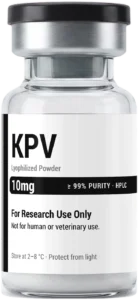
Despite its size, KPV has attracted attention in peptide research for a reason that has little to do with its role in pigmentation. A number of experimental studies have looked at KPV in relation to inflammation, immune signalling and tissue responses. Much of that work has been carried out in cell systems and animal models, so it is important to keep the research context in view when discussing what KPV may actually do.
Where KPV comes from
α-MSH is a naturally occurring melanocortin peptide with several biological roles. Its effects include the regulation of inflammatory responses through melanocortin receptors and other signalling pathways. KPV represents the final three amino acids of the α-MSH sequence.
What makes KPV particularly intriguing is that it appears to retain some of the anti-inflammatory activity associated with α-MSH without having the same pigment-producing activity. Reviews of the research describe KPV as lacking the sequence motif normally required for binding to known melanocortin receptors, suggesting that its biological actions are not simply a smaller version of conventional melanocortin receptor signalling.
That distinction matters. KPV is often grouped with melanocortin peptides, but the evidence suggests its mechanism is different and, in several experimental settings, may occur independently of the classic melanocortin receptors.
What researchers have looked at
Inflammation is the main area of interest.
One early line of research examined whether KPV could influence inflammatory responses involving immune-cell migration. In a 2003 study, researchers compared KPV with several other α-MSH-related peptides in experimental models of inflammation. KPV reduced the accumulation of inflammatory cells in the peritoneal cavity. The effect was not blocked by an MC3/4 receptor antagonist, and KPV did not produce the same increase in cyclic AMP observed with some melanocortin receptor agonists. The authors therefore suggested that KPV was unlikely to be working primarily through those melanocortin receptors.
This is one of the more interesting aspects of KPV research: its activity cannot simply be explained by saying that it activates a melanocortin receptor and switches inflammation off. The exact signalling process remains an area of investigation.
There has also been interest in inflammatory processes involving the gut. In a study using two mouse models of inflammatory bowel disease, KPV treatment was associated with earlier recovery, reduced inflammatory changes in colon tissue and lower myeloperoxidase activity. Effects were also observed in mice with a non-functional MC1 receptor, supporting the idea that the activity was at least partly independent of MC1R signalling.
Those findings are interesting from a research perspective, but they are still the results of animal experiments. They do not establish that KPV treats inflammatory bowel disease in people.
KPV and cellular signalling
The signalling picture becomes less straightforward when different experimental models are compared.
Research involving human keratinocyte cells has examined α-MSH, KPV and related peptides in relation to intracellular signalling. In that work, KPV produced changes in intracellular calcium under specific experimental conditions, while the expected cyclic AMP response was not observed in the same way.
Other research into α-MSH-related peptides has focused on inflammatory mediators and pathways such as NF-κB, cytokine production, adhesion molecules and inflammatory-cell migration. KPV has been discussed as one of the smaller peptide fragments capable of retaining part of the anti-inflammatory behaviour associated with α-MSH.
It is worth being cautious here because “anti-inflammatory” can cover a lot of different biological effects. A peptide reducing a particular inflammatory marker in cultured cells is not the same thing as demonstrating a useful clinical effect in humans.
Why KPV continues to attract research interest
Part of the appeal is its simplicity. KPV contains only three amino acids, which makes it considerably smaller than the parent α-MSH molecule. Researchers have therefore shown interest in studying some of the biological effects of α-MSH using a much shorter peptide.
There is another practical point. α-MSH has pigmentary effects as part of its broader biological activity, whereas KPV has been investigated for anti-inflammatory activity without the same pigmentary response. Reviews have consequently suggested that KPV and related tripeptides could be useful starting points for investigating inflammatory conditions, particularly where modulation of immune responses is of interest.
That does not mean KPV has become an established treatment. The gap between experimental peptide research and an approved medicine is substantial, involving questions around pharmacokinetics, dosing, delivery, toxicity, manufacturing quality and properly controlled human trials.
Current research picture
The published literature gives KPV a reasonably clear research identity: it is an α-MSH-derived tripeptide that has been investigated mainly for its potential influence on inflammatory and immune processes.
The strongest areas of interest so far include experimental inflammation, intestinal inflammation, keratinocyte biology and the signalling behaviour of melanocortin-derived peptides. Animal studies have produced findings that justify further investigation, particularly around inflammatory responses in the gut and the apparent ability of KPV to act through pathways that do not depend entirely on classical melanocortin receptors.
At the same time, the evidence should not be stretched beyond what the studies actually show. Much of the KPV literature is preclinical, and the presence of promising laboratory findings does not establish safety or effectiveness as a treatment for human disease.
For research purposes, KPV is therefore best viewed as a small α-MSH-derived peptide with an interesting experimental profile, rather than as a clinically established anti-inflammatory medicine. Its size, biological activity and unusual relationship with melanocortin signalling continue to make it a useful subject for laboratory investigation.
Published batch records
Every batch of KPV we have sold, each with its published Certificate of Analysis.
| Batch | Size | Purity (HPLC) | Tested | Certificate |
|---|---|---|---|---|
| KP-10-18 Current stock | 10mg | ≥99.0% | Oct 2026 | View CoA |
Research Use Only. KPV is supplied strictly for laboratory research. Nothing on this page is dosing guidance, medical advice, or a suggestion of human or veterinary use.