
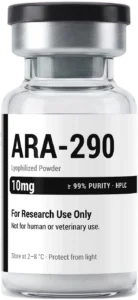
It is also known by names including cibinetide and helix B surface peptide (HBSP). Research into ARA-290 has mainly centred on tissue protection, inflammation, nerve injury and repair processes. Early work has produced findings in cell and animal models, followed by small human clinical studies, particularly in neuropathy and diabetic eye disease.
Where ARA-290 comes from
EPO is best known for its role in erythropoiesis — the process through which red blood cells are produced. However, researchers found that EPO also has biological effects outside the blood-forming system. These include responses associated with cell survival, inflammation and tissue repair.
The problem is that using EPO to investigate these effects can also activate its classical erythropoietic pathway. That can alter red blood cell production and introduce unwanted effects. This led researchers to look more closely at individual regions of the EPO molecule.
One of those regions is helix B. Research published in PNAS identified the surface of this helix as having tissue-protective activity. An 11-amino-acid peptide was subsequently developed to reproduce the relevant three-dimensional structure. This peptide became known as ARA-290 or HBSP. Importantly, experiments reported that the peptide did not produce the erythropoietic effects associated with conventional EPO.
That distinction is central to most ARA-290 research.
How ARA-290 is being studied
ARA-290 has been investigated in relation to what researchers have described as the tissue-protective receptor, involving the erythropoietin receptor and the beta-common receptor (CD131). The proposed signalling response is associated with cellular protection and the regulation of inflammatory processes rather than the stimulation of red blood cell production.
This places ARA-290 in an interesting position in peptide research. Rather than treating it simply as a smaller form of EPO, researchers have used it to examine whether selected structural features of EPO can produce protective biological responses without reproducing its haematopoietic activity.
Preclinical studies have looked at several areas, including peripheral nerve injury, ischaemia-reperfusion injury, wound healing and neurological damage. In the original research, the peptide showed protective effects in several experimental models, although results from animal studies cannot automatically be translated into clinical effectiveness in people.
ARA-290 and nerve research
Neuropathy has become one of the more notable areas of human research involving ARA-290.
A small randomised, placebo-controlled study investigated the peptide in people with sarcoidosis-associated small fibre neuropathy. Participants received ARA-290 for 28 days, and the study reported improvements in neuropathic symptoms, as well as changes in corneal small nerve fibre density and sensory measures. The researchers described the results as supporting further investigation rather than establishing ARA-290 as an approved treatment.
Another phase 2 study examined ARA-290 in people with type 2 diabetes and neuropathic symptoms. Participants received 4 mg of ARA-290 or placebo daily for 28 days, followed by a further observation period. The published results reported improvements in neuropathic symptoms and some metabolic measures, and a subgroup also showed changes in corneal nerve fibre density. The authors concluded that the findings warranted continued clinical evaluation.
The findings of these studies give insight into ARA-290’s research background, but due to their limited scope, it is important to use caution in interpreting their results. They provide signals for further research rather than the same level of evidence expected from large, definitive clinical trials.
Research into inflammation and tissue protection
Inflammation is another recurring theme.
The proposed tissue-protective activity of ARA-290 is linked to signalling that can influence inflammatory responses and cell survival. Experimental work has investigated effects on immune cells, cytokine signalling and tissue damage. Animal model research has also identified its usefulness in nerve injuries and repair.
For example, studies in models of neuropathic pain have reported reduced mechanical allodynia after ARA-290 treatment, together with changes in spinal microglial responses. These findings have helped researchers explore whether the peptide might affect both inflammatory signalling and the longer-term processes involved in nerve injury.
Other experimental work has examined ARA-290 in conditions involving tissue stress, including kidney ischaemia-reperfusion injury and wound healing. These areas remain part of the wider preclinical research picture rather than established clinical applications.
ARA-290 and eye research
ARA-290 has also been studied in diabetic macular oedema, where inflammation, vascular changes and retinal damage are important areas of research.
A phase 2 study published in 2020 involved nine participants, eight of whom completed it. Participants self-administered 4 mg of cibinetide daily for 12 weeks. The trial found no improvement in its main measures of best-corrected visual acuity, central retinal thickness or central retinal sensitivity. No serious adverse events or anti-cibinetide antibodies were reported during the study.
The small sample size makes the study difficult to use for broad conclusions. Still, it provides useful information about how ARA-290 has been investigated clinically and where the research has produced less encouraging findings.
What makes ARA-290 different?
The main research interest is not simply that ARA-290 is a peptide. It is the way researchers have tried to separate selected tissue-protective properties of EPO from its role in erythropoiesis.
That approach has made ARA-290 useful as a research tool for studying the relationship between EPO-derived signalling, inflammation, nerve biology and tissue repair. It has also allowed researchers to investigate whether activating tissue-protective pathways without increasing red blood cell production could have therapeutic potential.
At the same time, ARA-290 should still be viewed as an investigational peptide. Findings from laboratory models and small clinical trials do not establish effectiveness for a particular medical condition, and research results have varied between indications.
ARA-290 in peptide research
For research purposes, ARA-290 is an intriguing example of how peptide design can start with a naturally occurring protein and focus on one specific structural region. Its development from the helix B region of EPO illustrates the broader idea of studying smaller peptide sequences for selective biological activity.
Current literature covers several lines of investigation, particularly neuropathy, inflammation, tissue protection and retinal disease. Some human studies have reported potentially useful biological or symptomatic changes, while others have not demonstrated improvement in their primary clinical outcomes.
For researchers, that mix of findings is part of what makes ARA-290 worth examining. It provides a useful model for investigating tissue-protective signalling and highlights the gap that can exist between promising laboratory results and reproducible clinical outcomes.
Published batch records
Every batch of ARA-290 we have sold, each with its published Certificate of Analysis.
| Batch | Size | Purity (HPLC) | Tested | Certificate |
|---|---|---|---|---|
| AR-10-02 Current stock | 10mg | ≥99.0% | Oct 2026 | View CoA |
Research Use Only. ARA-290 is supplied strictly for laboratory research. Nothing on this page is dosing guidance, medical advice, or a suggestion of human or veterinary use.