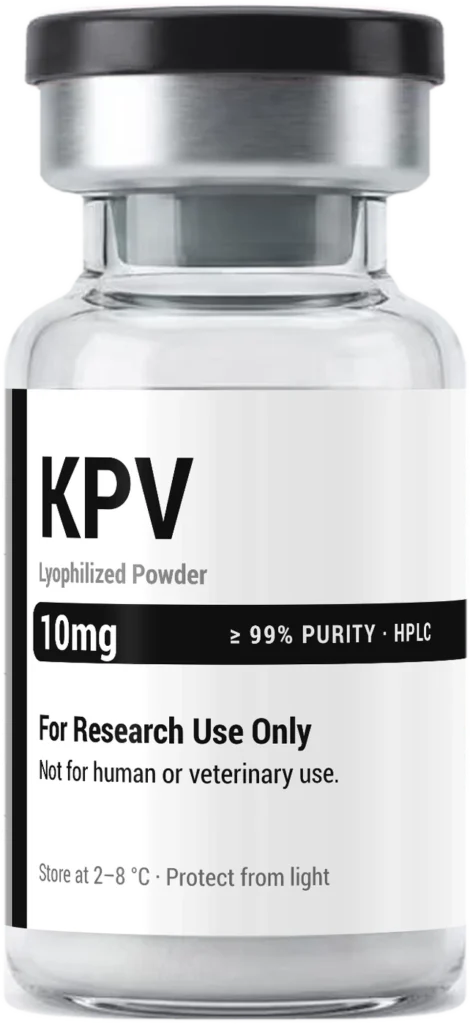
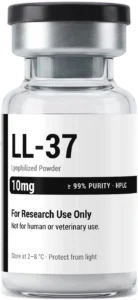
Vial label design and print may vary between batches. Product specifications remain unchanged.
At a glance
Strength
10mg per vial
Form
Lyophilised powder
Purity
≥ 99% (HPLC)
CAS number
67727-97-3
Molecular weight
342.43 g/mol
Certificate of Analysis
Batch KP-10-18 · Prime Peptides UK
Tissue & repair
KPV
Synthetic research peptide · 10mg · CAS 67727-97-3
£24.95 In stock · ready to shipper vial · £2.50 per mg
KPV 10mg is coming soon. It goes on sale as soon as its batch certificate is published - every vial we sell has a matching CoA.
Bank transferBitcoin Encrypted checkout · card details are never taken on this site
Multi-item discount. Add any 2 items for 4% off the whole order, 7% at 3, 10% at 4. Applied automatically at checkout.
Part of a stack. KPV is in the Recovery & Repair Stack (BPC-157 10mg · TB-500 10mg · KPV 10mg).
Free
Free lab add-on. Bacteriostatic water is included with every peptide order at no extra cost.
Lab essentials tap to add to this order
RUOResearch Use Only. Not for human or veterinary use. By purchasing you confirm you are a qualified researcher and accept responsibility for safe, lawful handling.
Same-day dispatch
Orders before 3:00 PM leave the same working day, tracked, in plain packaging. Free UK delivery over £200.
Secure payment
Bank transfer or Bitcoin over an encrypted checkout. No card details are stored or handled on this site.
Batch tested
Every batch is HPLC and mass spectrometry tested, and its certificate is published before it ships.
KPV 10mg≥99% HPLC · In stock
£24.95
Compound Overview
What Is KPV 10mg?
KPV 10mg is a laboratory research format of the short tripeptide Lys-Pro-Val, which is often referred to by the three-letter code KPV. The molecule is identical to the C-terminal residues 11–13 of α-melanocyte-stimulating hormone (α-MSH) and has been featured in experimental studies of inflammatory signalling and peptide transport. A research format for laboratory investigation and analysis of material in a controlled environment with a defined amount.
KPV is an exceptionally short research peptide with just the three amino-acids: lysine, proline and valine. It also has a scientific description, that is L-lysyl-L-prolyl-L-valine or α-MSH (11-13).
KPV also provides researchers with a short amino acid sequence that is structurally well defined and can be studied in a controlled experimental system, unlike those of larger peptides which have long amino acid chains. KPV has been studied in regard to inflammatory signalling, cytokine activity, intestinal peptide transport and cellular responses. A large part of this work is still in the preclinical phase and experimental findings should not be considered as proven clinical effects.
In this product, the reference to "10mg" only indicates the amount of KPV research material provided. Does not constitute a recommended dose. The format is designed for use in laboratories that require a specific amount for experimental design, analysis, or other research activities that adhere to laboratory procedures.
Technical Data
KPV Product Specifications
Technical Specification Sheet
KPV · 10MG · RUO
Product Name
KPV 10mg
Compound
L-Lysyl-L-Prolyl-L-Valine
Abbreviation / Sequence
KPV (Lys-Pro-Val)
Sequence notation
H-Lys-Pro-Val-OH
Strength
10mg research material
Peptide Type
Tripeptide
Residue Count
3 amino acids
Molecular Formula
C₁₆H₃₀N₄O₄
Molecular Weight
342.43 g/mol
Research Classification
Experimental/research peptide
Testing
Refer to the applicable batch documentation
COA
Batch-specific Certificate of Analysis where provided
Intended Use
Laboratory and scientific research only
Human Use
Not intended for human consumption or administration
CAS Number
67727-97-3
Purity
≥99% by HPLC
The 10mg designation describes product quantity and should not be interpreted as a recommended experimental concentration or biological dose.
The Science
Scientific Background: From α-MSH to KPV
KPV attracted scientific attention because it represents the three C-terminal amino acids of α-MSH. Alpha-MSH itself is a 13-amino-acid peptide derived from proopiomelanocortin and has been investigated extensively in experimental models involving melanocortin biology and inflammatory regulation.
Research into shortened fragments helped scientists examine which regions of α-MSH might contribute to particular biological observations. KPV became especially interesting because experimental studies suggested that the short C-terminal sequence retained certain activities observed with the larger peptide, despite lacking the complete structure of α-MSH.
A 2003 study investigating α-MSH-related peptides found activity associated with KPV in experimental inflammatory models and suggested that its observed effects differed mechanistically from those of some melanocortin receptor-active peptides. Other laboratory work has examined how KPV interacts with inflammatory signalling pathways.
These findings provide a scientific basis for continued laboratory interest in KPV, but the evidence base is dominated by cellular and animal research. It therefore does not establish KPV as an approved treatment or demonstrate therapeutic outcomes in humans.
Laboratory Focus
Why Is KPV Studied in Laboratory Research?
A common research interest of KPV is the molecular mechanisms underlying inflammatory signaling. Cell-based systems and experimental animal models have been employed to examine the effect of this short peptide on the signalling responses under controlled conditions.
Inflammatory Signalling
For instance, published studies have investigated KPV as related to the widely studied NF-κB signalling pathway which plays a role in cellular inflammation. Investigations have also included cytokine-associated signalling and the connection between KPV and experimental responses that are experimented with via interleukin-1.
Immune Modulation
Another research direction is related to the biology of the intestine. Laboratory tests have been done to determine if the peptide transporter PepT1, which carries dipeptides and tripeptides, can also transport KPV into the cell. Intestinal epithelial and immune-cell models have been used in experiments to provide evidence of PepT1-mediated transport under certain experimental conditions.
Receptor Signalling
The research avenues for which KPV is useful include peptide transport, short-peptide structure and inflammatory signalling. They should, however, be interpreted as locations of scientific research, and not as proof of clinical use.
Product Format
What Does the 10mg KPV Research Format Represent?
10mg
Nominal Research Quantity
The KPV 10mg UK format contains 10 milligrams of research material within the supplied product format. This number identifies the amount of material available to the laboratory; it does not describe potency, effectiveness or an appropriate dose for a person or animal.
Material requirements can vary considerably between laboratories. A project involving repeated analytical runs, multiple experimental groups or several assays may have different material requirements from a small preliminary investigation. Researchers may therefore encounter KPV offered in different quantities.
A 10mg format can allow a laboratory to incorporate the material into its own experimental planning according to validated protocols, study scale and analytical requirements. Appropriate quantities, concentrations and controls must be determined by qualified researchers according to the particular experimental design.
This distinction is important when evaluating KPV peptide 10mg products. Strength labels on research materials should be read as supplied quantities rather than recommendations for administration.
Verification
KPV Identity, Quality Testing and Certificate of Analysis
For a small research peptide such as KPV, the product label alone provides limited information about analytical quality. Researchers should also consider the supporting documentation associated with the specific batch they receive.
Batch-Specific CoA
A Certificate of Analysis (COA) can provide useful batch-level information, potentially including product identity, batch or lot reference and reported analytical results. Where High-Performance Liquid Chromatography (HPLC) is used, chromatographic data can contribute to purity assessment by showing the relative distribution of detected components under the stated analytical conditions.
HPLC Analysis
Identity and purity are related but different questions. A high reported chromatographic purity does not, by itself, establish molecular identity. Researchers should therefore review the actual methods and results presented on the batch documentation rather than relying exclusively on a headline percentage.
Documentation & Transparency
Batch numbers and traceable documentation are particularly valuable because they connect analytical information to the research material being supplied. Any testing claims for KPV 10mg should be checked against the relevant current batch COA.
Handling
Storage and Laboratory Handling of KPV 10mg
Environmental Conditions
Research peptides should be stored as per the storage instructions provided with the specific product and as per the standard operating procedure in the lab. Laboratory materials may be affected by variables such as temperature, humidity, exposure to environment and contamination.
Labelling & Traceability
KPV 10mg should continue to be appropriately labelled and stored in its original packaging (where feasible) to maintain product identity and batch information. When conditions are not specified in the supplier's documentation, then laboratories should take steps to reduce unnecessary exposure to moisture, heat or direct light.
Reconstitution Practice
All ready-to-use materials from experiments must be handled following the experimental protocol that has been determined for the specific research project. Storage advice on the product page is not meant to be preparation, reconstitution or administration advice.
The amount supplied is just one factor to consider with regard to a KPV 10mg in a UK research product. Researchers should be able to determine the compound being supplied and have the documentation related to the batch.
Some useful information to review is the stated sequence, the amount of product, the batch number, the analytical testing data, whether or not a Certificate of Analysis is available, packaging and storage documentation. When working with experimental compounds, supplier transparency is especially critical as the outcome of the research is partly dependent on the confidence that the research compound used is correct and consistent.
It is also important for UK laboratories that supply peptides for research purposes, to differentiate between laboratory products and authorised medicinal products. The mention of KPV in scientific literature does not mean that it is an approved medicine. Prime Peptides UK cannot stress enough that KPV 10mg is a research grade substance and should only be used for research and investigation in a laboratory environment.
Analytical Records
Batch certificates for KPV
Every order ships with the CoA matched to its batch number, and the analytical records
are published here - open the certificate before you order, or cross-check the one in
your parcel.
KPV is a tripeptide consisting of lysine-proline-valine, represented by the single-letter sequence K-P-V. It corresponds to residues 11–13 at the C-terminal end of α-MSH. Its short sequence has made it useful in experimental work examining how specific fragments of larger peptides behave in laboratory systems.
What exactly does 10mg mean on a KPV product?
The 10mg label states the quantity of KPV research material supplied in the product format. It does not represent a recommended dose, concentration or administration amount. Laboratory requirements vary according to study design, number of experiments, analytical methods and institutional protocols.
What areas of research have involved KPV?
Published preclinical research has investigated KPV in areas including inflammatory signalling, cytokine-related responses, NF-κB-associated pathways and intestinal peptide transport. Some experiments have used cultured cells, while others have involved animal models. These findings remain research observations and should not be presented as evidence of established therapeutic benefit in humans.
Why is KPV associated with alpha-MSH?
KPV corresponds to the final three amino acids of the 13-residue α-MSH sequence. Researchers studying α-MSH investigated shorter peptide fragments to understand which portions of the molecule might contribute to experimentally observed biological activity. This work led to continued scientific interest in the KPV sequence as a distinct research tripeptide.
What should I look for in a KPV 10mg COA?
A useful batch-specific COA should clearly identify the compound and connect the analytical information to a batch or lot number. Depending on the testing performed, documentation may contain chromatographic purity information, identity-related analysis and other quality data. Researchers should review the actual results and methods rather than relying solely on marketing claims about purity.
Is KPV 10mg intended for human use?
The KPV 10mg presented here is only intended for the use of the laboratory in research. It is not provided for human food, self-medication, diagnostics or therapeutic use. The results of research that involve KPV should not be read as instructions or evidence for personal use based on scientific or cellular or animal studies.
PG
Medically & Scientifically Reviewed By
Dr. Priyanka Goel
Scientific & Medical Content Reviewer
Reviews research content against current published literature and UK regulatory guidance, ensuring compound information is accurate, referenced and presented for research use only.
KPV 10mg is intended for laboratory, analytical and scientific research only. It is not designed to be consumed by humans, administered to oneself, used by veterinarians for diagnosis, treatment or prevention of medical conditions, or used by veterinarians. Research background and educational information are provided by this compound. The conclusions from experiments, especially in-vitro or animal experiments should not be viewed as proven clinical benefit or suggested as medical advice.