
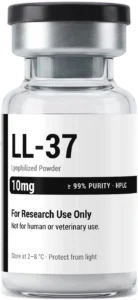
The name comes from its structure: the mature peptide contains 37 amino acids and begins with two leucine residues. It is derived from a larger precursor protein, human cathelicidin antimicrobial peptide 18 (hCAP18), encoded by the CAMP gene. Once the precursor is processed by proteolytic enzymes, the active LL-37 peptide is released.
That background matters when looking at LL-37 in research. Its biological activity is not limited to simply killing bacteria. Researchers have studied its effects on microbial membranes, immune signalling, cell migration, angiogenesis and wound repair. At the same time, some of these effects can be context-dependent, which is one reason LL-37 remains an active area of investigation.
What is LL-37?
LL-37 is a small positively charged peptide of 37 amino acids. It is classified as a cationic antimicrobial peptide or host-defence peptide.
Its structure helps explain much of its activity. LL-37 has both hydrophobic and hydrophilic regions, giving it an amphipathic character. In water it can remain relatively disordered, but when it interacts with membranes, it can adopt a more defined alpha-helical structure. This allows it to interact with negatively charged surfaces, including components of bacterial membranes.
The peptide is produced by several types of cells, including epithelial cells and immune cells. It has been found in the skin, respiratory tract, and other areas exposed to the outside. Production can increase in response to infection, injury and inflammatory signals. Vitamin D signalling is also involved in regulating CAMP expression in some cells.
Antimicrobial activity
The most established area of LL-37 research is its antimicrobial behaviour.
Laboratory studies have shown activity against a range of Gram-positive and Gram-negative bacteria, as well as activity against certain fungi and viruses. One important mechanism involves interaction with microbial membranes. Because LL-37 carries a positive charge, it can be attracted towards negatively charged components of microbial surfaces. Once associated with the membrane, the peptide can disturb its organisation and permeability.
However, this observation does not mean that LL-37 works by one simple mechanism. Its interaction with bacterial cell-wall components, endotoxins and intracellular targets has also been examined. This is of particular interest since LL-37 can bind to molecules such as lipopolysaccharide (LPS) which is involved in the inflammatory response to Gram-negative bacteria.
Unlike traditional antibiotics, LL-37 has both “direct” antimicrobial and immunological activities. It is also being looked at as part of the host-defence system, not just as a method of killing microbes.
LL-37 and inflammation
LL-37 also has a complicated relationship with inflammation.
The peptide can influence immune-cell movement and signalling, including interactions involving neutrophils, monocytes, T cells and other immune cells. It has also been linked with signalling pathways involving receptors and cellular systems such as FPR2, EGFR and P2X7. These interactions can affect cytokine production, cell migration and other parts of the innate immune response.
This aspect of the research is less straightforward. LL-37 can have both pro-inflammatory and anti-inflammatory effects depending on the biological environment, concentration and other factors. A recent review, for example, describes LL-37 as capable of influencing infection control while also affecting inflammatory signalling and host-cell viability.
So it would be misleading to describe LL-37 simply as an “anti-inflammatory peptide.” Its role is better understood as immunomodulatory. It can alter how cells respond to their surroundings rather than switching inflammation off in a predictable way.
Research into wound healing
Another area attracting attention is tissue repair.
LL-37 has been investigated for its effects on keratinocyte migration, cell proliferation, angiogenesis and other processes involved in wound closure. Research has also reported effects on fibroblasts and collagen-related activity. These findings have made LL-37 interesting to researchers looking at how antimicrobial defence and tissue regeneration might overlap.
There is a useful biological logic behind these findings. A damaged area needs protection from microbes, but it also needs coordinated cellular activity to rebuild the tissue. A molecule that can influence both antimicrobial defence and cell signalling is, therefore, of interest.
However, results from cell and animal studies should not automatically be treated as evidence of a proven human wound-healing therapy. Much of the enthusiasm around LL-37 still comes from preclinical research.
Why LL-37 remains of interest
LL-37 is unusual because several biological functions sit within the same relatively small peptide. Its antimicrobial effects are well documented, but researchers are also interested in its ability to communicate with host cells.
Current research has looked at possible applications in areas including antimicrobial strategies, wound repair, inflammatory disorders and the development of new approaches to infections where conventional antibiotics may be less effective. Modified versions and LL-37-inspired peptides are also being investigated, partly because the natural peptide can have limitations relating to stability, toxicity and its effects on mammalian cells.
For research purposes, this makes LL-37 particularly useful as a model for understanding host-defence peptides. It shows that antimicrobial activity and immune regulation are not necessarily separate processes. The same molecule can interact with microbes while also changing how surrounding human cells behave.
Research status
LL-37 remains a research subject rather than an established general-purpose therapeutic peptide. Findings from laboratory experiments, animal models and human biological studies need to be considered separately, particularly when looking at claims around wound healing, inflammation or antimicrobial treatment.
There is also an important safety consideration in the research literature. LL-37 is biologically active against human cells as well as microbes, and its effects can vary with concentration and local conditions. Recent research has highlighted that higher concentrations may become cytotoxic to certain cell types.
For that reason, LL-37 is best viewed as a biologically active host-defence peptide with several promising research directions rather than as a peptide with one clearly defined medical purpose.
For researchers, its real interest lies in that complexity. LL-37 brings together antimicrobial defence, immune signalling and tissue responses in a single molecule, giving researchers plenty to investigate as work continues on host-defence peptides and new antimicrobial approaches.
Published batch records
Every batch of LL-37 we have sold, each with its published Certificate of Analysis.
| Batch | Size | Purity (HPLC) | Tested | Certificate |
|---|---|---|---|---|
| LL-10-19 Current stock | 10mg | ≥99.0% | Oct 2026 | View CoA |
Research Use Only. LL-37 is supplied strictly for laboratory research. Nothing on this page is dosing guidance, medical advice, or a suggestion of human or veterinary use.