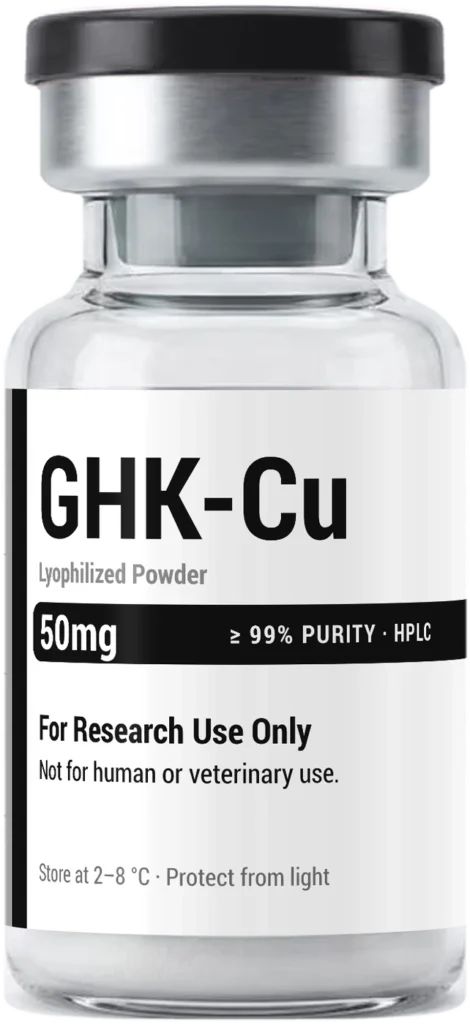
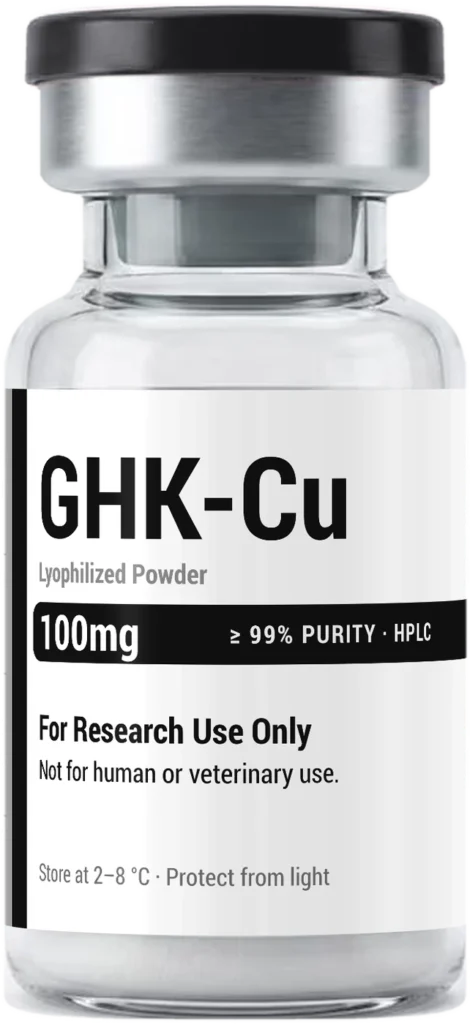
Vial label design and print may vary between batches. Product specifications remain unchanged.
At a glance
Strength
50mg per vial
Form
Lyophilised powder
Purity
≥ 99% (HPLC)
CAS number
89030-95-5
Molecular weight
401.91 g/mol
Certificate of Analysis
Batch CU-50-12 · Prime Peptides UK
Storage
Follow the storage conditions stated in supplier documentation and the relevant laboratory SOP
Copper & cosmetic
GHK-Cu
Synthetic research peptide · 50mg · CAS 89030-95-5
£24.95 In stock · ready to shipper vial · £0.50 per mg
Choose strengthPrice per vial
GHK-Cu 50mg is coming soon. It goes on sale as soon as its batch certificate is published - every vial we sell has a matching CoA.
Bank transferBitcoin Encrypted checkout · card details are never taken on this site
Multi-item discount. Add any 2 items for 4% off the whole order, 7% at 3, 10% at 4. Applied automatically at checkout.
Free
Free lab add-on. Bacteriostatic water is included with every peptide order at no extra cost.
Lab essentials tap to add to this order
RUOResearch Use Only. Not for human or veterinary use. By purchasing you confirm you are a qualified researcher and accept responsibility for safe, lawful handling.
Same-day dispatch
Orders before 3:00 PM leave the same working day, tracked, in plain packaging. Free UK delivery over £200.
Secure payment
Bank transfer or Bitcoin over an encrypted checkout. No card details are stored or handled on this site.
Batch tested
Every batch is HPLC and mass spectrometry tested, and its certificate is published before it ships.
GHK-Cu 50mg≥99% HPLC · In stock
£24.95
Compound Overview
What Is GHK-Cu 50mg?
GHK-Cu 50mg is a laboratory research format of Copper Tripeptide-1, commonly known as GHK-Cu, a copper-binding tripeptide. Glycyl-L-histidyl-L-lysine (GHK) is the underlying peptide, which has an affinity for copper ions (Cu²⁺) and has been studied in relation to the biology of the extracellular matrix, activity of fibroblasts, cellular signalling and tissue-remodelling pathways.
The 50mg designation refers only to the quantity of research material supplied. It is not a recommended dose or indication for human use.
GHK (glycine-histidine-lysine) is a naturally occurring tripeptide that can bind copper to form the GHK-Cu complex. Both GHK and its copper-bound form have been described in scientific literature. GHK-Cu has attracted interest because copper is involved in a wide range of biochemical reactions and can interact with proteins related to tissue structure and cellular signalling.
Copper Tripeptide-1 is another common scientific and cosmetic ingredient name for the compound. Copper Tripeptide-1 is a copper complex of Tripeptide-1, according to the European Commission CosIng database.
In this product, 50mg refers to the stated quantity of GHK-Cu research material supplied. A 50mg quantity may suit laboratory programmes that require more starting material than smaller formats. The amount of material selected should be based on validated laboratory protocols, assay requirements and experimental design, and should NOT be based on human-use considerations.
Sizes & Prices
GHK-Cu sizes and prices
Each size is supplied from its own tested batch with its own Certificate of Analysis. The size is the amount of research material in the vial; larger vials cost less per mg.
Size
Price
Per mg
Batch certificate
Choose
50mg
£24.95
£0.50
CU-50-12
100mg
£39.95
£0.40
CU-100-12
Technical Data
GHK-Cu Product Specifications
Technical Specification Sheet
GHK-CU · RUO
Product
GHK-Cu 50mg
Compound
Glycyl-L-histidyl-L-lysine copper complex
Common name
GHK-Cu / Copper Tripeptide-1
Research quantity
50mg
Peptide sequence
Gly-His-Lys for the GHK peptide component
Classification
Copper-binding tripeptide research compound
Intended use
Laboratory and scientific research only
Human use
Not for human consumption or self-administration
Documentation
Researchers should consult the applicable product label and batch-specific analytical documentation
Storage
Follow the storage conditions stated in supplier documentation and the relevant laboratory SOP
CAS Number
89030-95-5
Molecular Formula
C14H22CuN6O4
Molecular Weight
401.91 g/mol
Purity
≥99% by HPLC
Technical properties can vary according to salt form and product specification. For this reason, researchers should use the batch documentation supplied with the material rather than assume that a specification from another GHK-Cu preparation applies to the product being studied.
The Science
Scientific Background of GHK-Cu
GHK has been studied for several decades. GHK is a small tripeptide that can form a complex with copper ions. This GHK-Cu complex has been investigated under a range of experimental conditions. Published research includes investigations of fibroblasts, collagen-related processes, extracellular-matrix components, angiogenesis-associated signalling and tissue-remodelling models.
Laboratory studies have also investigated the possible effects of GHK-Cu on the expression of growth factors. Another experiment with irradiated fibroblasts showed that the copper tripeptide complex alters the production of two growth factors, basic fibroblast growth factor and vascular endothelial growth factor.
Research Context
These findings raise useful questions for further research, but they should not be treated as evidence that a laboratory GHK-Cu product has therapeutic effects in humans. Most of the literature presented on GHK-Cu is based on in-vitro experiments, animal models, mechanistic work, some limited clinical studies, and the results vary depending on the experimental system employed.
GHK-Cu therefore remains relevant to biological pathway research, but these findings should not be turned into unsupported health claims.
Laboratory Focus
Why Is GHK-Cu Studied in Laboratory Research?
Scientific interest in GHK-Cu continues because researchers have examined it across a range of cellular and extracellular processes.
Skin & Collagen Research
Collagen production and cell behaviour have been studied in the presence of copper peptide complexes in fibroblast studies. Association of GHK-Cu with components of extracellular-matrix organisation (collagen, glycosaminoglycans and proteoglycans) has also been studied in experimental literature.
Inflammatory Signalling
Signalling for angiogenesis and tissue remodelling have been explored in other work. Animal studies have investigated copper tripeptide complexes in wound models and laboratory studies have hypothesised potential antioxidant, inflammatory, and gene-regulatory mechanisms of action for GHK and GHK-Cu.
Laboratory Research
Not all results reported have been favourable. One clinical trial testing a topical copper tripeptide product following CO₂ laser resurfacing, for instance, did not find objective differences in outcomes with the use of such products.
Interpreting Results
This ambiguous evidence is just one of the reasons that research results need to be interpreted cautiously and that no experimental results should simply be extrapolated to humans and proclaimed as known benefits.
Product Format
Understanding the 50mg GHK-Cu Research Format
50mg
Nominal Research Quantity
The 50mg in GHK-Cu 50mg refers to the total quantity of research material supplied. It is not an instruction for administration or application.
The amount of any research compound needed varies by laboratory depending on the extent of the investigation. Material requirements differ between laboratories and experimental designs. A preliminary study may require less material than a project involving repeated analytical runs, multiple assay plates, comparison groups or several experimental stages.
When considering a 50mg format, laboratories may look at the number of planned experiments, assay design, analytical methods, reference controls and the overall scale of the project.
Before an experiment, a researcher should identify what materials are needed and use their own laboratory procedures to record the calculations.
Importantly, the existence of the 50mg format does not define a therapeutic strength, recommended dose or therapeutic quantity for a person. Its relevance is only in terms of the amount of research material available for controlled lab work.
Verification
Quality Testing, Analytical Documentation and COA
Analytical documentation is an important consideration when sourcing GHK-Cu 50mg or other research peptides.
Batch-Specific CoA
Researchers should first confirm that the documentation corresponds to the exact compound and batch supplied. A Certificate of Analysis may contain information including product identity, batch or lot number, analytical methodology and reported test results.
HPLC Analysis
High-performance liquid chromatography (HPLC) is commonly used in peptide research for analytical separation and purity assessment. However, an HPLC chromatogram alone should not automatically be interpreted as complete confirmation of every characteristic of a compound. Different analytical techniques answer different questions.
Documentation & Transparency
Where independent or additional analytical testing is claimed, researchers should verify the actual laboratory report rather than rely solely on marketing terminology.
Product information should therefore avoid unsupported statements such as “guaranteed purity” or “pharmaceutical grade”. Any stated purity result, testing method or specification should correspond directly to the documentation for the relevant GHK-Cu 50mg batch.
Handling
Storage and Laboratory Handling
Documentation First
The storage procedures provided with the specific GHK-Cu research material should be followed in line with the laboratory's SOPs.
Environmental Conditions
Researchers should consider factors that may affect material integrity, including temperature, prolonged light exposure, moisture, contamination and unnecessary exposure to the environment.
Labelling & Traceability
Labels and batch information should remain recorded throughout storage to maintain sample traceability. If a Certificate of Analysis or batch documentation is supplied by the supplier these should be kept with the laboratory's sample documentation.
Documentation First
The storage instructions for formulations and physical forms may vary between suppliers and should not be assumed from other GHK-Cu products. This information is for research material handling purposes only, and is not intended to be a guideline for GHK-Cu preparation for human administration.
Researchers comparing UK suppliers of GHK-Cu 50mg should look beyond the product name alone.
Important considerations include whether the supplier clearly identifies the compound and stated quantity, provides relevant batch information, explains the analytical testing performed and makes supporting documentation available where applicable.
Traceability is particularly useful when multiple batches are incorporated into longer experimental programmes. Laboratories may also wish to review packaging information, storage requirements and procedures for matching a delivered product with its Certificate of Analysis.
When searching to purchaseGHK-Cu 50mg in the UK for legitimate laboratory research, purchasing decisions should therefore be based on verifiable product information and suitability for the intended experimental protocol rather than unsupported claims about biological outcomes.
GHK-Cu supplied as research material should remain clearly separated from products marketed or authorised for human therapeutic use.
Analytical Records
Batch certificates for GHK-Cu
Every order ships with the CoA matched to its batch number, and the analytical records
are published here - open the certificate before you order, or cross-check the one in
your parcel.
GHK-Cu identifies the copper complex of the tripeptide glycyl-L-histidyl-L-lysine. The 50mg figure describes the stated quantity of research material supplied in the product. It does not represent a recommended human dose, treatment protocol or administration amount.
Is GHK-Cu 50mg intended for human use?
No. This GHK-Cu 50mg product is positioned strictly as research material for laboratory and scientific investigation. It should not be represented as a medicine, dietary supplement or product for self-administration.
Is GHK-Cu the same as Copper Tripeptide-1?
GHK-Cu is commonly associated with the name Copper Tripeptide-1. The European Commission’s CosIng database describes Copper Tripeptide-1 as the copper complex of Tripeptide-1. Researchers should nevertheless check the exact chemical and batch specification of the material they purchase.
Why would laboratories choose a 50mg research quantity?
Material requirements vary according to experimental design. Larger programmes may involve multiple assays, replicates, analytical runs or comparative investigations. The 50mg designation simply provides information about the quantity supplied; it does not indicate greater effectiveness or a preferred experimental concentration.
What research areas have investigated GHK-Cu?
Published work has explored fibroblast activity, extracellular-matrix biology, collagen-associated processes, angiogenesis-related signalling, tissue-remodelling models and several cellular pathways. Much of this evidence is preclinical or mechanistic and should not be presented as established therapeutic evidence.
What should be checked on a GHK-Cu Certificate of Analysis?
Researchers should ensure the COA is for the compound and batch received. This may contain useful information, such as batch identification, analytical methodology, reported results, and other applicable specifications. Any purity or testing statement on the product page should match the relevant analytical documentation.
PG
Medically & Scientifically Reviewed By
Dr. Priyanka Goel
Scientific & Medical Content Reviewer
Reviews research content against current published literature and UK regulatory guidance, ensuring compound information is accurate, referenced and presented for research use only.
GHK-Cu 50mg is only supplied for laboratory, analytical and scientific research. It is not intended for human consumption, self-administration, diagnosis or treatment. The content on this page is provided for educational and research-related purposes only. The information provided in experimental and preclinical trials should not be considered as established medical benefits or medical guidance.