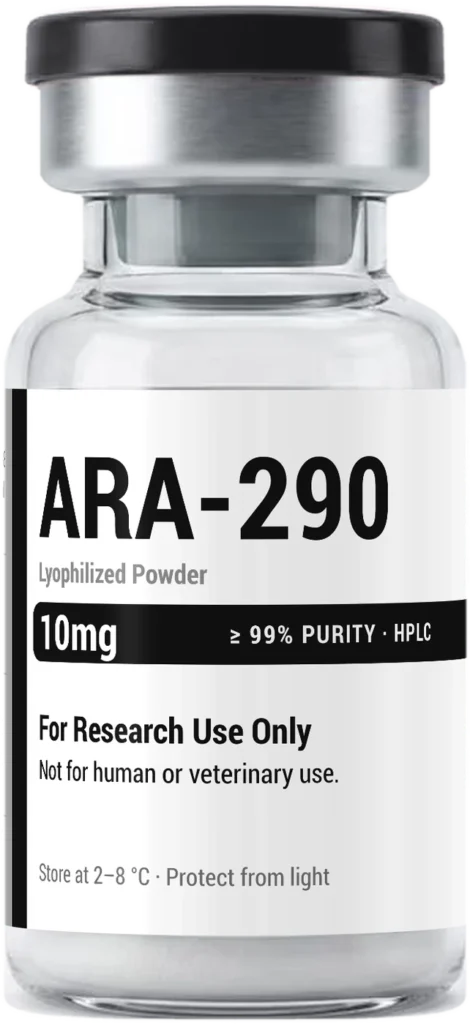
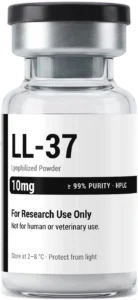
Vial label design and print may vary between batches. Product specifications remain unchanged.
At a glance
Strength
10mg per vial
Form
Lyophilised powder
Purity
≥ 99% (HPLC)
CAS number
1208243-50-8
Molecular weight
1257.4 g/mol
Certificate of Analysis
Batch AR-10-02 · Prime Peptides UK
Storage
Follow product documentation and laboratory SOPs
Tissue & repair
ARA-290
Synthetic research peptide · 10mg · CAS 1208243-50-8
£29.95 In stock · ready to shipper vial · £3.00 per mg
ARA-290 10mg is coming soon. It goes on sale as soon as its batch certificate is published - every vial we sell has a matching CoA.
Bank transferBitcoin Encrypted checkout · card details are never taken on this site
Multi-item discount. Add any 2 items for 4% off the whole order, 7% at 3, 10% at 4. Applied automatically at checkout.
Free
Free lab add-on. Bacteriostatic water is included with every peptide order at no extra cost.
Lab essentials tap to add to this order
RUOResearch Use Only. Not for human or veterinary use. By purchasing you confirm you are a qualified researcher and accept responsibility for safe, lawful handling.
Same-day dispatch
Orders before 3:00 PM leave the same working day, tracked, in plain packaging. Free UK delivery over £200.
Secure payment
Bank transfer or Bitcoin over an encrypted checkout. No card details are stored or handled on this site.
Batch tested
Every batch is HPLC and mass spectrometry tested, and its certificate is published before it ships.
ARA-290 10mg≥99% HPLC · In stock
£29.95
Compound Overview
What Is ARA-290 10mg?
ARA-290 10mg is a synthetic research peptide supplied as a defined quantity of laboratory material for scientific investigation. Also known in scientific literature as cibinetide, ARA-290 was developed from a specific region of erythropoietin (EPO) and has been experimentally investigated for its interaction with tissue-protective signalling pathways. The 10mg format identifies the amount of research material supplied and should not be interpreted as a dosage recommendation.
ARA-290 10mg is supplied strictly for laboratory and scientific research and is not intended for human consumption or therapeutic use. This positioning follows the research-only requirements specified for Prime Peptides UK product pages.
ARA-290 is a synthetic peptide, based on the structure of a glycoprotein called erythropoietin, which is well known for its activity in erythropoiesis. Unlike the whole biological activity of EPO, ARA-290 was engineered from a small region that is linked to tissue-protective signalling.
The compound is often referred to in research literature as an 11-amino-acid peptide, and has even been investigated with the name ‘cibinetide’. Experimental studies have been mainly directed at the signalling of the innate repair receptor, which has been associated with both the erythropoietin receptor and beta common receptor (CD131).
It is crucial to note this difference in the context of ARA-290 being used as a research compound. If it has scientific interest, that does not necessarily mean that the experimental results prove therapeutic effects.
In the case of this product, 10mg is only the amount of ARA-290 research material provided. It does not provide any indication of the right amount, time or biological effectiveness of the drug. The amount of materials needed will vary from laboratory to laboratory depending upon the size and scope of the research.
Technical Data
ARA-290 Product Specifications
Technical Specification Sheet
ARA-290 · 10MG · RUO
Product Name
ARA-290 10mg
Alternative Research Name
Cibinetide
Compound Type
Synthetic peptide
Peptide Length
11 amino acids
Strength
10mg research material
Format
Laboratory research product
Research Classification
Investigational peptide
Documentation
Batch-specific Certificate of Analysis with every batch
Intended Purpose
Laboratory and scientific research only
Human Use
Not intended for human consumption or self-administration
Storage
Follow product documentation and laboratory SOPs
CAS Number
1208243-50-8
Amino-Acid Sequence
Gln-Glu-Gln-Leu-Glu-Arg-Ala-Leu-Asn-Ser-Ser
Molecular Formula
C51H84N16O21
Molecular Weight
1257.4 g/mol
Purity
≥99% by HPLC
Researchers should consult the batch documentation accompanying the specific material rather than assuming that analytical specifications are identical between batches.
The Science
Scientific Background of ARA-290
ARA-290 emerged from research examining biological activities associated with erythropoietin beyond its established role in red blood cell production. Investigators identified regions of the EPO molecule that appeared relevant to signalling pathways associated with cellular responses to tissue stress.
ARA-290 was subsequently developed as a short synthetic peptide intended to reproduce selected signalling characteristics without functioning as conventional erythropoietin. This has made the compound useful for investigating how particular receptor systems may participate in cellular protection and repair-related processes.
A major area of experimental interest concerns the innate repair receptor (IRR). Research has examined whether ARA-290-mediated interaction with this receptor system may influence signalling associated with inflammation, cellular stress and tissue responses.
The scientific evidence requires careful interpretation. Much of the mechanistic understanding surrounding ARA-290 originates from experimental models, while limited clinical investigation has also taken place. Findings from laboratory, animal or early-stage clinical research should not be presented as evidence that ARA-290 is an established treatment.
For researchers, its value lies primarily in investigating defined biological pathways and hypotheses.
Laboratory Focus
Why Is ARA-290 Studied in Research?
ARA-290 attracts scientific attention because it provides researchers with a comparatively targeted compound for examining signalling associated with EPO-derived tissue-protective pathways.
Inflammatory Signalling
Preclinical studies have explored the peptide in experimental settings involving inflammatory signalling, cellular stress responses, tissue injury models and neurological pathways. Researchers have also investigated how innate repair receptor signalling may affect cellular responses under experimentally induced stress.
Neurological Pathways
Another area of interest involves peripheral nerve and small-fibre research. These investigations are important scientifically, but their existence should not be confused with approval of ARA-290 for treating neurological conditions.
Metabolic Research
The peptide has additionally appeared in research examining metabolic and inflammatory mechanisms. Such studies can help scientists understand receptor activity, downstream signalling and interactions between biological pathways.
Interpreting Results
Results depend heavily on the experimental model, methodology and endpoints selected. A response observed in a cell culture or animal model cannot automatically be extrapolated to people.
ARA-290 therefore remains best described as an investigational research compound, with its mechanisms and potential biological significance continuing to be studied.
Product Format
Understanding the ARA-290 10mg Research Format
10mg
Nominal Research Quantity
The 10mg designation is used to define the nominal amount of ARA-290 material delivered as part of this product format. It does not provide a suggested experimental concentration and does not contain any human dosage information.
This difference is especially important if the laboratory is comparing different amounts of the same research peptide. A 10mg research format may be chosen when there are enough materials to perform a number of analytical methods or the experiments are to be repeated or for a specific study scale. Different laboratories may require different materials.
Determine material needs based on approved study documentation and institutional procedures and not based on product pages.
The way ARA-290 10mg is presented in this manner provides a reasonably realistic idea of the strength of ARA-290 from a laboratory supply point of view, but does not suggest that a higher dose is more effective, safer or scientifically preferable.
Number of assaysExperimental designAnalytical methodReplication needsLaboratory procedure
Verification
Quality Testing, Identification and Certificate of Analysis
Analytical documentation is particularly important when sourcing experimental peptides because researchers need to understand what material they are working with.
Batch-Specific CoA
A Certificate of Analysis (COA) can provide batch-specific information such as product identity, batch reference and reported analytical results. Depending on the testing performed, chromatographic methods such as high-performance liquid chromatography (HPLC) may be used to evaluate sample composition and reported purity.
Identity vs Purity
Researchers should distinguish between identity and purity. A high reported purity result alone does not necessarily establish every characteristic of a research material. The analytical methods used, batch identification and supporting documentation should be considered together.
Documentation & Transparency
Where independent laboratory testing is stated for ARA-290 10mg, researchers should review the actual documentation available for the relevant batch rather than relying solely on general marketing terminology.
Prime Peptides UK should not make any claim about a particular percentage of purity or testing unless it can be substantiated by the appropriate analytical data. This method is in support of research transparency and traceability.
Handling
Storage and Laboratory Handling of ARA-290 10mg
Documentation First
Research peptides should be handled according to the documentation supplied with the individual product and the laboratory's established standard operating procedures.
Environmental Conditions
ARA-290 10mg should remain appropriately labelled and protected from conditions that may compromise research-material integrity. Temperature, moisture, light exposure and repeated environmental changes may be relevant considerations depending on the supplied formulation.
Contamination Control
Laboratories should also use suitable contamination-control procedures and maintain clear batch identification throughout storage and experimental work.
Labelling & Traceability
Any storage instructions stated on the product label or accompanying documentation should take precedence over general online information.
Note
These recommendations concern preservation and traceability of laboratory material only. They are not instructions for preparing ARA-290 for administration to people or animals.
UK suppliers should not rely on the name of the drug for assessing ARA-290 10mg. The identification, strength information, batch references and available analytical documentation can all help in the laboratory purchasing decision.
A supplier must be able to differentiate research products from medicines and not market experimental medications as licensed medicines. Clear restrictions on research use are thus a crucial component of responsible supply.
If you are searching for ARA-290 10mg for research purposes, you should also consider packaging, storage details, COA availability, and if the documentation matches the batch received.
ARA-290 should be identifiable during procurement and storage and in the laboratory. Good traceability enables the link to be made between analytical documentation and experimental records and the material used in a study.
Analytical Records
Batch certificates for ARA-290
Every order ships with the CoA matched to its batch number, and the analytical records
are published here - open the certificate before you order, or cross-check the one in
your parcel.
Cibinetide is the name commonly associated with ARA-290 in scientific literature. ARA-290 is a synthetic 11-amino-acid peptide developed from a region of erythropoietin associated with tissue-protective signalling. Researchers reviewing published literature may therefore encounter both names. Product identity should still be confirmed through the supplier's batch documentation.
What exactly does 10mg mean on ARA-290 10mg?
The 10mg figure describes the nominal amount of peptide research material supplied in the product. It does not represent a recommended dose or administration amount. The quantity required for legitimate laboratory work depends on experimental design, analytical procedures, number of assays and the laboratory's approved research protocol.
What is the innate repair receptor in ARA-290 research?
Scientific investigation of ARA-290 has focused on signalling associated with the innate repair receptor, often described in the literature in relation to EPOR and CD131 receptor components. They have studied this route in experimental models of cellular stress and inflammatory responses. These mechanistic studies do not reflect ARA-290 as an approved medicine.
Has ARA-290 only been investigated in laboratory models?
No. ARA-290/cibinetide has been examined in preclinical research and has also reached limited human clinical investigation. However, the existence of clinical research does not mean the compound is an established or generally approved medicine. Evidence must be interpreted according to study design, endpoints, sample size and overall research limitations.
What documentation should accompany ARA-290 research material?
Researchers should look for clear product identification, strength, batch information and a relevant Certificate of Analysis where available. If analytical testing such as HPLC is reported, the documentation should identify the results associated with the specific batch. Laboratories should retain relevant records as part of their normal research traceability procedures.
Why might a laboratory select a 10mg ARA-290 format?
The needs for material vary from project to project. A specific amount may be required for a laboratory due to repeat experiments, several analytical tests, a specific length of study, or the extent of the overall project. The 10mg format merely offers a prescriptive amount of research material. It should not be seen as being scientifically superior to another quantity or used as guidance for administration.
PG
Medically & Scientifically Reviewed By
Dr. Priyanka Goel
Scientific & Medical Content Reviewer
Reviews research content against current published literature and UK regulatory guidance, ensuring compound information is accurate, referenced and presented for research use only.
ARA-290 10mg is a laboratory research supply only. It is not intended for human consumption, self-administration, diagnostic procedures or therapeutic application. Mention of experimental results indicate areas of research and do not imply medical benefits or medical advice. When working with investigational compounds, researchers should adhere to relevant UK regulations, applicable laboratory procedures and institutional requirements.