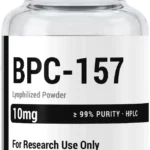
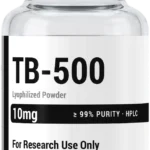
BPC-157 and TB-500 are often mentioned together when people are looking into peptide research, particularly around recovery and tissue repair. At first glance, they can seem quite similar. Both have been studied for their potential involvement in repair processes, and both have attracted a lot of attention online.
That does not mean they are interchangeable, though. They are different peptides, they come from different research backgrounds, and the evidence available for each one is not quite the same.
It is also worth separating scientific research from some of the stronger claims found online. A peptide showing intriguing results in laboratory or animal studies does not automatically mean the same thing will happen in humans.
BPC-157
BPC-157 is a synthetic peptide made up of 15 amino acids. It has been the subject of a fair amount of preclinical research over the years, with studies looking at areas such as tissue repair, inflammation, blood vessel formation and gastrointestinal function.
Researchers have looked at BPC-157 in a range of animal models, including studies involving tendons, muscles, ligaments, nerves and the digestive system. Some of the findings have been interesting enough to encourage further research.
There is much less human research available, though.
A systematic review published in 2025 identified 36 studies relating to BPC-157. Of those, 35 were preclinical studies, and only one was a clinical study. That gives some context to how early the research still is.
There has also been a tiny human pilot study involving intravenous BPC-157. Only two adults took part, so while the study provides some early information, it is far too small to draw reliable conclusions about either effectiveness or long-term safety.
In other words, there is still much to explore, but BPC-157 lacks the level of human evidence typically associated with established treatments.
TB-500
TB-500 is commonly described as a synthetic fragment related to thymosin beta-4, a naturally occurring peptide that has been studied for its role in several biological processes.
Research into thymosin beta-4 has looked at cell migration, angiogenesis and tissue repair, among other areas. These processes are part of the reason thymosin beta-4 and related peptides have attracted interest in regenerative research.
One thing that can cause confusion is the way TB-500 and thymosin beta-4 are discussed online. They are related, but they should not simply be treated as exactly the same compound.
There have been human studies involving thymosin beta-4, including research looking at its safety and tolerability in healthy volunteers. That research is useful for understanding thymosin beta-4 itself, but it should not automatically be taken as proof that TB-500 has the same effects.
Specific human evidence for TB-500 is still limited.
BPC-157 vs TB-500
So, how do the two compare?
BPC-157 has mainly been investigated in preclinical settings. A large part of that work has focused on tissue protection, healing-related processes, inflammation and the gastrointestinal system.
TB-500 has a different research background, largely linked to the biology of thymosin beta-4 and processes such as cell movement and blood vessel formation.
There is some overlap in the areas being investigated, which explains why the two are often discussed in the same conversations. But similar research interests do not make the peptides the same.
It is also difficult to say that one has been “proven” to work better than the other. There simply is not enough high-quality human research to make that kind of comparison.
This is particularly important when reading claims about muscle recovery, tendon repair or faster healing. Some of these claims are based on laboratory or animal findings rather than well-controlled human trials.
What does the research actually show?
This is probably the most useful question to ask when comparing BPC-157 and TB-500.
With BPC-157, the preclinical research is certainly interesting. Studies have reported effects in different models of tissue injury and inflammation. But animal research is an early stage of the research process. Results seen in animals do not necessarily translate into the same results in people.
TB-500 presents a similar issue. There is research surrounding thymosin beta-4 and its biological activity, but the evidence specifically supporting TB-500 in humans is much thinner.
It is therefore better to look at the exact study rather than rely on a general statement that a peptide has been “shown to help healing.” on a general statement that a peptide has been “shown to help healing”.
Was the study carried out in humans or animals? How many people took part? What form of the peptide was used? Was there a control group? These details make a big difference.
Are BPC-157 and TB-500 approved medicines?
Neither should be assumed to be an approved treatment simply because it is available online or is widely discussed.
Regulatory information also highlights some of the uncertainties around these compounds. The US FDA has raised concerns about the limited safety information available for BPC-157 and has noted a lack of human exposure data for drug products containing TB-500 (thymosin beta-4 fragment).
This is one reason the term “research peptide” matters. It describes a product in the context of research and should not be taken to mean that the product has been approved for treating a medical condition.
Product quality is another separate issue. Purity, identity, formulation, storage and handling can all affect what a researcher is actually working with.
Which one has more research behind it?
That depends on what is meant by “more research”.
BPC-157 has a sizeable body of preclinical research and has been investigated in a number of different experimental models. There is growing interest in taking that research further, but human clinical evidence remains limited.
Thymosin beta-4, meanwhile, has its history of laboratory and human research. The important distinction is that research on thymosin beta-4 should not automatically be presented as research proving the effects of TB-500.
So rather than looking for a simple winner between BPC-157 and TB-500, it makes more sense to look at the evidence behind each compound separately.
The bottom line
BPC-157 and TB-500 are both interesting areas of peptide research, but they are not the same compound, and the evidence behind them should not be mixed together.
BPC-157 has attracted considerable attention because of findings from preclinical studies involving tissue repair and other biological processes. TB-500 is connected with research into thymosin beta-4 and processes such as cell migration and angiogenesis.
There is still a gap between these early findings and knowing how useful either peptide might be in humans.
For anyone researching BPC-157 or TB-500, the best place to start is the underlying evidence. Look at what was actually tested, who or what was studied, and whether the findings have been replicated. That provides a much clearer picture than simply comparing claims made about the two peptides online.
As research develops, better-designed human studies should help clarify where these compounds may fit within peptide and regenerative research.
Research Use Only. This comparison describes published research characteristics. It is not treatment advice and does not suggest that either compound should be used by people or animals.