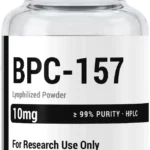
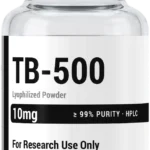
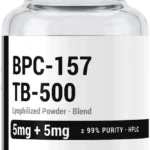
BPC-157 and TB-500 are often mentioned together in peptide research, particularly when the subject is tissue repair, recovery and regenerative biology. You will also see the two discussed on forums and in online peptide communities as though they are an established combination. That is where things need a bit more context.
Both compounds have attracted interest because of findings from laboratory and animal research. But the amount of reliable human evidence is much smaller than the online attention would suggest. They are also not interchangeable compounds, and the phrase “BPC-157 + TB-500” can make the combination sound more scientifically established than it actually is.
So what are they, and why are researchers interested in them?
What is BPC-157?
BPC-157, short for Body Protection Compound-157, is a synthetic peptide consisting of 15 amino acids. It is based on a peptide sequence associated with gastric tissue and has been investigated mainly in preclinical research.
Most of the research on BPC-157 is experimental, looking at tissue repair and cellular response. We have studied tendon and ligament injury, muscle damage, the gastrointestinal tract, blood vessels and inflammatory processes.
Some proposed mechanisms involve angiogenesis, fibroblast activity and signalling pathways associated with tissue repair. In simpler terms, researchers are interested in whether BPC-157 can influence some of the processes involved in maintaining or repairing damaged tissue.
That does not mean those effects have been demonstrated as a reliable treatment in people.
Recent reviews continue to describe the human evidence as very limited. The published literature includes small exploratory studies involving areas such as knee pain, interstitial cystitis and short-term safety observations, but these studies are nowhere near the same evidence base as a well-established medicine.
The FDA review in 2026 also identified a few human studies involving different routes and experimental settings. It said, “The studies were generally short, with limited safety information and small numbers of participants.”
That distinction matters. A promising laboratory result is a reason for further research, not proof that the same effect will occur in humans.
What is TB-500?
TB-500 is commonly described as a synthetic fragment related to thymosin beta-4, a naturally occurring peptide involved in cellular processes such as actin regulation, cell migration and tissue-related signalling.
Research into thymosin beta-4 has looked at processes including wound repair, angiogenesis and cellular movement. TB-500 has subsequently become popular in the wider peptide market because of the theory that these biological effects may have relevance to recovery and tissue regeneration.
There is, however, an important scientific distinction between thymosin beta-4 research and TB-500 itself. Results obtained with the naturally occurring peptide cannot automatically be treated as evidence for a particular synthetic fragment or commercial preparation.
This is one of the areas where online descriptions can become confusing.
The FDA reported in 2026 that it had not identified clinical studies in which TB-500 had been administered to patients to treat a disease or condition. It therefore concluded that there was not enough evidence to assess its effectiveness for wound healing.
So although the underlying biology is interesting, TB-500 remains an investigational subject rather than an established treatment.
Why are BPC-157 and TB-500 discussed together?
The basic attraction is fairly straightforward.
BPC-157 research has focused heavily on tissue protection, repair processes and vascular responses. TB-500 is discussed in connection with cellular migration, angiogenesis and tissue repair. Because those areas overlap, researchers and peptide users have developed an interest in whether the two could have complementary effects.
That idea, however, is not the same as having clinical evidence that combining them produces better results.
There is currently no strong human clinical evidence establishing that BPC-157 and TB-500 work better together than either compound on its own. There is also no well-established clinical protocol for the combination.
This is an important point for anyone reading claims about the pair online. A proposed mechanism can sound convincing while still being several steps away from a demonstrated clinical outcome.
What does the research actually tell us?
The picture is mixed, but not difficult to understand once animal and human research are separated.
Preclinical research provides reasons for scientists to continue studying both compounds. There are biological signals worth investigating, particularly around tissue repair and vascular processes.
The situation is different when it comes to human evidence.
For BPC-157, there are a handful of small human studies, but they do not provide the sort of large, controlled evidence normally needed to establish effectiveness and long-term safety. A 2026 review described the compound as having substantial preclinical research behind it while noting the absence of an approved formulation, validated dosing regimen and completed Phase II clinical trial.
The evidence gap is even clearer for TB-500. The FDA’s 2026 review found no evidence of human exposure to TB-500 in clinical studies and noted that questions remain about potential safety risks.
That means claims about the combination should be treated as hypotheses rather than settled medical facts.
Safety and regulatory considerations
The lack of clinical evidence is not simply an academic issue. It also makes it harder to establish what the risks might be, particularly with repeated exposure or products obtained outside conventional pharmaceutical supply chains.
The FDA has raised concerns about BPC-157 relating to immunogenicity and the quality and characterisation of peptide products. For TB-500, similar concerns include aggregation, peptide-related impurities and the absence of useful human exposure data.
For UK readers, it is also worth checking the regulatory status of any medicinal product through the MHRA rather than assuming that an online seller’s description represents official approval. The MHRA’s medicines database provides information on licensed medicines, product characteristics and public assessment reports.
There is another consideration for competitive athletes. The World Anti-Doping Agency lists thymosin-beta-4 and its derivatives, including TB-500, under prohibited substances.
BPC-157 + TB-500: where does that leave the research?
There is a genuine scientific reason for researchers to remain interested in both peptides. Their proposed biological actions overlap with several processes involved in tissue repair, which helps explain why the combination has become so widely discussed.
But the evidence needs to stay in proportion.
BPC-157 has some early human research, although it remains investigational and lacks the clinical evidence needed to establish its effectiveness or long-term safety. TB-500 has an even more limited human evidence base. And there is currently no solid clinical evidence showing that using the two together produces a proven regenerative effect.
For now, BPC-157 + TB-500 is best understood as an area of peptide research rather than an established medical treatment. The interesting part is what future controlled human studies might show. Until those studies are available, claims about faster healing, injury recovery or superior results from the combination should not be presented as facts.
Research Use Only. This comparison describes published research characteristics. It is not treatment advice and does not suggest that either compound should be used by people or animals.