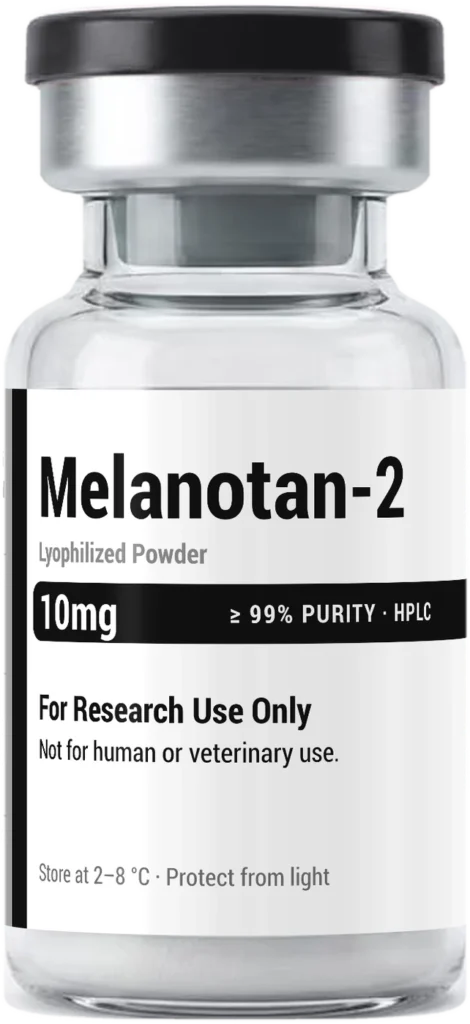
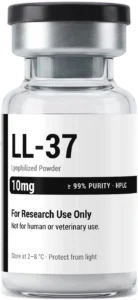
Vial label design and print may vary between batches. Product specifications remain unchanged.
At a glance
Strength
10mg per vial
Form
Lyophilised powder
Purity
≥ 99% (HPLC)
CAS number
121062-08-6
Molecular weight
1024.18 g/mol
Certificate of Analysis
Batch MT2-10-20 · Prime Peptides UK
Melanogenesis
Melanotan-2
Synthetic research peptide · 10mg · CAS 121062-08-6
£24.95 In stock · ready to shipper vial · £2.50 per mg
Melanotan-2 10mg is coming soon. It goes on sale as soon as its batch certificate is published - every vial we sell has a matching CoA.
Bank transferBitcoin Encrypted checkout · card details are never taken on this site
Multi-item discount. Add any 2 items for 4% off the whole order, 7% at 3, 10% at 4. Applied automatically at checkout.
Free
Free lab add-on. Bacteriostatic water is included with every peptide order at no extra cost.
Lab essentials tap to add to this order
RUOResearch Use Only. Not for human or veterinary use. By purchasing you confirm you are a qualified researcher and accept responsibility for safe, lawful handling.
Same-day dispatch
Orders before 3:00 PM leave the same working day, tracked, in plain packaging. Free UK delivery over £200.
Secure payment
Bank transfer or Bitcoin over an encrypted checkout. No card details are stored or handled on this site.
Batch tested
Every batch is HPLC and mass spectrometry tested, and its certificate is published before it ships.
Melanotan-2 10mg≥99% HPLC · In stock
£24.95
Compound Overview
What Is Melanotan-2 10mg?
Melanotan-2 10mg, is a laboratory formatted version of Melanotan II (MT-II), a synthetic cyclic peptide, that was created as an analogue of alpha-melanocyte-stimulating hormone (α-MSH). MT-II has been involved in experimental research on the melanocortin system, melanocortin signalling and related receptor systems as they interact with melanocortin receptors. This 10mg dosage is used only for controlled laboratory and scientific research within the UK and is provided to identify the amount of research material that is being provided.
Melanotan-2, also known as Melanotan II or MT-II, is a synthetic cyclic peptide that was developed from melanocortin biology research. It was created to mimic the endogenous human melanocortin peptide α-MSH. The compound was structurally modified from the naturally occurring hormone, resulting in a molecule that can be used to test receptor activity and related biological processes.
MT-II is typically referred to as the sequence, Ac-Nle-cyclo[Asp-His-D-Phe-Arg-Trp-Lys]-NH₂. The molecular formula for Melanotan II is C50H69N15O9 and has a molecular weight of ~1024.2 g/mol (according to PubChem).
With this product 10mg is only the amount of peptide research material provided. It is not a dosage, a recommendation for drug therapy or an indication of appropriateness for giving. The format is designed for a laboratory with appropriate equipment for controlled analytical, biochemical or experimental work.
Technical Data
Melanotan-2 Product Specifications
Technical Specification Sheet
MELANOTAN-2 · 10MG · RUO
Product Name
Melanotan-2 10mg
Alternative Name
Melanotan II / MT-II
Compound Type
Synthetic cyclic peptide
Research Format
10mg per vial
Molecular Formula
C50H69N15O9
Molecular Weight
Approx. 1024.2 g/mol
CAS Number
121062-08-6
Research Classification
Experimental melanocortin peptide
Intended Use
Laboratory and scientific research only
Documentation
Batch-specific COA where provided
Market
United Kingdom
Amino-Acid Sequence
Ac-Nle-cyclo[Asp-His-D-Phe-Arg-Trp-Lys]-NH2
Purity
≥99% by HPLC
The molecular identity, formula and molecular weight above correspond to the Melanotan II parent compound recorded by PubChem. Researchers should consult the documentation supplied with the individual batch when evaluating a specific vial.
The Science
Scientific Background of Melanotan II
Melanotan-2 emerged from research into synthetic analogues of α-MSH. Rather than being a direct copy of the endogenous peptide, MT-II has a cyclic structure incorporating selected amino-acid modifications. These structural characteristics have been investigated because they alter the way the molecule interacts with melanocortin receptors.
The melanocortin receptor family consists of several G-protein-coupled receptors involved in different physiological signalling systems. Laboratory studies of melanocortin compounds therefore extend beyond simply observing pigment production. Researchers may use synthetic ligands to examine receptor binding, downstream signalling, structure-activity relationships and differences between receptor subtypes.
Early scientific work also included limited human investigation. A small 1996 pilot Phase I study described MT-II as a cyclic heptapeptide analogue of α-MSH and evaluated it in only three volunteers. Such early exploratory research should not be interpreted as establishing clinical efficacy, routine safety or approval for therapeutic use.
For contemporary laboratory work, Melanotan-2 is better understood as an experimental research compound whose biological activity provides a model for investigating melanocortin signalling.
Laboratory Focus
Why Is Melanotan-2 Studied in Laboratory Research?
A well-studied area of research is the melanocortin receptor signalling pathway. These receptors are activated by naturally-occurring melanocortin peptides, with synthetic analogues enabling the study of the effects of structural changes on receptor interactions and biological responses.
Pigmentation Pathways
Another research area is that of pigmentation biology. Melanocortin pathways are part of a controlled set of cell processes that lead to melanin production by melanocytes. Previous laboratory investigations using α-MSH and analogues have examined the morphological changes of melanocytes, increases and decreases in tyrosinase activity, and melanin content under experimental conditions.
Receptor Signalling
In addition, MT-II has also been featured in broader experimental studies of melanocortin receptor subtypes' functional roles. Researchers can study receptor activation, cell signalling or structure-activity relationships depending on the model.
Interpreting Results
Care must be taken with these areas of research. Results in cultured cells, animal studies or small studies are not necessarily predictive of an established effect in humans. The experimental model, study design, concentration, controls and quality of the available evidence should be taken into account in a responsible assessment rather than extrapolating laboratory observations into consumer benefits.
Product Format
Understanding the Melanotan-2 10mg Research Format
10mg
Nominal Research Quantity
The 10mg designation describes the total nominal quantity of Melanotan-2 research material supplied in the vial. It does not describe a recommended dose and should not be interpreted as instructions for human or veterinary administration.
A defined material quantity can be useful when laboratories are planning experimental work. Different projects may require different quantities according to the number of analytical runs, experimental replicates, assay design, validation work and overall study scale. A laboratory undertaking several planned analytical stages, for example, may assess its material requirements differently from a project conducting a single characterisation procedure.
This is why the 10mg format should be considered from a laboratory procurement perspective rather than in terms of supposed potency or therapeutic strength.
Researchers evaluating Melanotan-2 10mg in the UK products should therefore match the quantity purchased to their documented protocol, equipment and analytical requirements. Experimental planning and laboratory SOPs should determine how research material is managed, rather than consumer-oriented dosing information found online.
Verification
Quality Testing, Identity and Certificate of Analysis
With experimental peptides, the label alone does not provide enough information to evaluate a batch. Researchers should consider the analytical documentation accompanying the material and determine what testing has actually been completed.
Batch-Specific CoA
A Certificate of Analysis (COA) can provide useful batch-level information. Depending on the laboratory and analytical method used, documentation may include the product identity, batch or lot reference, reported analytical results and test methodology.
HPLC Analysis
High-performance liquid chromatography (HPLC) is a common method for checking the chromatographic purity of peptides. However, an HPLC result should not automatically be treated as complete proof of molecular identity. Complementary analytical methods may provide additional information depending on the research requirements.
Documentation & Transparency
Batch traceability is equally important. A useful COA should be clearly connected to the specific batch supplied rather than presented as generic documentation for a product name.
Researchers should review the actual analytical report and understand what each result demonstrates instead of relying solely on marketing phrases such as “lab tested” or “high purity”.
Handling
Storage and Laboratory Handling
Labelling & Traceability
Peptide research materials should be processed under controlled laboratory conditions, which are created for the protection of material integrity. Researchers must keep Melanotan-2 in its original packaging and follow the storage instructions on the product label, batch documentation or supplier information.
Environmental Conditions
Research materials may be affected Inappropriate temperatures, humidity, intense light, and repeated uncontrolled environmental changes can negatively impact research materials. Minimising unnecessary handling of samples and preventing contamination are also aspects of effective laboratory practice.
Documentation First
Validation of SOPs is required instead of relying on assumptions based on unrelated peptides, as storage requirements can vary for different physical forms and analytical procedures.
Reconstitution Practice
Melanotan 2 is not intended to provide instructions on preparing, reconstituting or injecting or administering Melanotan-2. These are intended only for laboratory use and do not include such information.
Researchers comparing a Melanotan-2 10mg in the UK supplier should look beyond the quantity printed on the vial. Product identification, batch traceability and accessible analytical documentation provide considerably more useful information when assessing research material.
Check whether the supplier clearly identifies the compound and quantity, explains its research-only status and provides relevant COA or testing information where available. Packaging and storage guidance should also be sufficiently clear for laboratory personnel to manage incoming material appropriately.
The UK regulatory context also deserves particular attention. Melanotan II should not be represented as an approved consumer treatment. In a December 2025 parliamentary answer, the UK Government stated that Melanotan II injections and pens are considered medicinal products, while explaining that product classification is determined according to the relevant circumstances.
Prime Peptides UK supplies this 10mg format strictly as research material and does not position it for personal use.
Analytical Records
Batch certificates for Melanotan-2
Every order ships with the CoA matched to its batch number, and the analytical records
are published here - open the certificate before you order, or cross-check the one in
your parcel.
The 10mg figure identifies the nominal quantity of Melanotan-2 research material supplied in the product format. It should not be interpreted as a recommended dose, administration amount or treatment protocol. On the basis of their laboratory techniques, analysis goals, and authorized experimental protocols, researchers should plan the materials they will need.
Is Melanotan-2 10mg a medicine for personal use?
No. This product is positioned exclusively for laboratory and scientific research and is not offered for human consumption or self-administration. Melanotan II has been investigated experimentally, but research findings should not be confused with approval of this laboratory product as a treatment. UK regulatory classification can also depend on how a Melanotan II product is presented and supplied.
What makes Melanotan II different from naturally occurring α-MSH?
Melanotan II is a synthetic cyclic analogue rather than naturally occurring α-MSH itself. Its modified structure has made it useful for experimental investigation of melanocortin receptor activity and structure-activity relationships. The established Melanotan II structure includes a cyclic peptide arrangement and D-phenylalanine substitution. The researchers should distinguish MT-II from other melanocortin analogues when reviewing scientific literature.
What information should appear on a Melanotan-2 COA?
Researchers should look for a clear compound identity, batch or lot reference, analytical methodology and reported test results. Where HPLC data are supplied, the report should identify the sample and result associated with the batch. A COA is most useful when it can be directly matched to the research material received rather than functioning as generic product documentation.
Why might a laboratory choose a 10mg research format?
Laboratories may require different quantities of material depending on experimental scale, number of assays, analytical repetitions and study design. A 10mg vial provides a defined quantity for research planning. It does not mean that 10mg is scientifically “better”, more effective or appropriate for administration compared with another quantity. Selection should be driven by legitimate experimental requirements.
What research areas are associated with Melanotan-2?
Melanotan-2 has been used in studies of melanocortin receptors, melanocortin pathways and biological signalling. Previous studies have included pre-clinical studies and small exploratory clinical studies in humans. Evidence quality is completely unique depending upon the research question, and results from the various types of experiments conducted in one model should not be extrapolated to approved therapeutic claims. Researchers should evaluate the original literature and its limitations when designing and interpreting studies.
PG
Medically & Scientifically Reviewed By
Dr. Priyanka Goel
Scientific & Medical Content Reviewer
Reviews research content against current published literature and UK regulatory guidance, ensuring compound information is accurate, referenced and presented for research use only.
Melanotan-2 10mg is only provided as research lab or scientific material. It is not for human consumption, self-administration, cosmetic use, diagnostic procedures or therapy. No information on this page is intended to be medical advice or instructions for people to use Melanotan-2. Researchers have the responsibility to ensure that acquisition, storage and experimental use meet the applicable requirements of the UK, institution and laboratory safety requirements.