
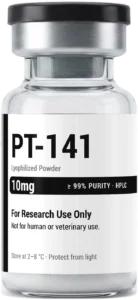
It is sometimes grouped together with experimental peptides because of its history in peptide research, although bremelanotide is not simply an untested laboratory compound. It has been developed as a pharmaceutical treatment and was approved in the United States under the name Vyleesi for acquired, generalised hypoactive sexual desire disorder (HSDD) in premenopausal women. That distinction matters when looking at the research, particularly when comparing published clinical findings with broader claims made about PT-141 online.
What is PT-141?
PT-141 is a synthetic cyclic peptide derived from research on melanocortin signalling. It is structurally related to alpha-melanocyte-stimulating hormone (α-MSH), a naturally occurring peptide involved in several physiological processes.
Its main area of interest has been the melanocortin receptor system. Bremelanotide interacts with several melanocortin receptor subtypes, with activity at MC1R, MC3R, MC4R and MC5R. At therapeutic concentrations, MC1R and MC4R activity is particularly relevant. Researchers have paid close attention to MC4R due to its role in central nervous system pathways associated with sexual behaviour.
That provides PT-141 a slightly different research profile from drugs aimed primarily at increasing genital blood flow. The proposed action is more closely linked to the neural signalling involved in sexual motivation and arousal.
The exact mechanism behind its effects on sexual desire is still not completely established, however. Even the regulatory information for bremelanotide states that the mechanism by which it improves HSDD is unknown.
PT-141 and sexual function research
Interest in PT-141 grew from earlier melanocortin research, which showed that compounds acting on these receptors could influence sexual behaviour.
Early human research was relatively small. One study involving premenopausal women with female sexual arousal disorder investigated a single intranasal dose of bremelanotide. More women reported moderate or high sexual desire after receiving bremelanotide than after placebo, although the study was small and did not establish the sort of evidence available from later Phase 3 trials.
Later research shifted towards subcutaneous administration and larger controlled studies.
The Phase 3 RECONNECT programme included two randomised, placebo-controlled trials involving more than 1,200 women in the safety population. The studies reported statistically significant improvements in measures of sexual desire and reductions in distress associated with low sexual desire compared with placebo.
There is an important detail here: these findings relate specifically to women with HSDD who met the criteria used in the clinical trials. They should not automatically be interpreted as evidence that PT-141 produces the same effects in everyone or that it is a general-purpose treatment for sexual performance.
Researchers have also continued to examine how meaningful the measured changes actually are. Some later academic commentary has questioned the validity of certain outcome measures used in the Phase 3 trials, highlighting the difficulties involved in measuring subjective aspects of sexual desire and distress.
Therefore, while there is human clinical evidence behind bremelanotide, the research is more nuanced than some simplified descriptions of PT-141 suggest.
How does PT-141 work?
The melanocortin system is involved in several biological functions, including appetite regulation, pigmentation and sexual behaviour. PT-141 acts as a melanocortin receptor agonist, meaning that it activates melanocortin receptors rather than supplying a conventional sex hormone.
MC4R has received particular attention. Research indicates that melanocortin signalling involving MC4R in the central nervous system can influence sexual responses. Regulatory research has also identified neural pathways, including areas of the hypothalamus, as relevant to the effects observed with melanocortin agonists.
This is one reason PT-141 remains intriguing from a research perspective. It provides a way to study how peptide signalling and central nervous system pathways may influence sexual motivation and behaviour.
The biology is not completely straightforward, though. Bremelanotide is not selective for a single melanocortin receptor, and its wider receptor activity helps explain why effects outside sexual function can also occur.
Safety and tolerability
Safety is an important part of any PT-141 research discussion.
Clinical studies have identified nausea, flushing, headache and injection-site reactions among the more frequently reported adverse effects. In an integrated analysis of Phase 3 studies, nausea occurred in around 40% of participants receiving bremelanotide, compared with a much smaller proportion receiving placebo. Flushing and headache were also more common with treatment.
Temporary increases in blood pressure have also been observed. For this reason, cardiovascular considerations form an important part of the clinical safety profile.
Longer-term research has followed participants for up to a year beyond the initial controlled treatment period. The open-label extension did not identify new major safety signals, although nausea, flushing and headache remained among the commonly reported treatment-related effects.
Researchers consider these findings useful because they demonstrate that PT-141’s effects extend beyond the intended sexual-function pathway. Receptor activity throughout the body produces additional physiological responses.
PT-141 in current research
PT-141 is an intriguing example of a peptide moving from experimental research into clinical development. Its history includes laboratory work, small human studies, dose-finding trials and large Phase 3 investigations.
For research purposes, the compound is particularly relevant to studies examining melanocortin receptors, neurobiology, sexual motivation and the relationship between central signalling and sexual response.
It is also worth keeping the evidence in perspective. The strongest human data concern bremelanotide in premenopausal women with acquired, generalised HSDD. Evidence for unrelated uses or for wider performance-enhancing claims is much less established.
PT-141 therefore sits in an unusual position within peptide research: it has a well-developed scientific and clinical history, but there are still questions around mechanism, patient response and how meaningful changes in subjective measures of sexual desire are in everyday life.
For anyone examining PT-141 from a research angle, the published clinical literature is considerably more informative than broad claims about the peptide circulating online. The available evidence provides researchers a useful window into melanocortin signalling and sexual function, while also showing why dosage, population, study design and outcome measures matter when interpreting results.
Published batch records
Every batch of PT-141 we have sold, each with its published Certificate of Analysis.
| Batch | Size | Purity (HPLC) | Tested | Certificate |
|---|---|---|---|---|
| PT-10-23 Current stock | 10mg | ≥99.0% | Oct 2026 | View CoA |
Research Use Only. PT-141 is supplied strictly for laboratory research. Nothing on this page is dosing guidance, medical advice, or a suggestion of human or veterinary use.