
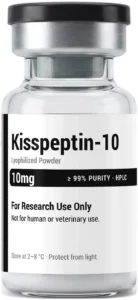
That distinction matters. Kisspeptin-10 is mainly studied as a tool for understanding how the brain communicates with the reproductive system. Research has looked at its interaction with the kisspeptin receptor, commonly called KISS1R, and the subsequent effects on GnRH and gonadotrophin secretion.
What is Kisspeptin-10?
Kisspeptin refers to peptides produced from the KISS1 gene. Several biologically active forms exist, including kisspeptin-54 and shorter fragments such as kisspeptin-10. Despite the difference in size, these peptides can interact with KISS1R, a G-protein-coupled receptor found on GnRH neurones.
Kisspeptin-10 is therefore intriguing less as a simple “hormone replacement” and more as a means for researchers to examine a key signalling point within the hypothalamic-pituitary-gonadal (HPG) axis.
The underlying pathway is fairly well established. Kisspeptin signalling can stimulate GnRH neurones, which then influence the release of luteinising hormone (LH) and follicle-stimulating hormone (FSH). These gonadotrophins are involved in the regulation of reproductive function in both men and women.
Why researchers are interested in it
The kisspeptin system changed the way scientists viewed reproductive hormone regulation. Rather than GnRH activity operating in isolation, research identified kisspeptin as an important upstream regulator.
Human studies have provided particularly useful evidence. The kisspeptin-10 studies suggest that exposure may stimulate LH secretion and modulate GnRH-associated activity. This response has been studied in a number of physiological and reproductive contexts, including healthy men and women and individuals with some reproductive disorders.
There’s a more complicated side to the story as well. Kisspeptin signalling does not simply behave like an on/off switch. Its activity is connected with other neuropeptide systems, particularly neurokinin B and dynorphin. Together these signalling pathways form part of the network involved in regulating GnRH secretion.
That makes Kisspeptin-10 useful for research into the wider control system rather than just one isolated hormone.
Kisspeptin-10 and KISS1R
KISS1R is the receptor through which kisspeptin signalling is primarily mediated. It was originally known as GPR54, and genetic research helped establish just how important this receptor is to normal reproductive development.
Inactivating mutations affecting KISS1R have been associated with impaired pubertal development and hypogonadotropic hypogonadism. Findings like these helped establish a direct connection between the kisspeptin system and reproductive maturation.
For laboratory researchers, this receptor-level relationship is one of the main reasons kisspeptin peptides continue to receive attention. Changes in the pathway can be investigated alongside changes in GnRH, LH, FSH and reproductive hormone signalling.
What has human research shown?
Human research has produced some intriguing findings, although it is important not to stretch those findings beyond what the studies actually demonstrate.
Investigations using kisspeptin-10 have reported increases in LH and GnRH-related activity under particular experimental conditions. Research has also explored responses in men with reproductive disorders, women at different points in their menstrual cycles, and people with alterations in related neuropeptide signalling pathways.
One area of interest is whether prolonged kisspeptin exposure causes the system to become less responsive. A human study reviewed in the literature reported that continuous exposure to receptor-saturating concentrations of kisspeptin-10 did not produce the expected loss of response over a 22-hour period. That does not mean the peptide has unlimited activity or that prolonged exposure is clinically appropriate; it is simply an observation from a controlled research setting.
Other work with kisspeptin agonists has also shown that endocrine responses can change depending on the pattern and duration of exposure. This is one reason researchers continue to distinguish between short-term physiological effects and longer-term outcomes.
Areas being investigated
Kisspeptin-10 research mainly focuses on reproductive endocrinology and neuroendocrine signalling.
Researchers have investigated or discussed its relevance to:
- GnRH and LH secretion
- reproductive hormone regulation
- puberty and pubertal development
- fertility biology
- hypogonadotrophic hypogonadism
- menstrual-cycle signalling
- Researchers are also interested in whether the kisspeptin system could eventually lead to new approaches in reproductive medicine.
- kisspeptin, neurokinin B and dynorphin signalling
There is also interest in whether the kisspeptin system could eventually contribute to new approaches in reproductive medicine. Reviews have discussed potential applications involving disorders of reproductive hormone signalling, while also pointing out that further work is needed before experimental findings can be translated into established clinical applications.
Research status
Kisspeptin-10 should be viewed in the context of experimental and clinical research rather than as an established general-purpose medicine.
A peptide studied in human research does not automatically indicate that an unlicensed product is suitable for personal use. Research preparations and medicinal products are not interchangeable, even if they contain the same named peptide. Purity, formulation, sterility, stability and manufacturing controls can all affect the reliability of experimental material.
For UK readers the difference is especially important in terms of regulation. Medicines and clinical investigations are regulated. The MHRA has a specific responsibility for the regulation of medicines and clinical trials in the UK. Clinical studies should have adequate scientific justification and safety protections for participants, the agency said.
The bigger picture
Kisspeptin-10 is intriguing because it provides researchers a relatively direct way to investigate one of the brain’s control points for reproductive hormone activity.
The peptide itself is only part of the picture. The KISS1/KISS1R system interacts with GnRH neurones and sits within a broader network involving neurokinin B, dynorphin, metabolic signals and sex-steroid feedback. That network helps explain why reproductive endocrinology can be much more complicated than measuring a single hormone level.
Current research, therefore, tends to focus on understanding the signalling pathway, identifying where it may be altered in disease, and working out whether manipulating kisspeptin signalling could have useful clinical applications. Kisspeptin-10 serves as a crucial research tool due to its well-established underlying biology, yet many potential therapeutic applications are still under investigation.
For research purposes, the most useful way to view Kisspeptin-10 is as a peptide involved in studying the KISS1/KISS1R–GnRH pathway and its influence on reproductive endocrine signalling. It is an area where laboratory findings, human physiology and potential clinical applications continue to overlap — but they should not be treated as interchangeable.
Published batch records
Every batch of Kisspeptin-10 we have sold, each with its published Certificate of Analysis.
| Batch | Size | Purity (HPLC) | Tested | Certificate |
|---|---|---|---|---|
| KS-10-16 Current stock | 10mg | ≥99.0% | Oct 2026 | View CoA |
Research Use Only. Kisspeptin-10 is supplied strictly for laboratory research. Nothing on this page is dosing guidance, medical advice, or a suggestion of human or veterinary use.