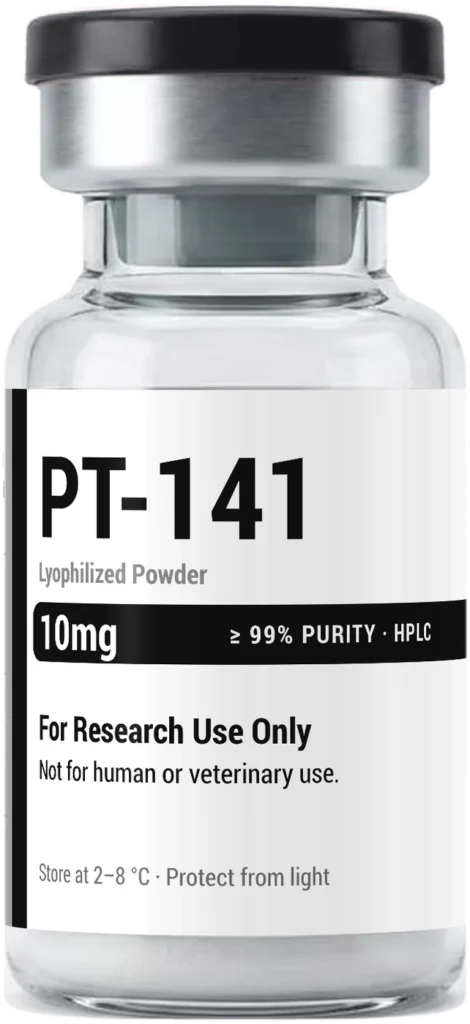
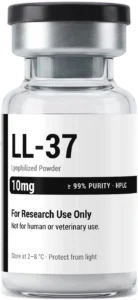
Vial label design and print may vary between batches. Product specifications remain unchanged.
At a glance
Strength
10mg per vial
Form
Lyophilised powder
Purity
≥ 99% (HPLC)
CAS number
189691-06-3
Molecular weight
1025.16 g/mol
Certificate of Analysis
Batch PT-10-23 · Prime Peptides UK
Reproductive signalling
PT-141
Synthetic research peptide · 10mg · CAS 189691-06-3
£19.95 In stock · ready to shipper vial · £1.99 per mg
PT-141 10mg is coming soon. It goes on sale as soon as its batch certificate is published - every vial we sell has a matching CoA.
Bank transferBitcoin Encrypted checkout · card details are never taken on this site
Multi-item discount. Add any 2 items for 4% off the whole order, 7% at 3, 10% at 4. Applied automatically at checkout.
Free
Free lab add-on. Bacteriostatic water is included with every peptide order at no extra cost.
Lab essentials tap to add to this order
RUOResearch Use Only. Not for human or veterinary use. By purchasing you confirm you are a qualified researcher and accept responsibility for safe, lawful handling.
Same-day dispatch
Orders before 3:00 PM leave the same working day, tracked, in plain packaging. Free UK delivery over £200.
Secure payment
Bank transfer or Bitcoin over an encrypted checkout. No card details are stored or handled on this site.
Batch tested
Every batch is HPLC and mass spectrometry tested, and its certificate is published before it ships.
PT-141 10mg≥99% HPLC · In stock
£19.95
Compound Overview
What Is PT-141 10mg?
PT-141 10mg is a research version of bremelanotide, a synthetic cyclic peptide that is linked to melanocortin receptor research. PT-141 is a peptide that has been studied because of its interaction with melanocortin signalling pathways, specifically receptors located in the central nervous system, which are not as widely studied as many experimental peptides that are primarily studied in tissue models in the periphery. This 10mg format is an exact amount of research material for analytical and controlled laboratory work.
The original research designation for bremelanotide is PT-141, which is a synthetic peptide analogue based on studies with alpha-melanocyte-stimulating hormone (α-MSH). It is also a member of the melanocortin peptide field and has been studied for its activity at melanocortin receptors such as MC3R and MC4R. These receptors have been studied in the scientific literature as melanocortin signalling is involved in many central biological processes.
Bremelanotide is a 7-amino-acid cyclic peptide in structure. The condensed sequence given by PubChem is Ac-Nle-Asp-His-D-Phe-Arg-Trp-Lys, cyclisation is included in the sequence. The molecular formula of the free-base is C50H68N14O10 and the molecular weight is about 1025.2 g/mol.
With research products from PT-104 UK, 10mg refers to the amount of peptide material provided. It is a product specification and not a recommended dosage or indication for use. It is limited in its use to the laboratory for investigation and scientific analysis.
Technical Data
PT-141 Product Specifications
Technical Specification Sheet
PT-141 · 10MG · RUO
Product Name
PT-141 10mg
Compound
Bremelanotide (PT-141)
Strength
10mg research material
Classification
Synthetic cyclic melanocortin peptide
Sequence
Ac-Nle-Asp-His-D-Phe-Arg-Trp-Lys
Molecular Formula
C50H68N14O10 (bremelanotide free base)
Molecular Weight
Approximately 1025.2 g/mol (free base)
Format
Research peptide
Testing
Refer to the applicable batch documentation
COA
Batch-specific Certificate of Analysis with every batch
Intended Use
Laboratory and scientific research only
Human Use
Not intended for human consumption or self-administration
CAS Number
189691-06-3
Purity
≥99% by HPLC
Researchers should consult the specific product COA because salt form and other analytical details may affect the specifications reported for an individual batch. Bremelanotide acetate, for example, has different formula and molecular-weight data from the free-base compound.
The Science
Scientific Background: PT-141 and Melanocortin Signalling
The scientific history of PT-141 is closely connected with research into the melanocortin system. Bremelanotide is a synthetic analogue of α-MSH and has been described in peer-reviewed literature as a melanocortin receptor agonist. Earlier investigations identified activity involving MC3R and MC4R, receptors that are expressed in the central nervous system.
This receptor-based mechanism distinguishes PT-141 from compounds whose experimental activity is studied primarily through vascular or peripheral pathways. Researchers have therefore used PT-141 as a compound for investigating how melanocortin signalling may influence centrally mediated physiological responses.
Published research includes animal models, receptor studies and human clinical investigations. This creates a broader evidence base than is available for many compounds sold solely as research peptides. However, evidence from a published study does not mean that a laboratory PT-141 product offered as research material should be treated as a medicine.
For UK researchers, that distinction is particularly important. Product identity, intended purpose and regulatory status must remain separate from findings reported in international scientific literature.
Laboratory Focus
Why PT-141 Continues to Be Studied
The interest in PT-141 has stemmed from the fact that melanocortin receptors are involved in complex signalling pathways rather than in a single biological pathway. The majority of scientific interest has so far been directed towards MC3R and MC4R activity, and how melanocortin signalling can influence centrally mediated behavioural and physiological behavior.
Pigmentation Pathways
Initial experiments were conducted in animal models and results showed responses in the hypothalamus. Follow-up studies progressed to controlled human trials of melanocortin responses.
Receptor Signalling
The history of PT-141 is of particular interest for those studying the pharmacology of receptors, the interaction between peptides and receptors, melanocortin pathways and central signalling mechanisms.
Cellular Studies
Interpretation continues to be a process that needs to be handled with care. Any results from animal studies or receptor assays or studies of a well-defined clinical population should be interpreted in the context of the design of the study and its limitations. They are not necessarily transferable to other situations.
Interpreting Results
A PT-141 research peptide can consequently serve as experimental material for appropriately designed laboratory work, but scientific literature should not be converted into claims about what an independently sourced research product will do in people.
Product Format
What Does the 10mg Research Format Represent?
10mg
Nominal Research Quantity
The 10mg PT-141 research format designates the overall amount of peptide content that has been specified in the product presentation. The number is not intended to suggest a dosage to be given, nor does it offer any measure of efficacy, potency or suitability for any therapeutic use.
This distinction can be helpful in research product comparisons. The amount of a compound required will vary from one laboratory to another depending on the nature of a project, the number of analytical procedures to be performed, as well as the requirement for project validation and the design of the experimental work.
A 10mg presentation can thus be considered as an inventory and laboratory planning specification. Researchers can identify if the amount provided is suitable for their own tested procedures, instrumentation and experimental goals.
Importantly, the selection of the different amounts of PT-141 should depend on the research needs. The more that is stated does not necessarily mean that it is clinically “stronger”, more effective or preferred. Prime Peptides UK supplies PT-141 10mg for research purposes only and not as a dosage for humans.
Verification
Identity, Purity Testing and Batch Documentation
Analytical documentation is particularly valuable when sourcing compounds for laboratory research. A product label identifies what material is intended to be present, whereas analytical testing provides evidence that can help researchers assess the characteristics of a particular batch.
Batch-Specific CoA
For peptides, High-Performance Liquid Chromatography (HPLC) may be used to assess chromatographic purity. Other analytical techniques can provide additional information about molecular identity. The appropriate methods and results should be evaluated from the documentation accompanying the specific batch rather than assumed from general product descriptions.
Documentation & Transparency
A useful Certificate of Analysis (COA) may contain the compound name, batch or lot reference, analytical results, test method information and other product-specific details. Batch identification helps connect the material received by a laboratory with its supporting documentation.
Identity vs Purity
Researchers evaluating PT-141 10mg should therefore check the actual COA and available testing information. Purity percentages or analytical claims should never be inferred solely because a compound belongs to a particular peptide category.
Handling
Storage and Laboratory Handling
Labelling & Traceability
Peptide research materials must be treated in controlled laboratory conditions and following the batch documentation, product label and laboratory's standard operating procedure supplied by the supplier.
Environmental Conditions
Research materials may be affected by environmental exposures, and laboratories should take into account temperature, moisture, and light in setting up and establishing appropriate storage controls. The product should be clearly labelled and kept free from unnecessary and unnecessary contamination or repeated environmental exposures.
Laboratory Research
It is also important for the researchers to keep track of each batch while it is being stored, in order to trace the material to its corresponding COA and laboratory records.
Reconstitution Practice
All preparation in an analytical experiment should be made in accordance with an institution's approved research protocol. The information about storage and handling of PT-141 10mg is not intended to be a guideline for personal preparation, injection, consumption or other use amongst humans.
When comparing PT-141 10mg UK suppliers, researchers should consider more than the product name or stated quantity. Clear compound identification, transparent strength labelling and accessible batch documentation all contribute to more informed sourcing decisions.
Testing information should be sufficiently clear for researchers to understand what was examined and, where applicable, which analytical technique was used. The batch-specific COAs are preferred to generic paperwork that cannot be easily associated with the material supplied.
Packaging, traceability, storage guidelines, and UK dispatch information may all be important considerations when considering laboratory acquisition.
If you wish to purchase PT-141 10mg in the UK for legitimate research purposes, ensure that the seller clearly states the product is intended solely for research use and is not a substitute for any approved medication. Procurement decisions should ultimately reflect the requirements and compliance procedures of the laboratory or research organisation involved.
Analytical Records
Batch certificates for PT-141
Every order ships with the CoA matched to its batch number, and the analytical records
are published here - open the certificate before you order, or cross-check the one in
your parcel.
PT-141 is the developmental or research designation commonly associated with bremelanotide. Scientific databases describe bremelanotide as a synthetic cyclic peptide and melanocortin receptor agonist. Researchers should nevertheless check the exact chemical form stated on the product's batch documentation, since free-base and acetate forms have different molecular formulae and molecular weights.
What exactly does 10mg mean on a PT-141 product?
The 10mg figure specifies the stated quantity of research peptide material in the product format. It is an inventory specification for laboratory sourcing. It is not a recommendation for human dosing, administration or experimental use. Individual laboratories must determine material requirements according to their approved research protocols.
Which receptors are associated with PT-141 research?
The published scientific literature describes PT-141 as a melanocortin receptor agonist, with research particularly discussing MC3R and MC4R. These receptors have been studied in connection with signalling within the central nervous system. The precise biological consequences depend on the experimental model, receptor environment and study design.
Why should researchers distinguish PT-141 free base from acetate?
Molecular specification was a function of the chemical form. The free base of bremelanotide is C50H68N14O10 with a molecular weight of approximately 1025.2 g/mol (PubChem) while the acetate version of the compound has different specifications published. Researchers should therefore use the batch-specific documentation rather than assuming every PT-141 product has identical analytical characteristics.
What should be checked on a PT-141 10mg COA?
Researchers should look for clear product identification, batch or lot information, analytical methods, reported test results and a connection between the document and the physical batch received. Where HPLC or another analytical technique is reported, the COA should be assessed according to the laboratory's own quality requirements rather than relying on marketing terminology alone.
Is PT-141 10mg intended for human use in the UK?
No. The product PT-141 10mg listed here is intended for use solely as a laboratory research material. It is not offered as a medicinal product, a treatment or a product for self-administration in the UK. The results of the research should not be construed as instructions or justification for using research labelled products in humans.
PG
Medically & Scientifically Reviewed By
Dr. Priyanka Goel
Scientific & Medical Content Reviewer
Reviews research content against current published literature and UK regulatory guidance, ensuring compound information is accurate, referenced and presented for research use only.
PT-141 10mg is provided only as a substance for the purposes of legal scientific, analysis and research. It is not for use by humans, self-treating, diagnosing or therapy. The information provided herein is for educational and product information purposes, and is a description of the compound and its research background and does not form part of medical advice.