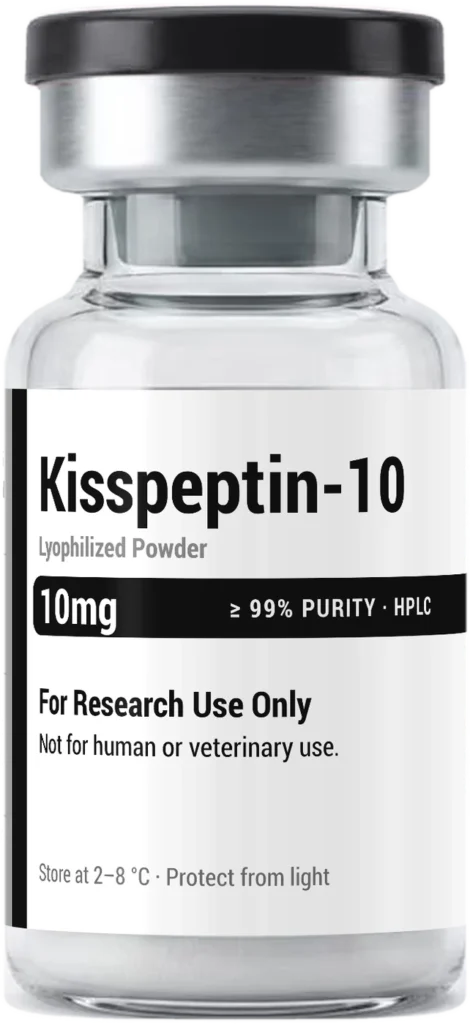
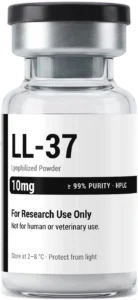
Vial label design and print may vary between batches. Product specifications remain unchanged.
At a glance
Strength
10mg per vial
Form
Lyophilised powder
Purity
≥ 99% (HPLC)
CAS number
374675-21-5
Molecular weight
1302.4 g/mol
Certificate of Analysis
Batch KS-10-16 · Prime Peptides UK
Storage
Follow the product label, supplier documentation and laboratory SOPs
Reproductive signalling
Kisspeptin-10
Synthetic research peptide · 10mg · CAS 374675-21-5
£29.95 In stock · ready to shipper vial · £3.00 per mg
Kisspeptin-10 10mg is coming soon. It goes on sale as soon as its batch certificate is published - every vial we sell has a matching CoA.
Bank transferBitcoin Encrypted checkout · card details are never taken on this site
Multi-item discount. Add any 2 items for 4% off the whole order, 7% at 3, 10% at 4. Applied automatically at checkout.
Free
Free lab add-on. Bacteriostatic water is included with every peptide order at no extra cost.
Lab essentials tap to add to this order
RUOResearch Use Only. Not for human or veterinary use. By purchasing you confirm you are a qualified researcher and accept responsibility for safe, lawful handling.
Same-day dispatch
Orders before 3:00 PM leave the same working day, tracked, in plain packaging. Free UK delivery over £200.
Secure payment
Bank transfer or Bitcoin over an encrypted checkout. No card details are stored or handled on this site.
Batch tested
Every batch is HPLC and mass spectrometry tested, and its certificate is published before it ships.
Kisspeptin-10 10mg≥99% HPLC · In stock
£29.95
Compound Overview
What Is Kisspeptin-10 10mg?
Kisspeptin-10 10mg is a laboratory research peptide, which is the biologically active part of the kisspeptin family with 10 amino acids. Kisspeptins are expressed from the gene KISS1 and bind to the kisspeptin receptor, KISS1R, which was formerly called GPR54. The 10mg format indicates the amount of peptide research material provided and is for controlled laboratory investigation. For scientific and research use only – not for human consumption or use as a medicine.
The shortest biologically active C-terminal fragment of the kisspeptin family is kisspeptin-10, often referred to as KP-10 or Kp-10 in scientific papers. KISS1R, previously called GPR54, is a G-protein coupled receptor which was identified as an endogenous ligand for kisspeptins, the peptide product of KISS1. In addition to KP-10, there are longer fragments of kisspeptin (KP-54, KP-14, KP-13).
Human Kisspeptin-10 is a C-terminal amidated decapeptide, YNWNSFGLRF. According to PubChem, the molecular formula is C63H83N17O14, and the molecular weight is about 1302.4 g/mol.
The 10mg designation refers specifically to the amount of research peptide supplied in the product format. It should not be interpreted as a human or animal dose. Kisspeptin-10 10mg provides research material for laboratories studying KISS1/KISS1R biology, receptor signalling and associated experimental pathways under appropriately controlled protocols.
Technical Data
Kisspeptin-10 Product Specifications
Technical Specification Sheet
KISSPEPTIN-10 · 10MG · RUO
Product name
Kisspeptin-10 10mg
Compound
Kisspeptin-10 / KP-10
Peptide type
Decapeptide
Strength
10mg research material
Sequence
YNWNSFGLRF-NH₂
Molecular formula
C63H83N17O14
Molecular weight
Approximately 1302.4 g/mol
Primary research target
KISS1R (GPR54)
Product format
Laboratory research peptide
Intended use
Scientific and laboratory research only
Documentation
Batch-specific Certificate of Analysis with every batch
Storage
Follow the product label, supplier documentation and laboratory SOPs
CAS Number
374675-21-5
Purity
≥99% by HPLC
The sequence, molecular formula and molecular weight above correspond to human Kisspeptin-10 as catalogued by PubChem.
The Science
Scientific Background of Kisspeptin-10
The scientific history of kisspeptin is closely connected with the KISS1 gene, originally investigated in relation to metastasis suppression. Research published in 2001 identified peptides derived from the KISS1 gene product as natural ligands for GPR54, subsequently renamed KISS1R.
Kisspeptin-10 represents the smallest active fragment and retains activity at the kisspeptin receptor. KISS1R is a G-protein-coupled receptor associated primarily with Gq/11 signalling. Receptor activation has been linked experimentally with phospholipase C signalling and intracellular calcium mobilisation.
A substantial part of the scientific literature concerns the role of the kisspeptin/KISS1R system within neuroendocrine reproductive biology. Experimental research has connected this signalling network with gonadotropin-releasing hormone (GnRH) neurons and regulation of the hypothalamic-pituitary-gonadal axis.
These observations provide research context rather than evidence that a 10 mg kisspeptin-10 laboratory product has an established therapeutic application. Findings vary according to model, experimental conditions and study design.
Laboratory Focus
Why Is Kisspeptin-10 Studied in Laboratories?
The advantage of kisspeptin-10 is that it offers a relatively short, biologically active ligand which allows the KISS1R signalling system to be studied.
Neurological Pathways
Receptor signalling is one of the important areas of investigation. The effects of the KP-10 binding to KISS1R on intracellular signalling events and subsequent cellular responses have been studied. The peptide also has relevance to experimental studies of the neuroendocrine pathways and reproductive-axis biology due to its association with them.
Receptor Signalling
Cellular migration and pathways involved with the historical suppression of metastasis by KISS1 have also been explored in other experimental studies. For instance, in the laboratory, investigations have been carried out of the interactions between KP-10/KISS1R signalling and CXCR4-mediated chemotactic responses. The research field is still growing.
Product Format
What Does the 10mg Research Format Represent?
10mg
Nominal Research Quantity
Kisspeptin-10 10 mg strength describes the total mass of peptide research material supplied. It does not represent a recommended concentration, administration amount or clinical dosage.
This distinction is important when comparing laboratory peptide lists. Because research programs vary greatly in size and approach, different numbers may be available. A laboratory undertaking several analytical tests, receptor assays, or duplicated research may require different materials than a short exploratory experiment.
A 10mg research format may therefore be evaluated according to factors such as the number of planned experiments, assay design, analytical workflow, replicate requirements and the laboratory's established protocols.
Researchers should calculate experimental material requirements according to their own validated methods and institutional procedures. The presence of 10mg on the vial or product listing describes the supplied quantity only; it does not establish how the compound should be administered or used in any biological subject.
Verification
Identity, Purity Testing and Certificate of Analysis
Analytical documentation is particularly important when sourcing Kisspeptin-10 10mg for controlled research. Laboratories require assurance that the received material is associated with clearly identified product and batch information.
Batch-Specific CoA
A Certificate of Analysis (COA) can provide useful information about a particular batch. Depending on the testing undertaken, documentation may report product identity, batch or lot number, analytical method and measured purity results.
HPLC Analysis
High-performance liquid chromatography (HPLC) is commonly used in peptide analysis to assess chromatographic purity. Other analytical techniques may be used to support identity or characterisation. Researchers should examine what a supplier's documentation actually reports rather than assuming that every analytical method has been performed.
Batch-Specific CoA
Batch traceability is equally valuable. Linking the vial, batch identifier and corresponding COA helps laboratories maintain clearer experimental records and assess consistency between research materials.
Purity percentages should only be accepted where supported by genuine analytical documentation rather than generic marketing statements.
Handling
Storage and Laboratory Handling
Environmental Conditions
The stability of peptide research materials can be affected by the environment. Therefore, Kisspeptin-10 10mg should be stored and used following the instructions stated in the product literature and within the laboratory guidelines.
Contamination Control
Temperature, moisture, and light exposure and contamination control should be taken into consideration by researchers when handling peptide materials. It also allows the product to be correctly labelled and the original batch identification to be kept, which aids with traceability throughout a research project.
Documentation First
If they have their own requirements for storage that are outlined in the supplier documentation these will take precedence over the general storage advice. The material should be incorporated into sample management and sample storage SOPs within laboratories.
Reconstitution Practice
This information is intended for laboratory use and does not provide instructions for preparation, injection or self-injection.
Researchers evaluating Kisspeptin-10 10mg UK suppliers should look beyond the quantity displayed on a product page. Clear identification of the compound, transparent analytical information and traceable batch documentation are more meaningful indicators when selecting materials for experimental work.
Important points to review include whether the product is explicitly labelled Kisspeptin-10 10mg, whether batch-specific documentation is available, what analytical methods are reported, and whether storage and handling information is clearly communicated.
Packaging and batch identification should also allow the supplied vial to be associated with its corresponding analytical records.
For UK laboratories sourcing research peptides, transparent product specifications make it easier to document materials accurately and maintain reproducible research records. Kisspeptin-10 10mg should always remain clearly distinguished from medicines or products intended for personal use.
Analytical Records
Batch certificates for Kisspeptin-10
Every order ships with the CoA matched to its batch number, and the analytical records
are published here - open the certificate before you order, or cross-check the one in
your parcel.
No. Both belong to the kisspeptin family, but they differ in peptide length. Kisspeptin-54 is a 54-amino-acid peptide, while Kisspeptin-10 is the shorter 10-amino-acid active C-terminal fragment. Scientific literature recognises KP-10 as the smallest biologically active kisspeptin fragment.
What exactly does 10mg mean on Kisspeptin-10 10mg?
The 10mg value identifies the total mass of Kisspeptin-10 research material supplied in the product format. It is a product quantity and not a recommended human or animal dosage. Experimental requirements must be determined through appropriate laboratory protocols.
Which receptor is associated with Kisspeptin-10 research?
Kisspeptin-10 is an endogenous ligand for the KISS1 receptor (KISS1R). The receptor was historically called GPR54 and may still appear under that name in older scientific publications. KISS1R is a G-protein-coupled receptor involved in several experimentally investigated signalling pathways.
What is the amino-acid sequence of human Kisspeptin-10?
PubChem records the sequence as Tyr-Asn-Trp-Asn-Ser-Phe-Gly-Leu-Arg-Phe, commonly represented by the one-letter sequence YNWNSFGLRF, with C-terminal amidation. The reported molecular formula is C63H83N17O14.
What documentation should accompany a research peptide?
Researchers should look for documentation that can be associated with the specific batch being supplied. Depending on the supplier and testing programme, a COA may contain batch identification, analytical methods and reported purity or identity information. Researchers should verify the actual documentation rather than relying solely on headline purity claims.
Is Kisspeptin-10 10mg supplied for human use?
The No. Kisspeptin-10 10mg listed on this page is for laboratory research use only. It is not marketed as a medicine or as a product to treat, diagnose or self-administer. Experimental or clinical studies published with kisspeptin should not be used as instructions for use of a research grade product.
PG
Medically & Scientifically Reviewed By
Dr. Priyanka Goel
Scientific & Medical Content Reviewer
Reviews research content against current published literature and UK regulatory guidance, ensuring compound information is accurate, referenced and presented for research use only.
Kisspeptin-10 (10mg) is provided only as a research sample for laboratory and scientific research. It should not be used for human consumption, self-administration, diagnosis or therapeutic purposes. The information provided here is intended to give an overview of the compound and the scientific background of the compound and is not intended to be medical advice.