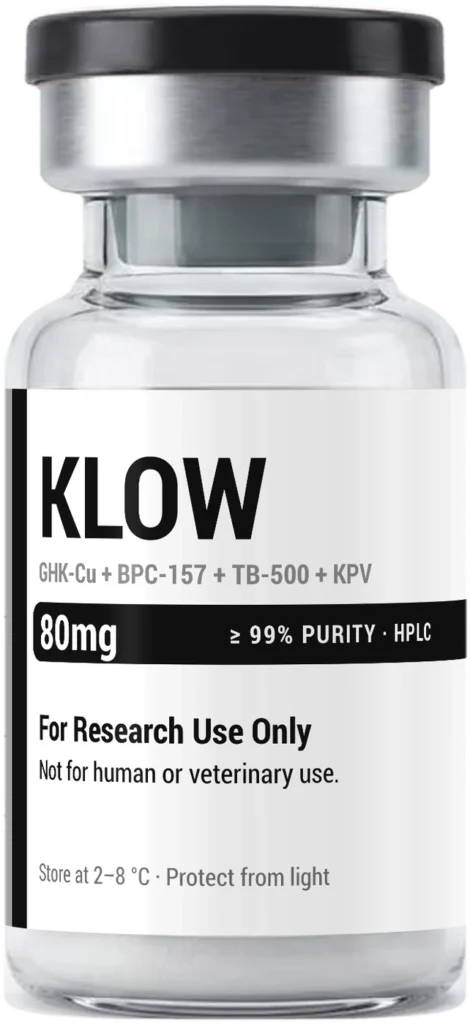
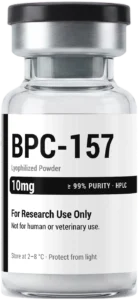
Vial label design and print may vary between batches. Product specifications remain unchanged.
At a glance
Strength
80mg per vial
Form
Lyophilised powder
Purity
≥ 99% (HPLC)
CAS number
Multi-compound
Molecular weight
80mg total peptide content
Certificate of Analysis
Batch KLOW-80-17 · Prime Peptides UK
Storage
Follow the product label, supplier documentation and relevant laboratory SOPs
Research blends
KLOW Blend
Synthetic research peptide · 80mg · CAS Multi-compound
£74.95 In stock · ready to shipper vial · £0.94 per mg
KLOW Blend 80mg is coming soon. It goes on sale as soon as its batch certificate is published - every vial we sell has a matching CoA.
Bank transferBitcoin Encrypted checkout · card details are never taken on this site
Multi-item discount. Add any 2 items for 4% off the whole order, 7% at 3, 10% at 4. Applied automatically at checkout.
Free
Free lab add-on. Bacteriostatic water is included with every peptide order at no extra cost.
Lab essentials tap to add to this order
RUOResearch Use Only. Not for human or veterinary use. By purchasing you confirm you are a qualified researcher and accept responsibility for safe, lawful handling.
Same-day dispatch
Orders before 3:00 PM leave the same working day, tracked, in plain packaging. Free UK delivery over £200.
Secure payment
Bank transfer or Bitcoin over an encrypted checkout. No card details are stored or handled on this site.
Batch tested
Every batch is HPLC and mass spectrometry tested, and its certificate is published before it ships.
KLOW Blend 80mg≥99% HPLC · In stock
£74.95
Compound Overview
What Is KLOW 80mg?
KLOW 4 is a four component research formula comprising GHK-Cu 50mg, BPC-157 10mg, TB-500 10mg and KPV 10mg in a single 80mg laboratory formula. This formulation provides the researcher with a set of several peptide systems that have been studied in experiments and have a fixed mixed preparation. It is for controlled use in the laboratory and for scientific investigation only and is not a medicine or treatment.
KLOW 80mg is a pre-formulated research mix that consists of four peptide-related compounds, that have all been found separately in experimental scientific literature. The standard dosage of 80mg is composed of 50mg GHK-Cu and 10mg each of BPC-157, TB-500 and KPV, which is a total of 80mg nominal peptide content.
GHK-Cu is a naturally occurring complex of three peptides with copper. BPC-157 is a synthetic peptide composed of just 15 amino acids that was mainly used in preclinical studies so far. The research peptide TB-500 is the product of experimental research, and KPV is the tripeptide Lys-Pro-Val extracted from the C-terminal portion of alpha-melanocyte-stimulating hormone.
Combining all of these in a single blend ensures researchers can study a multi-component system instead of keeping four separate materials. Importantly, the 80mg refers to the total amount of research material provided. It is not recommended for use and there is no information on administration in people or animals.
Technical Data
KLOW Blend Product Specifications
Technical Specification Sheet
KLOW BLEND · 80MG · RUO
Product name
KLOW 80mg
Product type
Multi-peptide research blend
Total strength
80mg
GHK-Cu
50mg
BPC-157
10mg
TB-500
10mg
KPV
10mg
Format
Lyophilised research material
Classification
Experimental multi-component peptide formulation
Intended purpose
Laboratory and scientific research only
Human use
Not intended for human consumption or self-administration
Documentation
Researchers should consult the batch-specific Certificate of Analysis supplied with each batch
Storage
Follow the product label, supplier documentation and relevant laboratory SOPs
Because KLOW contains several distinct components, assigning a single molecular formula, molecular weight or amino acid sequence to the complete 80mg mixture would be scientifically inappropriate.
The Science
Four Peptides Within One Research Formulation
The scientific interest surrounding KLOW comes from the different experimental backgrounds of its four components.
GHK-Cu, present at 50mg, is the largest component by mass. Scientific literature has examined GHK and its copper complex in connection with extracellular matrix activity, cellular signalling, tissue remodelling and related biological processes. Research includes laboratory, preclinical and some topical or dermatological contexts, although results from individual models should not be generalised into broad clinical claims.
BPC-157 has been investigated extensively in experimental models involving connective tissue, gastrointestinal systems, vascular responses and cellular repair mechanisms. Contemporary reviews continue to emphasise that much of this evidence comes from animals and other preclinical systems and that robust human clinical evidence remains limited.
KPV is a three-amino-acid peptide, Lys-Pro-Val. Laboratory research has examined its interaction with inflammatory signalling, including NF-κB and MAP kinase pathways, while animal studies have explored inflammatory gastrointestinal models.
TB-500-related research is commonly discussed alongside thymosin beta-4-associated mechanisms, including cellular migration, cytoskeletal organisation and tissue-response pathways. These subjects remain areas of experimental investigation rather than evidence of clinical benefit from the KLOW blend itself.
Laboratory Focus
Why KLOW Is Studied as a Multi-Component Blend
Combines a research material with an isolated peptide to develop other experimental questions. What researchers can do instead is to study a specific multi-component preparation that has been developed in a particular assay, analytical procedure, or experimental system.
Inflammatory Signalling
In the literature, the four KLOW components are linked with various fields of biological research. Some of the other areas of interest in extracellular matrix and tissue-remodelling research are those of GHK-Cu, which seem to be the most popular; BPC-157 has been researched in both models of repair and vascular ones; and KPV is being used in inflammatory signalling experiments, while peptides related to thymosin beta-4 have been studied in areas such as cell movement and tissue-response biology.
Laboratory Research
That is not evidence of additive or synergistic effects when combining the compounds. The properties of a commercial mixture can be assumed beyond those proven experimentally. Evidence for a given individual component cannot automatically be assumed to be evidence for KLOW 80mg as a whole.
Laboratory Research
When reading published documents and when planning controls and stating experimental findings, this distinction is significant.
Product Format
Understanding the 80mg KLOW Research Format
80mg
Nominal Research Quantity
The 80mg figure identifies the combined mass of the four materials within the vial. In the commonly documented formulation, 50mg is GHK-Cu and the remaining 30mg is divided equally between BPC-157, TB-500 and KPV at 10mg each.
This makes KLOW 80mg different from a conventional single-compound 80mg research product. Researchers assessing the material need to consider both the total nominal content and the individual components represented within that total.
The fixed formulation may be relevant when planning analytical studies involving a predetermined blend rather than four independently prepared compounds. Material requirements can vary according to the number of analytical runs, experimental replicates, assay design, controls, validation work and overall study scale.
The 80mg specification should therefore be understood purely as a laboratory product quantity. It does not establish an appropriate exposure level and should never be interpreted as dosing or administration guidance.
Verification
Analytical Quality, Identity and Certificate of Analysis
In the case of a multi-component preparation, it is even more important that the laboratory can be assured that it is receiving a product that is what it’s supposed to be, that it has the right characteristics, and that it is of acceptable quality.
Batch-Specific CoA
A Certificate of Analysis (COA) may be helpful for researchers to know which analytical observations are reported for a specific batch. The documentation may contain information such as batch identification, analytical date, purity information reported by the supplier and analytical methods employed in determining identity or purity.
HPLC Analysis
Within peptide analysis, HPLC is often employed to assess the chromatographic purity and MS can be used to help identify the molecule. A laboratory report for a blend should be analysed to compare the actual measurement reported and should not be trusted to validate each of the constituents separately.
Documentation & Transparency
The use of terms like “research grade” should not be used as a substitute for analytical documentation. In the absence of testing data, the actual COA information and identifiable batch information are much more useful than marketing terminology alone.
Handling
Storage and Laboratory Handling of KLOW 80mg
Environmental Conditions
Peptide research materials are sensitive to environmental factors, and must be stored as specified by the batch's instructions. Laboratories should store the material in suitable original packaging, and avoid unnecessary exposure to heat, moisture and intense light, and conditions which may lead to contamination or degradation.
Reconstitution Practice
Manipulations should be performed in a manner suitable for the analytical task to be completed. If their quality system requires it, researchers should record batch numbers, storage conditions, and dates of various preparations involved.
Documentation First
The instructions provided are generic and should not automatically be taken from an unrelated single peptide product; KLOW is actually four distinct components. Supplier documentation and laboratory SOPs should be used as a priority. This section covers lab preservation and sample protection, not KLOW preparation.
UK researchers taking a look at KLOW 80mg should not take the strength at face value. It should be clearly stated what the specific identity of all four components are, the details of the formulation, batch information and available analytical documentation.
The list should be useful in helping the customer differentiate KLOW from equally named peptide blends and know exactly what the customer is getting for the 80mg. Lack of labelling is particularly significant since KLOW is not a name for a single molecule.
R&D personnel should also check whether batch-specific COAs and packaging information, storage instructions, supplier contact details and the intended use are available prior to ordering R&D material.
Authorised medicines are differentiated from unlicensed medicines in the UK. KLOW should not, therefore, be marketed as a medicine authorised by MHRA or be made the subject of therapeutic claims. Only as laboratory research material is it placed here.
Analytical Records
Batch certificates for KLOW Blend
Every order ships with the CoA matched to its batch number, and the analytical records
are published here - open the certificate before you order, or cross-check the one in
your parcel.
The commonly documented KLOW 80mg research formulation contains four components: GHK-Cu 50mg, BPC-157 10mg, TB-500 10mg and KPV 10mg. Together, these quantities make 80mg of total research material. Researchers should still confirm the specification printed on the supplier's product documentation and batch information before beginning experimental work.
Why does KLOW contain more GHK-Cu than the other components?
In the normal formulation, the GHK-Cu (50mg) accounts for 50mg of the total 80mg mass, with a fixed 50:10:10:10 mass distribution. This is a feature of the product formulation, not an indication that one component is more effective or biologically essential than another. The experimental interpretation should take into account the actual composition and the objectives of the given study.
Is KLOW 80mg a single peptide?
No. KLOW is a blend name, not the chemical name of one peptide. The product combines GHK-Cu, BPC-157, TB-500 and KPV. Consequently, it would be misleading to assign the complete formulation one molecular formula, molecular weight or amino-acid sequence as though KLOW itself were an individual molecular entity.
Has KLOW 80mg been clinically proven?
Evidence concerning the individual components varies considerably, and much of the research relevant to BPC-157, KPV and related experimental peptides remains preclinical. Published findings concerning one constituent also do not prove that an 80mg KLOW mixture produces the same effects. The finished blend should therefore be regarded as an investigational research formulation rather than an established clinical treatment.
What should researchers look for on a KLOW COA?
Researchers should first confirm that the COA corresponds to the correct product and batch. Useful information may include batch or lot identification, analytical methods, reported results, testing date and information relevant to identity or purity. Where a blend is involved, laboratories should also establish whether the documentation adequately addresses the individual constituents rather than assuming that a single result characterises all four.
Is KLOW 80mg intended for human use?
The product supplied as No. KLOW 80mg is a research product used only in the laboratory or for scientific research. The 80mg relates to the amount of material in the research format and should not be considered as a human dose. The information on this product is not intended to be a guide for administration, injection, reconstitution, treatment or use by individuals.
PG
Medically & Scientifically Reviewed By
Dr. Priyanka Goel
Scientific & Medical Content Reviewer
Reviews research content against current published literature and UK regulatory guidance, ensuring compound information is accurate, referenced and presented for research use only.
KLOW 80mg is provided only for laboratory, analytical and scientific research. It is not intended for human consumption, self-administration, diagnostic or therapeutic use. The information contained herein is intended for educational purposes and should not be considered a recommendation for the use of any particular product or scientific literature as a medical treatment.