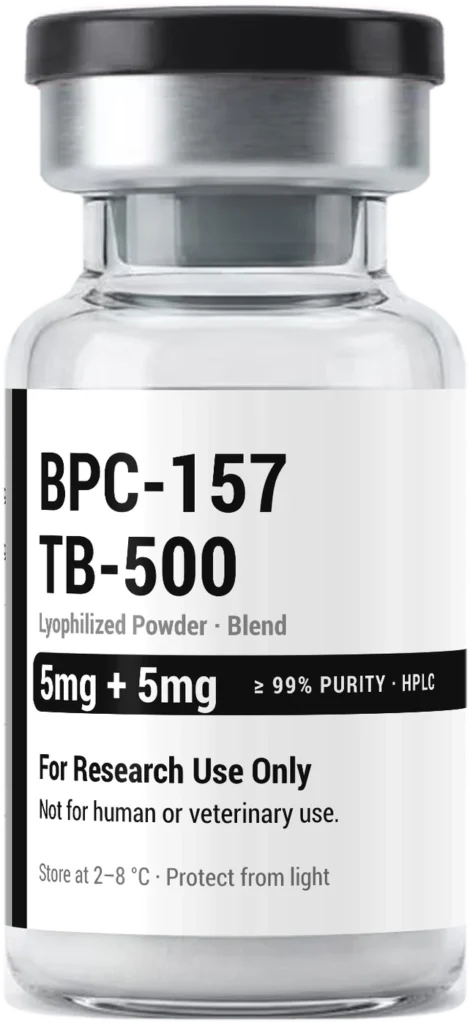
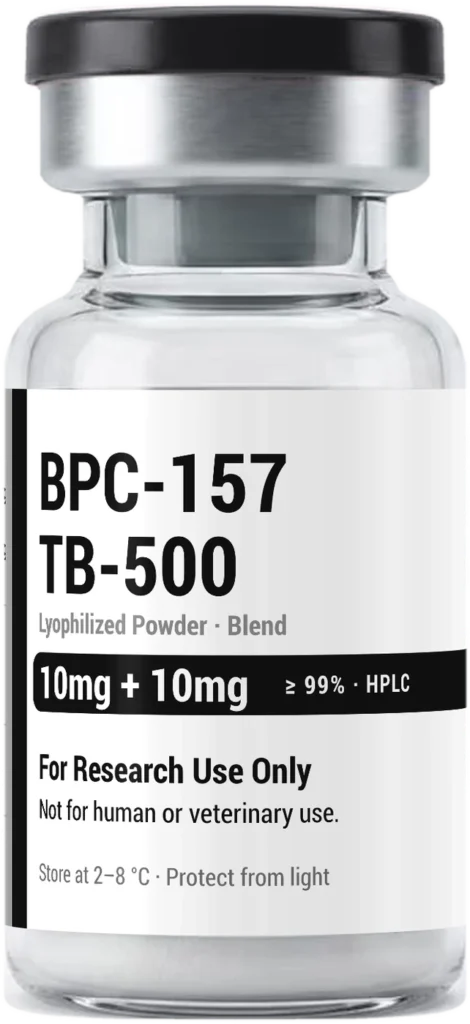
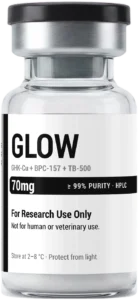
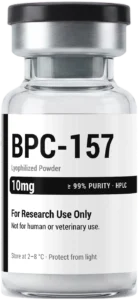
Vial label design and print may vary between batches. Product specifications remain unchanged.
At a glance
Strength
5mg + 5mg per vial
Form
Lyophilised powder
Purity
≥ 99% (HPLC)
CAS number
137525-51-0 / 77591-33-4
Molecular weight
1419.5 + 4963.4 g/mol
Certificate of Analysis
Batch BB-10-04 · Prime Peptides UK
Storage
Follow supplier documentation and laboratory SOPs
Research blends
BPC-157 + TB-500 Blend
Synthetic research peptide · 5mg + 5mg · CAS 137525-51-0 / 77591-33-4
£29.95 In stock · ready to shipper vial · £0.00 per mg
Choose strengthPrice per vial
BPC-157 + TB-500 Blend 5mg + 5mg is coming soon. It goes on sale as soon as its batch certificate is published - every vial we sell has a matching CoA.
Bank transferBitcoin Encrypted checkout · card details are never taken on this site
Multi-item discount. Add any 2 items for 4% off the whole order, 7% at 3, 10% at 4. Applied automatically at checkout.
Free
Free lab add-on. Bacteriostatic water is included with every peptide order at no extra cost.
Lab essentials tap to add to this order
RUOResearch Use Only. Not for human or veterinary use. By purchasing you confirm you are a qualified researcher and accept responsibility for safe, lawful handling.
Same-day dispatch
Orders before 3:00 PM leave the same working day, tracked, in plain packaging. Free UK delivery over £200.
Secure payment
Bank transfer or Bitcoin over an encrypted checkout. No card details are stored or handled on this site.
Batch tested
Every batch is HPLC and mass spectrometry tested, and its certificate is published before it ships.
BPC-157 + TB-500 5mg + 5mg is a laboratory product that combines 5mg of BPC-157 material with 5mg of TB-500-labelled material. The mix should be used for scientific and analytical research and not for therapeutic purposes. Research into BPC-157 has been primarily conducted in pre-clinical animal models focusing on gastrointestinal integrity, vascular responses and tissue-repair pathways, whereas research into thymosin beta-4 has focused on angiogenesis, cell migration and tissue-remodelling mechanisms. The 5mg + 5mg format is for indicating the amount of each research component provided, not a human dose or treatment recommendation.
Trust highlights: HPLC and MS tested by batch · Batch-specific COA with every batch · UK dispatch · Research Use Only
Two different research materials are equally labelled and combined in this product. Synthetic BPC-157 is a 15-amino-acid peptide that is frequently reported in the scientific literature as GEPPPGKPADDAGLV. It has been studied in experimental models of gastrointestinal tissue vascular signalling, angiogenesis and other repair processes. The majority of these conclusions are based on animal or laboratory studies and not on accepted clinical medicine.
While the use of TB-500 or research products labelled as such is often discussed in connection with thymosin beta-4 research, it is important to confirm the exact identity of the material provided by the laboratory, and not assume that it is the same as the native thymosin beta-4. Native thymosin beta-4 is a 43-amino-acid peptide that binds to actin, and has been studied with regard to cellular migration, angiogenesis and tissue-remodelling pathways.
The stated 5mg + 5mg strength therefore describes 5mg of each labelled component, providing a combined labelled research-material quantity of 10mg.
Sizes & Prices
BPC-157 + TB-500 Blend sizes and prices
Each size is supplied from its own tested batch with its own Certificate of Analysis. The size is the amount of research material in the vial; larger vials cost less per mg.
Size
Price
Per mg
Batch certificate
Choose
5mg + 5mg
£29.95
–
BB-10-04
10mg + 10mg
£39.95
–
BB-20-04
Technical Data
BPC-157 + TB-500 Blend Product Specifications
Technical Specification Sheet
BPC-157 + TB-500 BLEND · RUO
Product
BPC-157 + TB-500
Labelled strength
5mg BPC-157 + 5mg TB-500
Combined labelled quantity
10mg total research material
Classification
Experimental research peptide blend
Intended application
Laboratory and scientific research
Testing
Refer to current batch documentation
Certificate of Analysis
Batch-specific COA where available
Human use
Not intended for human consumption or self-administration
Storage
Follow supplier documentation and laboratory SOPs
CAS Number
137525-51-0 / 77591-33-4
Amino-Acid Sequence
BPC-157 (15-mer) + Thymosin Beta-4 (43-mer)
Molecular Formula
C62H98N16O22 + C212H350N56O78S
Molecular Weight
1419.5 + 4963.4 g/mol
Purity
≥99% by HPLC
The labelled strength describes the amount of material supplied. It should not be interpreted as evidence of clinical potency, effectiveness or safety.
The Science
Scientific Background of BPC-157 and Thymosin-Related Research
BPC-157 has garnered scientific interest due to research in multiple experimental systems. Published studies have examined vascular responses, nitric-oxide-related signalling, gastrointestinal mucosal models and angiogenesis-associated processes. Experimental evaluation of granulation tissue, collagen formation, and new-vessel development has also been investigated.
These results serve as a foundation for further laboratory study, but should be interpreted cautiously. Much of the literature is based on animal models and there are no experimental findings that establish efficacy in humans. A small human study was reported in 2025, but the evidence base for humans is limited.
Thymosin beta-4 has a distinct scientific literature. It is a 43-amino-acid peptide, which binds to actin and has been studied for its effects on cellular migration, angiogenesis and related processes.
It is important to note that the association of two research materials in one product does not demonstrate the additive or synergistic effects of these materials. Any combined effects should be determined through appropriately designed experiments.
Laboratory Focus
Why Researchers Study These Peptide Pathways
Tissue Repair Models
Research with BPC-157 has been centred around biological processes involved with tissue integrity, vascular responses and gastrointestinal experimental models. Additionally, interactions with nitric oxide, endothelial activity and pathways related to angiogenesis are considered in studies. Those observations may support hypothesis development and guide further laboratory investigation, but for preclinical observations to become claims about human recovery, treatment or healing, they must meet the criteria for scientific evidence.
Cellular Studies
Thymosin beta-4 is investigated differently mechanistically. Its interaction with actin is well documented and experimental studies have investigated the association of cell motility, endothelial migration and blood-vessel formation.
Interpreting Results
A combined BPC-157 + TB-500 research format may then be used by the laboratory if the experimental design requires both materials to be studied simultaneously. Control measures are still necessary. Results obtained from the blend should not be assumed to represent either component on its own, and results from studies of the isolated compounds should not be assumed to represent the behaviour of the combined research material.
Product Format
Understanding the 5mg + 5mg Research Format
5mg + 5mg
Nominal Research Quantity
A defining characteristic of this particular product is its equal 5mg + 5mg composition. Rather than representing 10mg of a single compound, the label identifies two separate research-material quantities within one product: 5mg BPC-157 and 5mg TB-500.
That distinction matters for laboratory inventory, experimental records and protocol planning. Researchers should record the components separately when documenting the material rather than referring to it simply as a 10mg peptide.
Material requirements can vary according to assay numbers, replicate structure, analytical methodology, study scale and experimental objectives. For that reason, availability in a particular strength should be viewed as a laboratory supply format rather than an indication that one quantity is inherently preferable to another.
Any preparation, dilution or analytical processing should be determined by a validated laboratory protocol and relevant batch documentation. The 5mg + 5mg designation is not a recommended human or animal dose, nor does it provide administration guidance.
Verification
Quality Testing, Purity and Certificate of Analysis
Clear documentation is particularly important for blended research products, since researchers require confidence in the identity and representation of both the labelled components.
Batch-Specific CoA
Batch-level data on the material supplied may be available in a Certificate of Analysis. Researchers should verify that the document is for the correct product and batch number, and should consider the analytical method conducted, not the purity figure alone.
HPLC Analysis
HPLC is often used to determine the peptide purity profile, but other analytical methods may be required for identity confirmation and molecular characterisation. The chromatographic purity result does not necessarily confirm all parameters of compound identity.
Batch-Specific CoA
If independent testing is referenced, it should be identified with the appropriate lot. Batch numbers can be used to link packaging, analytical records and laboratory inventory.
Prime Peptides UK should only publish a specific purity percentage, molecular specification or independent-testing claim where current supporting documentation exists. This avoids presenting assumptions as verified product characteristics.
Handling
Storage and Laboratory Handling
Documentation First
Research peptides should be treated as controlled laboratory materials. Storage conditions should follow the documentation supplied with the particular product and the laboratory's own standard operating procedures.
Environmental Conditions
Material should remain appropriately labelled and protected from conditions capable of compromising stability or analytical reliability, including unsuitable temperature, excessive moisture, contamination and unnecessary light exposure where applicable.
Labelling & Traceability
Maintaining the original batch identification throughout receipt, storage and experimental use improves traceability. Packaging integrity should also be inspected before the product enters a study.
Reconstitution Practice
If the material changes appearance or storage conditions have been compromised, researchers should assess its suitability before analytical use. These principles relate solely to laboratory material management and must not be interpreted as instructions for preparing BPC-157 or TB-500 for administration to humans or animals.
A BPC-157 + TB-500 5mg + 5mg supplier's ability to identify the product and provide analytical transparency is more valuable than exaggerated product claims.
Researchers should seek clarity on the two components, correct batch identification, access to relevant testing records, clear Research Use Only labelling and availability of a batch-specific COA.
The documentation should be based on the material supplied and not solely on general peptide information. There should also be packaging and storage directions that facilitate the tracking of materials from receipt to laboratory use.
When laboratories compare suppliers, commercial search terms may help identify available products; however, final selection should rely on product specifications, batch documentation, analytical transparency and suitability for the intended experimental protocol.
Analytical Records
Batch certificates for BPC-157 + TB-500 Blend
Every order ships with the CoA matched to its batch number, and the analytical records
are published here - open the certificate before you order, or cross-check the one in
your parcel.
The label indicates that the product contains 5mg of BPC-157 research material and 5mg of TB-500-labelled research material. The quantities are stated separately because it is a two-component blend. They describe the amount of material supplied and are not recommended doses.
Is BPC-157 + TB-500 5mg + 5mg intended for human use?
No. The product is positioned exclusively for laboratory and scientific research. It is not intended for human consumption, self-administration, diagnosis or therapeutic use. Experimental findings should not be converted into personal treatment instructions.
Why are BPC-157 and TB-500 supplied together?
A combined format may be relevant when an experimental design specifically requires investigation of both materials. However, simply placing two compounds together does not prove synergy or enhanced activity. Appropriate control groups and analytical methods are required to investigate combined effects.
Is TB-500 identical to thymosin beta-4?
Researchers should not make that assumption solely from a commercial product name. Native thymosin beta-4 is a characterised 43-amino-acid, actin-binding peptide. The exact identity of a TB-500-labelled research product should therefore be confirmed through its specifications and analytical documentation.
What should researchers review on the Certificate of Analysis?
Review the batch identifier, product identity, components tested, analytical methodology and reported results. For a blended product, documentation relating to both labelled components is particularly important. Researchers should also make sure that the COA corresponds to the lot actually supplied.
What scientific evidence exists for these research materials?
BPC-157 has mainly been investigated in preclinical and animal models covering gastrointestinal, vascular and tissue-related pathways, although limited human research has recently appeared. Thymosin beta-4 has an established experimental literature involving actin regulation, migration and angiogenesis. These findings do not demonstrate that a commercial BPC-157 + TB-500 blend is an approved or clinically established treatment.
PG
Medically & Scientifically Reviewed By
Dr. Priyanka Goel
Scientific & Medical Content Reviewer
Reviews research content against current published literature and UK regulatory guidance, ensuring compound information is accurate, referenced and presented for research use only.
BPC-157 + TB-500 5mg + 5mg is only available as a laboratory research material. It is not for human consumption, self-administration, diagnostic, veterinary or therapeutic use. The information on this page provides a summary of scientific literature and product context for research purposes only and is not intended to be medical advice. Benefits claimed from animal, cellular or other experimental studies should not be extrapolated to humans.