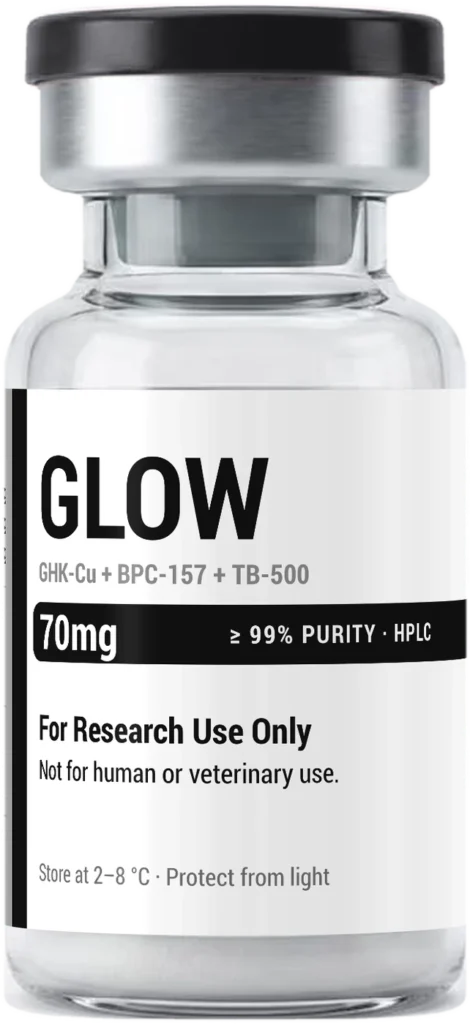
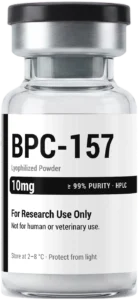
Vial label design and print may vary between batches. Product specifications remain unchanged.
At a glance
Strength
70mg per vial
Form
Lyophilised powder
Purity
≥ 99% (HPLC)
CAS number
Multi-compound
Molecular weight
70mg total peptide content
Certificate of Analysis
Batch GLOW-70-13 · Prime Peptides UK
Research blends
GLOW Blend
Synthetic research peptide · 70mg · CAS Multi-compound
£59.95 In stock · ready to shipper vial · £0.86 per mg
GLOW Blend 70mg is coming soon. It goes on sale as soon as its batch certificate is published - every vial we sell has a matching CoA.
Bank transferBitcoin Encrypted checkout · card details are never taken on this site
Multi-item discount. Add any 2 items for 4% off the whole order, 7% at 3, 10% at 4. Applied automatically at checkout.
Free
Free lab add-on. Bacteriostatic water is included with every peptide order at no extra cost.
Lab essentials tap to add to this order
RUOResearch Use Only. Not for human or veterinary use. By purchasing you confirm you are a qualified researcher and accept responsibility for safe, lawful handling.
Same-day dispatch
Orders before 3:00 PM leave the same working day, tracked, in plain packaging. Free UK delivery over £200.
Secure payment
Bank transfer or Bitcoin over an encrypted checkout. No card details are stored or handled on this site.
Batch tested
Every batch is HPLC and mass spectrometry tested, and its certificate is published before it ships.
GLOW Blend 70mg≥99% HPLC · In stock
£59.95
Compound Overview
What Is GLOW 70mg?
GLOW 70mg is a multi-component research blend of 70mg of GHK-Cu 50mg, BPC-157 10mg and TB-500 10mg all in one 70mg laboratory format. GLOW is not a single peptide but a collection, or a group, of three different peptides with different biochemical properties, for controlled experimental study. It is only available as a research material for laboratory and scientific use in the UK and should not be used in animals or humans.
The ingredients of GLOW 70mg are three peptide formulations, the copper binding tripeptide GHK-Cu, the synthetic pentadecapeptide BPC-157 and TB-500, a peptide compound that is part of thymosin beta-4 research. These components are packaged together in the 70mg format as 50mg GHK-Cu, 10mg BPC-157 and 10mg TB-500.
Experimental works have examined each component individually. GHK-Cu is an experienced researcher in the field of binding to copper, the role of the extracellular matrix in biological processes and cellular signalling. BPC-157 is mostly studied in preclinical models related to gastrointestinal, vascular and tissue models and the research on thymosin beta-4 has focused on cell migration and cytoskeletal organisation.
A combined GLOW research format has a purpose other than that of studying an isolated peptide. It allows laboratories to explore a multi-component material and investigate how the components behave when combined under defined experimental conditions.
The 70mg designation describes total research material per vial. It is not a dosage recommendation.
Technical Data
GLOW Blend Product Specifications
Technical Specification Sheet
GLOW BLEND · 70MG · RUO
Product Name
GLOW 70mg
Product Type
Multi-peptide research blend
Total Quantity
70mg
Composition
GHK-Cu 50mg + BPC-157 10mg + TB-500 10mg
Format
Lyophilised research material
Classification
Experimental laboratory research compound
Testing
Refer to current batch documentation
Documentation
Batch-specific Certificate of Analysis with every batch
Intended Use
Laboratory and scientific research only
Human Use
Not intended for human consumption or administration
CAS Number
Multi-compound
Amino-Acid Sequence
GHK-Cu 50mg + BPC-157 10mg + TB-500 10mg
Molecular Formula
Multi-compound blend
Molecular Weight
70mg total peptide content
Purity
≥99% by HPLC
Researchers should always consult the documentation supplied with the specific batch rather than assuming analytical results are identical between production lots.
The Science
Three Components, Three Distinct Research Histories
An important feature of GLOW 70mg is that its components do not represent variations of the same peptide. They have different structures and have been investigated independently.
GHK-Cu is a copper complex of the naturally occurring tripeptide glycyl-L-histidyl-L-lysine. Scientific work has explored its copper-binding behaviour and its relationship with extracellular matrix processes, gene expression and cellular responses.
BPC-157 is a synthetic 15-amino-acid peptide associated with a sequence described in gastric protein research. Published investigations are largely preclinical, with experimental models examining gastrointestinal biology, angiogenesis-related signalling and tissue responses.
TB-500 is associated with thymosin beta-4-derived research. Thymosin beta-4 has been investigated for its interactions with actin and its relevance to cellular migration and organization.
Research Context
Combining these materials does not establish that the blend has a therapeutic effect. Evidence concerning individual components should not automatically be interpreted as evidence for the GLOW formulation itself.
Laboratory Focus
Why Is the GLOW Combination Studied?
For research questions that involve interactions instead of the activity of a single compound, multi-compound formulations may be beneficial. GLOW provides a comprehensive package that can be seamlessly integrated into well- designed laboratory investigations of converging biochemical processes.
Tissue Repair Models
These individual components have been featured in studies of extracellular matrix organisation, cell migration, pathways associated with angiogenesis, the study of copper-dependent biology and experimental tissue models. These regions generate scientific curiosity in studying the interaction of various signalling systems in the same experimental environment.
Cellular Studies
However, there is an important difference between research rationale and research demonstrated benefit. The majority of the literature on BPC-157 and thymosin related compounds is from cell, animal or other preclinical models. Those systems can't be directly translated into effects in people.
Laboratory Research
The formulation of GLOW should thus be regarded as an experimental research blend, and not as a therapeutic formulation. Combined-compound experiments should be interpreted with the evidence for each component and the limitations of the combined-compound experiment in mind.
Product Format
Why the 70mg Format Matters in Laboratory Research
70mg
Nominal Research Quantity
The 70mg label describes the combined quantity of material contained in the research vial. In the formulation described here, the total consists of 50mg GHK-Cu plus 10mg BPC-157 and 10mg TB-500, giving 70mg overall.
This distinction is particularly important because “70mg” should not be interpreted as the amount of any single component.
Laboratories may source different material quantities according to practical experimental requirements. The appropriate format can depend on the number of planned assays, replication requirements, analytical methods, study duration and overall scale of a project.
A 70mg combined format may be relevant where a protocol specifically requires the three components in the stated composition. Conversely, research requiring independent adjustment of each compound may be better suited to separately characterised materials.
Prime Peptides UK presents the strength as product quantity information only, not as guidance for administration, dosing or clinical use.
Verification
Analytical Testing and Batch Documentation
Analytical transparency is particularly crucial with a multi-component research product, as it is important for researchers to understand what material is connected to a specific batch.
Batch-Specific CoA
A Certificate of Analysis (COA) may contain information useful at the batch level that includes product identification, lot/batch reference, analytical methods and results. High-Performance Liquid Chromatography (HPLC) can be employed to determine chromatographic purity (where applicable), and mass spectrometry can be used to give information relevant to the molecular identity.
Identity vs Purity
Identity testing and purity testing answer different analytical questions: one confirms what the material is, the other how much of it is the target compound. Purity data should not be considered absolute proof of all properties of a compound prepared from a blend.
Documentation & Transparency
Researchers who want to assess GLOW 70mg should therefore consult the documentation for the specific batch that they are buying, not the general quality of peptides.
If Prime Peptides UK offers Independent Testing or Batch specific Analytical Documentation, the current COA should be referenced for exact reported results. The purity percentage should not be assumed to be consistent across batches unless supported by the appropriate documentation.
Handling
Storage and Controlled Laboratory Handling
Labelling & Traceability
GLOW 70mg will be stored and used in the same manner as the storage description provided on the label and in the laboratory standard operating procedures and COA.
Environmental Conditions
Research materials based on peptides may be sensitive to the environment. The laboratory should control excessive heat, direct light, moisture, and potential sources of contamination. Peptide storage conditions may vary depending on formulation and product condition, and the batch-specific instructions should be followed rather than generic peptide storage guidance.
Environmental Conditions
Proper laboratory practice also involves clearly identifying the product, retaining batch data and minimising unnecessary exposure to the environment during the analytical work.
Note
Preparation and handling are only to be done within an appropriate laboratory protocol. The data is not meant to be used to prepare GLOW for human or veterinary use, or for use by individuals.
Researchers looking for GLOW 70mg in the UK should consider more than the quantity shown on the vial. Clear identification of all three components is particularly important for a blended product.
Useful supplier information includes the precise composition, total research-material quantity, batch or lot identification, analytical documentation, storage guidance and intended-use statement. A batch-specific COA is more informative than a generic certificate that cannot be connected to the material supplied.
Packaging and traceability also matter. Researchers should be able to identify which documentation corresponds to the product received and retain that information as part of laboratory records where required.
UK sourcing can additionally simplify communication and dispatch for domestic laboratories, but location alone does not establish product quality. Analytical evidence, transparent labelling and appropriate research-only positioning should remain central considerations when evaluating a peptide supplier in the UK.
Analytical Records
Batch certificates for GLOW Blend
Every order ships with the CoA matched to its batch number, and the analytical records
are published here - open the certificate before you order, or cross-check the one in
your parcel.
The formulation described on this page contains three research components in one vial: 50mg GHK-Cu, 10mg BPC-157 and 10mg TB-500, providing 70mg of total material. Because GLOW is a blend rather than an individual peptide, researchers should check the product specification and batch documentation to confirm the composition of the material supplied.
Does 70mg refer to the amount of each peptide?
No. The 70mg mark refers to the total amount of research material in the vial. It should not be interpreted as 70mg of GHK-Cu, BPC-157 or TB-500 individually. It also does not represent a recommended human or animal dose.
Why combine GHK-Cu, BPC-157 and TB-500?
The components have been investigated independently across different areas of preclinical and biochemical research. A combined formulation allows researchers to examine a defined multi-component material where an experimental design requires these compounds together. It does not mean that therapeutic benefits of the combination have been established.
Is GLOW 70mg an approved medicine in the UK?
GLOW 70mg sold as a research peptide blend should not be presented as an authorised UK medicine. This product is positioned exclusively as laboratory research material. It is not supplied for treating, preventing or diagnosing disease and should not be used for self-administration.
What should I look for on a GLOW Certificate of Analysis?
Check that the COA can be linked to the product through a batch or lot identifier. Review the listed material, test date, analytical methods and reported results. For a blend, researchers should also check whether the documentation clearly identifies the components being analysed rather than relying only on a general product name.
Is research on GLOW the same as research on its individual components?
No. There is no evidence to suggest that the behaviour of a formulation containing all three is similar to that of GHK-Cu, BPC-157 or thymosin beta-4 related compounds. There may be the presence of other experimental variables due to interaction between components. It is important that researchers distinguish literature on the individual components from evidence produced with the combined GLOW formulation.
PG
Medically & Scientifically Reviewed By
Dr. Priyanka Goel
Scientific & Medical Content Reviewer
Reviews research content against current published literature and UK regulatory guidance, ensuring compound information is accurate, referenced and presented for research use only.
GLOW 70mg is only provided as a material for controlled laboratory and scientific research. Not for veterinary use, self-medication, diagnosis or therapeutic use. Statements about biological pathways like GHK-Cu, BPC-157, TB-500, and others are based on science and should not be taken as confirmed health benefits or medical advice.