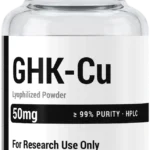
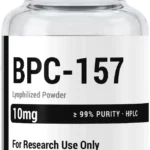
GHK-Cu and BPC-157 are two peptides that often come up when people look into tissue repair and recovery. They are sometimes placed in the same category, but they are quite different compounds and have been studied for different reasons.
GHK-Cu is best known for research around skin, collagen and tissue remodelling. BPC-157, on the other hand, has attracted more attention for research into healing, inflammation and different types of tissue injury, particularly in animal studies.
So, although both are linked with repair, the research behind them is not really looking at the same thing.
What is GHK-Cu?
GHK-Cu stands for glycyl-L-histidyl-L-lysine copper. GHK is a small peptide that can bind to copper, forming the GHK-Cu complex.
It is naturally found in the body, including in human plasma, although levels of GHK are reported to change with age. Researchers have been interested in it for years because of its possible role in tissue repair and remodelling.
A lot of the early work looked at fibroblasts and collagen. Laboratory research found that GHK-Cu could stimulate collagen production in fibroblast cells. Animal wound studies have also reported increased collagen and other components of the extracellular matrix after GHK-Cu treatment.
This is one reason GHK-Cu is commonly associated with skin repair and ageing research.
More recent reviews continue to look at its possible uses in skin regeneration and aesthetic medicine. However, the amount of good-quality clinical evidence is still limited. A recent review of topical GHK noted that there is still not enough clinical research to clearly establish how effective GHK-Cu is when used for wrinkles and skin ageing.
What is BPC-157?
BPC-157 is a synthetic peptide made up of 15 amino acids. It is sometimes described as a gastric peptide because it was originally studied in relation to compounds found in the stomach.
Research into BPC-157 has gone in a different direction. Studies have looked at wound healing, blood vessels, inflammation, the gastrointestinal system, muscles, tendons, ligaments and other tissues.
Much of this work has been carried out in animals. Research has reported effects involving processes such as blood vessel formation, collagen production, fibroblast activity and nitric oxide signalling. These findings are interesting, but animal results do not automatically mean that the same effects will happen in people.
Human research is still quite small. A 2026 review noted that available clinical evidence comes from only a small number of subjects and that there is still no validated dosing regimen or completed Phase II clinical trial for BPC-157.
GHK-Cu and BPC-157 are not doing the same thing.
This is probably the main point to understand when comparing the two.
GHK-Cu has a strong connection with skin and extracellular matrix research. Researchers have looked at collagen, fibroblasts, wound repair, skin elasticity and tissue remodelling. This has also made GHK-Cu popular in cosmetic and skincare products.
BPC-157 has a much broader research profile. Studies have investigated its possible effects on different injured tissues and on processes involved in healing and inflammation. Some of the research has focused on muscles, tendons and ligaments, while other work has looked at the gastrointestinal system and vascular function.
That does not mean BPC-157 is proven to repair all of these tissues in humans. In fact, the lack of strong human clinical evidence is one of the most significant gaps in the current research.
What does the research say about healing?
Both peptides have shown interesting results in laboratory and preclinical research, but the type of evidence matters.
With GHK-Cu, studies have reported increased collagen production and changes in extracellular matrix components. Some research has also examined fibroblast and keratinocyte activity, shedding light on the peptide’s ongoing study for skin repair.
BPC-157 has produced positive findings in a range of animal injury models. Reviews have reported research involving tendon, ligament, muscle and bone healing, along with wound and gastrointestinal repair.
The difference is that neither set of findings should be treated as proof of a treatment effect in humans. A recent review covering peptides used in sports and musculoskeletal research found that most of the published work was preclinical, while human studies were limited and often lacked strong controls.
Which one has more human research?
There is no simple answer, because the research areas are different.
GHK-Cu has been studied in relation to human skin and cosmetic applications, but recent reviews still point out gaps in controlled clinical evidence, particularly for topical use and anti-wrinkle claims.
BPC-157 has had some small human studies, but the overall clinical evidence remains limited. There are still major unanswered questions around dosing, delivery, pharmacokinetics and long-term safety.
So it is worth being careful with strong claims about either peptide. Research interest is not the same as clinical proof.
GHK-Cu vs BPC-157: the simple difference
GHK-Cu is mainly discussed around skin, collagen and tissue remodelling, while BPC-157 is more often researched in connection with tissue injury, healing and inflammation.
GHK-Cu has a long history of laboratory and wound-healing research, especially around collagen and connective tissue. BPC-157 has generated a large amount of preclinical research across several types of tissue, but its human evidence is still at an early stage.
Both are interesting areas of peptide research, but neither should be confused with an established medical treatment simply because laboratory or animal studies have produced promising findings.
For anyone comparing GHK-Cu and BPC-157, the most useful thing is to look beyond the claims made online and verify what type of study actually supports each one. At the moment, that distinction matters quite a lot.
Research Use Only. This comparison describes published research characteristics. It is not treatment advice and does not suggest that either compound should be used by people or animals.