
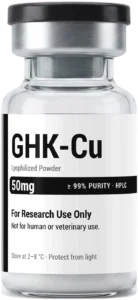
It is a relatively small peptide, but there is quite a lot of research surrounding it. Some of that work looks at skin cells and collagen-related processes, while other studies have explored wound healing, inflammation and changes in tissue structure. That range is part of what makes GHK-Cu interesting to researchers.
It is also worth separating laboratory research from the claims sometimes made about copper peptides in cosmetic or health products. Findings from cell studies or experimental models do not automatically mean the same effect will occur in people.
What is GHK-Cu?
GHK-Cu is generally described as a copper complex of the naturally occurring tripeptide GHK. GHK itself is found in the human body and has been detected in biological fluids and tissues. Research has suggested that its levels may change with age, which has led to interest in how the peptide might interact with processes involved in tissue maintenance.
The copper component is important. Copper is an essential trace element involved in several biological processes, including enzymes associated with connective tissue and antioxidant defence. GHK can bind copper, forming the complex commonly referred to as GHK-Cu.
Researchers have been more interested in the biological activity of GHK-Cu as a whole than in its role as a source of copper. This includes its interaction with cells, signalling pathways and components of the extracellular environment.
Why is GHK-Cu studied?
A large part of the interest comes from research into tissue remodelling.
The extracellular matrix provides structural support around cells and contains proteins such as collagen and elastin. Changes to this matrix are important in normal wound repair as well as ageing and tissue damage. Experimental research has investigated whether GHK-Cu can influence some of the cellular processes involved in this environment.
Skin research is particularly common. Laboratory and preclinical studies have examined fibroblasts, collagen production and other markers associated with skin structure. Some research has also looked at the peptide’s effects on inflammatory signalling and oxidative processes.
This does not make GHK-Cu a proven treatment for ageing skin or tissue injury. It simply explains why the compound continues to appear in experimental research and cosmetic science.
GHK-Cu and collagen research
Collagen is one of the main structural proteins in connective tissue, so it naturally comes up in studies involving GHK-Cu.
Fibroblasts are among the cells responsible for producing components of the extracellular matrix, including collagen. Researchers have examined how GHK-Cu interacts with these cells and whether it can alter the expression or production of particular matrix-related proteins.
Some experimental findings have been encouraging, but the details matter. Results can vary depending on the model used, the concentration of the compound and how the peptide is delivered.
A result seen in cultured cells should not be read as evidence that applying or administering GHK-Cu will produce the same result in a human body. There are several biological barriers between those two situations, including absorption, distribution, metabolism and the local environment around the target tissue.
Interest in wound and tissue repair
GHK-Cu has also been investigated in connection with wound healing. Wound repair is not a single process. It involves inflammation, cell migration, formation of new tissue, extracellular matrix production and later remodelling.
Because GHK-Cu has been studied in relation to several of these processes, researchers have explored whether it may have a role in experimental models of tissue repair.
There have been laboratory and animal studies looking at changes such as collagen deposition, cell activity and tissue organisation. These studies provide useful clues about possible biological mechanisms, but they are not the same as controlled clinical evidence in humans.
For research purposes, this distinction is important. A peptide can show an intriguing mechanism in an experimental setting without eventually becoming an established medical treatment.
GHK-Cu, inflammation and oxidative processes
Another area of interest is the relationship between GHK-Cu and inflammatory or oxidative pathways.
Inflammation is a normal part of the body’s response to injury, although excessive or prolonged inflammatory activity can contribute to tissue damage. Researchers have therefore looked at whether GHK-Cu affects certain inflammatory mediators or cellular responses.
Oxidative stress has also appeared in the wider research surrounding copper peptides. Again, findings depend heavily on the experimental model. GHK-Cu should not be treated as a general antioxidant simply because some laboratory research has examined oxidative pathways.
The more useful way to view these findings is as evidence that the peptide can interact with biological processes that may be relevant to tissue maintenance.
How GHK-Cu is used in research
GHK-Cu can appear in different forms depending on the study. Researchers may work with the peptide in cell culture experiments, biochemical investigations or animal models. The concentration, formulation, purity and method of exposure can all affect the outcome.
This distinction is one reason research-grade material needs to be considered separately from finished cosmetic products containing copper peptides. A product’s stated concentration does not, by itself, tell you how much active compound reaches a particular tissue.
For laboratory work, analytical characterisation is also important. Peptide identity, purity and the presence of related impurities can all influence experimental results.
What the research does — and does not — show
GHK-Cu has a substantial history of experimental interest, particularly in areas connected with skin biology, extracellular matrix regulation and tissue repair. There are plausible biological mechanisms behind some of the effects being investigated, and several preclinical findings have helped keep the peptide in research discussions.
At the same time, researchers should not stretch the evidence beyond what the studies actually demonstrate.
GHK-Cu is not an established treatment for ageing, wounds, hair loss or other medical conditions simply because research has investigated those areas. Evidence from cell cultures and animal studies is useful for understanding mechanisms, but human clinical evidence is needed before firm conclusions about effectiveness or safety can be made.
For those using GHK-Cu as a research compound, the context of the study matters as much as the peptide itself. Experimental design, purity, concentration, exposure time and analytical methods may affect results.
So, to summarise, GHK-Cu is best viewed as a copper binding peptide with an interesting body of laboratory and pre-clinical research behind it. Its association with collagen, extracellular matrix activity, wound healing and cellular signalling continues to make it a subject of investigation. The answers to the questions about its clinical utility depend on further evidence.
Published batch records
Every batch of GHK-Cu we have sold, each with its published Certificate of Analysis.
Research Use Only. GHK-Cu is supplied strictly for laboratory research. Nothing on this page is dosing guidance, medical advice, or a suggestion of human or veterinary use.