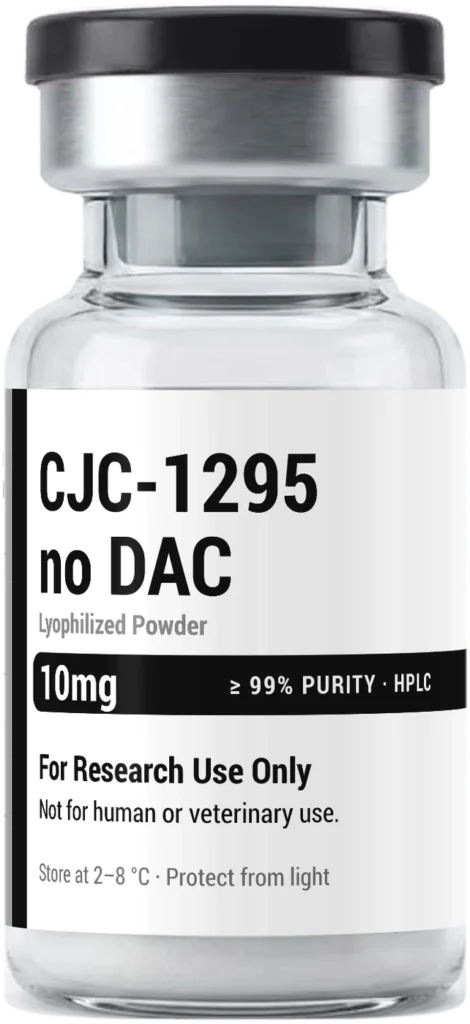
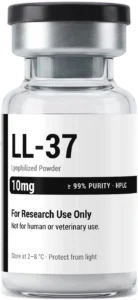
Vial label design and print may vary between batches. Product specifications remain unchanged.
At a glance
Strength
10mg per vial
Form
Lyophilised powder
Purity
≥ 99% (HPLC)
CAS number
863288-34-0
Molecular weight
3367.9 g/mol
Certificate of Analysis
Batch CND-10-08 · Prime Peptides UK
Growth hormone secretagogues
CJC-1295 No DAC
Synthetic research peptide · 10mg · CAS 863288-34-0
£34.95 In stock · ready to shipper vial · £3.50 per mg
CJC-1295 No DAC 10mg is coming soon. It goes on sale as soon as its batch certificate is published - every vial we sell has a matching CoA.
Bank transferBitcoin Encrypted checkout · card details are never taken on this site
Multi-item discount. Add any 2 items for 4% off the whole order, 7% at 3, 10% at 4. Applied automatically at checkout.
Free
Free lab add-on. Bacteriostatic water is included with every peptide order at no extra cost.
Lab essentials tap to add to this order
RUOResearch Use Only. Not for human or veterinary use. By purchasing you confirm you are a qualified researcher and accept responsibility for safe, lawful handling.
Same-day dispatch
Orders before 3:00 PM leave the same working day, tracked, in plain packaging. Free UK delivery over £200.
Secure payment
Bank transfer or Bitcoin over an encrypted checkout. No card details are stored or handled on this site.
Batch tested
Every batch is HPLC and mass spectrometry tested, and its certificate is published before it ships.
CJC-1295 No DAC 10mg≥99% HPLC · In stock
£34.95
Compound Overview
What Is CJC-1295 No DAC 10mg?
CJC-1295 No DAC 10mg is a laboratory research peptide that is purchased in a controlled amount of 10mg for scientific research. The no-DAC form is commonly linked to modified growth hormone-releasing factor (GRF) research, and is the form in which the Drug Affinity Complex found in the CJC-1295 analogue is not present. This product is not intended for medical use or for human consumption; it is for laboratory and analytical research purposes only in the UK.
CJC-1295 No DAC is an experimental synthetic peptide used in some research studies related to the growth hormone-releasing hormone (GHRH)-related signalling pathway. The name is common to research suppliers for a modified version of the GRF 1-29 type peptide which lacks a Drug Affinity Complex (DAC) with the long-acting CJC-1295.
The peptide itself is a 29 amino acid sequence that shares homology with the active N-terminal part of the human GHRH. Modifications were made to this shorter sequence to increase its stability relative to unmodified GRF fragments to enable researchers to study GHRH-receptor related activity in experimental conditions.
With this product 10mg is only the amount of research peptide material delivered. This product does not provide a recommended dose, concentration for administration, or clinical strength.
This is especially relevant because of the fact that sometimes the term “CJC-1295” is used interchangeably with “CJC-1295 with DAC” and “CJC-1295 no DAC.” To include material in a study, researchers should therefore verify the exact product identity and supporting analytical documentation.
Technical Data
CJC-1295 No DAC Product Specifications
Technical Specification Sheet
CJC-1295 NO DAC · 10MG · RUO
Product Name
CJC-1295 No DAC 10mg
Research Description
Modified GRF 1-29-type peptide
Strength
10mg research material
Peptide Length
29 amino acids
Molecular Formula
C152H252N44O42
Approx. Molecular Weight
3367.9 g/mol
Format
Laboratory research peptide
Classification
Experimental research compound
Documentation
Batch-specific Certificate of Analysis with every batch
Intended Use
Laboratory and scientific research only
Human Use
Not intended for human consumption or administration
PubChem lists the without-DAC compound with molecular formula C152H252N44O42 and a calculated molecular weight of approximately 3367.9 g/mol.
The Science
Scientific Background: Modified GRF and CJC-1295 No DAC
Growth hormone-releasing hormone is a signalling peptide, produced by the hypothalamus, that regulates the physiological release of growth hormone. The biological activity is localised in the N-terminal part of the molecule, which has prompted the study of shorter GRF fragments and modified GRF analogues.
From this broad spectrum of peptide modification, compounds related to CJC-1295 have been developed. A crucial difference has to do with the presence or absence of DAC. The native CJC-1295 is a modified version of the peptide including a reactive modification to increase its affinity for circulating albumin, which changes the peptide's pharmacokinetic properties. According to PubChem, DAC-containing CJC-1295 is a maleimido derivative of hGRF(1-29).
The product popularly known as CJC-1295 no DAC, on the other hand, doesn't have this Drug Affinity Complex. It is therefore considered an independent research type, rather than just a dose of DAC in CJC-1295 alone.
Research Context
Studies on these peptides have focused on GHRH receptor activity, endocrine signalling and the structure-function relations of peptides. The investigation should not be read as a statement that any product of CJC-1295 without DAC is proven to be a therapeutic product. It is used here in an experimental and laboratory context.
Laboratory Focus
Why Is CJC-1295 No DAC Studied in Research?
One reason CJC-1295 no DAC appears in laboratory research is its relationship to the GHRH signalling pathway. Modified GRF sequences provide experimental tools through which researchers can examine how structural changes to naturally occurring peptide fragments affect receptor interaction and biological signalling.
Receptor Signalling
Researchers may investigate receptor activation, peptide stability, molecular interactions and downstream signalling responses using controlled experimental models. Comparative work may also examine how the absence of DAC changes the properties of a GRF analogue relative to a DAC-modified compound.
Laboratory Research
This structural comparison is scientifically useful because attaching an affinity complex can substantially change how a peptide behaves. Removing that component provides a different experimental variable for studies concerned with peptide design and pharmacokinetic principles.
Interpreting Results
Evidence relating to CJC-1295 analogues should nevertheless be interpreted carefully. Findings from biochemical assays, experimental models or early human research on related molecules cannot automatically be transferred to every commercially labelled CJC-1295 research material. Compound identity, sequence, formulation and experimental conditions all matter when interpreting published findings.
Product Format
What Does the 10mg Research Format Mean?
10mg
Nominal Research Quantity
The 10mg designation identifies the amount of CJC-1295 no DAC research material contained in the product format. It should not be confused with a recommended amount for administration or a statement about therapeutic potency.
A 10mg format may be relevant to laboratories planning experimental work that requires a defined quantity of starting material. Material requirements can differ substantially according to the number of assays, analytical method, study duration, replicate requirements and the scale of an experimental programme.
For example, a laboratory conducting several analytical stages may require a different total quantity from a project focused on a limited characterisation assay. The appropriate amount is therefore determined by the study design and institutional protocol rather than by consumer-style concepts of a “stronger” or “weaker” product.
Researchers comparing CJC-1295 no DAC 10mg UK listings should consequently treat 10mg as a supply quantity, while separately evaluating identity, analytical documentation and suitability for their intended laboratory workflow.
Verification
Quality Testing, Identity and Certificate of Analysis
When the name of a product is used on the research market, confusion may occur between DAC and non-DAC forms, therefore it is particularly relevant for a CJC 1295 no DAC. This does not replace proper identity and quality information to be provided on a product label.
Batch-Specific CoA
Researchers may receive data related to the specific batch delivered from a Certificate of Analysis (COA). Depending on the analytical work executed, documentation could report the identity of the peptide, purity related results, batch information, test methodology.
HPLC Analysis
Peptide analysis is often used to assess chromatographic purity by high performance liquid chromatography (HPLC). Molecular identity and other related quality assessments can be performed with other analytical methods. Importantly, an HPLC purity result is not sufficient to prove all aspects of a peptide's identity, composition and suitability for the specific experiment.
Documentation & Transparency
Therefore, researchers who wish to use CJC-1295 without DAC should check the specific documentation for the batch, instead of relying on general marketing claims. Traceable batch info also assists the laboratories to keep proper records of procurement and experiments.
Handling
Storage and Laboratory Handling
Documentation First
Peptide research materials should be handled under controlled laboratory conditions in accordance with the supplier's documentation and the laboratory's own standard operating procedures.
Environmental Conditions
Until required for experimental work, the product should remain in its original labelled container and be protected from conditions that could compromise material integrity. Temperature, moisture, repeated environmental exposure and direct light may be relevant considerations for peptide stability.
Contamination Control
Laboratories should also use appropriate contamination-control procedures and maintain clear batch identification throughout storage and experimental handling. Where a batch-specific COA or product documentation provides particular storage requirements, those instructions should take precedence over general guidance.
Reconstitution Practice
This information relates to laboratory material management only and is not preparation or administration guidance.
UK suppliers need to consider more than just the name and amount of CJC-1295 No DAC 10mg; researchers should evaluate it. The identification of a compound is particularly important when there are peptides involved with and without DAC, because of the similar terminology.
Beneficial supplier information may encompass the actual product description, batch number, analytical documentation, whether there is COA available, and the storage instructions, along with clear research only labelling. Packaging should also be sufficient to enable the laboratory to identify and track the material correctly after receipt.
While location may help with domestic laboratory sourcing and dispatch, it is not an indicator of product quality. Documentation on the specific batch should be evaluated, and the material compared to the requirements of the experimental protocol.
The Prime Peptides UK product page is designed for research scientists and institutions in the UK, incorporating research-only compliance and batch documentation.
Analytical Records
Batch certificates for CJC-1295 No DAC
Every order ships with the CoA matched to its batch number, and the analytical records
are published here - open the certificate before you order, or cross-check the one in
your parcel.
No. The terminology can be confusing, but the defining distinction is the Drug Affinity Complex. DAC-containing CJC-1295 was designed with an affinity-based modification that changes the molecule's characteristics. CJC-1295 no DAC refers to a modified GRF-type research peptide without this component. Researchers should confirm the exact identity of any material they purchase rather than treating the names as interchangeable.
What exactly does 10mg mean on this product?
The 10mg figure describes the total quantity of peptide research material supplied. It is a product-format specification only. It should not be interpreted as a recommended dose, administration quantity or indication of clinical effectiveness. Laboratory material requirements should be determined from the experimental design and relevant research protocol.
Why does the absence of DAC matter in laboratory research?
DAC was developed to alter the behaviour of the peptide through affinity binding. A peptide without this modification represents a different experimental format. This distinction can be relevant when researchers study peptide structure, stability, receptor-related signalling or differences between modified GRF analogues.
What information should be reviewed on the COA?
Researchers should check whether the Certificate of Analysis corresponds to the batch supplied. Useful information may include product identity, batch or lot reference, analytical method, reported purity-related data and other test results. The meaning and limitations of each analytical method should also be considered rather than relying on a single headline percentage.
Is CJC-1295 No DAC 10mg approved for human use in the UK?
This product is positioned strictly as laboratory research material and should not be treated as an authorised medicine. It is not supplied for human consumption, self-administration or therapeutic use. Researchers should maintain a clear distinction between experimental peptide research and authorised medicinal products.
How should a laboratory choose between different quantities of CJC-1295 No DAC?
The quantity required is not a universal recommendation, but is dependent on the research programme. Laboratories can take into account the planning of the number of experiments and their scale, requirements for replicates, analytical procedures, and internal protocols. A ten-milligram format only means a certain amount of material for research; this does not mean that all studies should use this amount of material.
PG
Medically & Scientifically Reviewed By
Dr. Priyanka Goel
Scientific & Medical Content Reviewer
Reviews research content against current published literature and UK regulatory guidance, ensuring compound information is accurate, referenced and presented for research use only.
CJC-1295 No DAC 10mg is supplied for research use only, and is not intended for human use. Not meant for human consumption, use for self, diagnostic or therapeutic purposes. The information on this page is a product description and discussion of the research context, and should not be construed as medical or treatment advice.