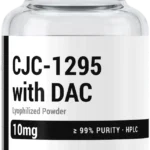
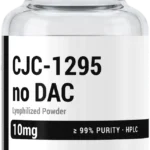
CJC-1295 DAC and CJC-1295 without DAC are often spoken about as though they are simply two versions of the same research peptide. They share a related GHRH-based structure, but the addition of the Drug Affinity Complex (DAC) changes how the compound behaves in the body.
That difference is the main reason the two names should not be treated as interchangeable.
For anyone looking at CJC-1295 research, the first thing to keep straight is the pharmacokinetic profile. CJC-1295 with DAC was specifically designed to remain in circulation for much longer by interacting with albumin. In published human research, the drug produced a prolonged rise in growth hormone (GH) and IGF-1. The no-DAC form does not contain that albumin-binding modification, so it does not have the same long-acting profile.
What does DAC actually change?
The DAC component is more than a label attached to the product name.
CJC-1295 with DAC can bind to circulating albumin, a plentiful protein in the bloodstream. This effectively provides the peptide a much longer residence time. In a randomised, placebo-controlled study involving healthy adults, researchers estimated the half-life of CJC-1295 at around 5.8 to 8.1 days. Following a single administration, average GH concentrations increased by roughly two- to ten-fold for six days or more, while IGF-1 remained elevated for around nine to eleven days.
That is a completely unique pattern from the short-lived signalling associated with GHRH-type peptides without the DAC modification.
It is also worth being careful with the terminology here. The commonly quoted multi-day half-life belongs to the DAC compound studied in those trials. It should not simply be copied onto a no-DAC research product.
CJC-1295 without DAC: where does it fit?
The no-DAC version is commonly marketed under names such as CJC-1295 no DAC or Modified GRF 1-29.
Its basic research interest comes from its relationship with GHRH. Rather than providing GH itself, it is intended to act on the GHRH pathway and stimulate the pituitary to release GH. That makes it quite different from simply administering exogenous growth hormone.
The difficulty is the evidence base.
A 2026 review of peptides affecting the GH–IGF-1 axis noted that, while CJC-1295 with DAC has human pharmacokinetic and pharmacodynamic data, the no-DAC form remains essentially uncharacterised in published human research. The review also highlights how easily information about the DAC form transfers to the no-DAC product, although the two compounds have different pharmacokinetic properties.
So when a website claims a precise half-life, specific GH increase or defined duration of action for CJC-1295 without DAC, it is worth checking where that number actually came from.
A figure measured in a DAC study is not automatically a figure for the no-DAC molecule.
A closer look at the two profiles reveals important differences.
The simplest way to understand the difference is to think about duration.
CJC-1295 with DAC was engineered for prolonged exposure. The albumin-binding component helps keep the peptide in circulation, producing sustained stimulation of the GHRH pathway. Human studies found that GH and IGF-1 remained elevated for days following administration.
CJC-1295 without DAC lacks that albumin-binding component. It is therefore discussed as a shorter-acting GHRH analogue. However, the exact human pharmacokinetic profile of this specific molecule has not been properly established in controlled clinical studies. Claims about an exact half-life should therefore be treated as estimates or extrapolations rather than established clinical measurements.
This distinction matters because pharmacokinetics affects almost everything that follows: exposure time, dosing intervals used in studies, the pattern of receptor stimulation and the way researchers interpret blood measurements.
What happened to GH and IGF-1 in the DAC studies?
The published CJC-1295 research offers valuable insights, but it is critical to put them in context.
In healthy adults aged 21 to 61, single doses of the DAC form produced dose-dependent increases in average GH and IGF-1. With repeated administration, IGF-1 remained above baseline for up to 28 days in the study period. The researchers also reported no serious adverse reactions during the trials.
Another study looked more closely at GH secretion patterns. The normal pulsatile pattern of GH secretion was preserved after CJC-1295 administration. Basal GH increased substantially, while mean GH and IGF-1 also rose. Again, this was research involving the long-acting DAC form, not the no-DAC compound.
That last point is easy to miss when reading summaries online.
Does one have more research behind it?
The research record is not evenly distributed.
The most solid direct evidence in humans is with CJC-1295 with DAC. Researchers have studied its pharmacokinetics and its effects on GH and IGF-1 in controlled studies in healthy adults.
For CJC-1295 without DAC, the published human evidence is much thinner. The 2026 review specifically identifies a lack of controlled clinical studies directly evaluating the compound in humans. As a result, claims about body composition, recovery, sleep or performance should not be presented as established clinical outcomes for the no-DAC molecule.
The conclusion is probably the most useful takeaway from the comparison: the names are similar, but the evidence should be separated.
Regulatory and research status
Neither form should be confused with an established licensed medicine in the UK.
CJC-1295 is still a research compound rather than an approved treatment for a recognised medical condition. In the US, the FDA has separately evaluated CJC-1295 and CJC-1295 DAC and noted that neither is a component of an FDA-approved drug. The agency also raised concerns about the available safety information when considering the substances for possible inclusion in the compounding framework.
For research purposes, that means source quality and compound identity matter considerably. A paper referring to CJC-1295 does not necessarily describe every material sold under the CJC-1295 name today.
The practical distinction
In simple terms, DAC is the feature that turns CJC-1295 into a long-acting compound. The published human studies demonstrate that profile clearly.
The no-DAC version belongs to the same broader GHRH analogue discussion, but its direct human evidence is far less developed. It should not inherit the DAC form’s half-life, study results or clinical claims simply because the two names are similar.
For anyone comparing the two for research purposes, checking the exact molecular form first is probably more useful than relying on the product name alone. That small detail changes how the available evidence should be read.
Research Use Only. This comparison describes published research characteristics. It is not treatment advice and does not suggest that either compound should be used by people or animals.