
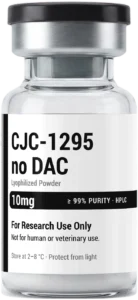
That distinction matters when looking at CJC-1295. A lot of information found online focuses on areas such as muscle growth, fat loss, recovery or anti-ageing. These are common subjects of discussion, but they should not be confused with outcomes that have been properly established in human clinical research.
What is CJC-1295?
CJC-1295 is an analogue based on human GHRH, developed to have a longer half-life. It is a compound designed to bind to albumin in circulation, thereby extending its residence in the body. In initial laboratory experiments, CJC-1295 was shown to be a stable and biologically active GHRH analogue with a substantially longer plasma half-life than native GHRH fragments.
The main interest of research is how it interacts with the existing GH system of the body. Rather than actually giving growth hormone, CJC-1295 works by stimulating the GHRH pathway, causing the pituitary gland to release more of the body’s own GH.
That’s unlike recombinant human growth hormone, which supplies the hormone itself. It also suggests that responses may be dependent on the function of the underlying GH axis.
Why researchers became interested in it
One of the obvious limitations of natural GHRH is its short duration of action. CJC-1295 was developed partly to address that problem.
A 2006 study in healthy adults examined the pharmacokinetic and pharmacodynamic effects of CJC-1295. Researchers reported an estimated half-life of roughly 5.8 to 8.1 days. Following a single subcutaneous dose, mean GH concentrations increased by around two- to ten-fold for six days or more, while IGF-1 concentrations increased by approximately 1.5- to three-fold for nine to 11 days. With repeated dosing, IGF-1 remained above baseline for considerably longer.
Those findings help explain why CJC-1295 continues to appear in peptide research. Its activity is not simply about producing a brief GH response. The compound was investigated for its ability to influence the GH/IGF-1 axis over an extended period.
Effects on growth hormone signalling
Another human study looked more closely at how CJC-1295 affected the natural pattern of GH secretion.
The researchers found that GH secretion remained pulsatile following administration. The frequency and size of the GH pulses did not change significantly, but baseline or trough GH levels increased substantially. One week after administration, mean GH levels increased about 46%, and IGF-1 increased about 45% in the study group.
This is an interesting part of the research because GH is not normally released at one constant rate throughout the day. It is secreted in pulses, and those patterns are influenced by several physiological factors.
CJC-1295 therefore provides a useful research model for examining what happens when GHRH stimulation is extended without completely removing the body’s normal pulsatile GH secretion.
CJC-1295 and IGF-1
IGF-1 is an important part of the GH signalling pathway. Much of the biological activity associated with GH involves downstream effects mediated through IGF-1, particularly in tissues such as muscle, bone and connective tissue.
The human CJC-1295 studies provide clear evidence that the compound can increase circulating IGF-1 in healthy adults. The first clinical investigation reported increases lasting for days after a single administration, with repeated administration producing a longer-lasting elevation.
However, increased IGF-1 on a blood test is not the same thing as proving a particular clinical benefit. This situation is where some online descriptions of CJC-1295 go further than the available evidence.
Claims about improved body composition, faster recovery, increased athletic performance or noticeable anti-ageing effects require their own clinical evidence. The early CJC-1295 trials were primarily concerned with pharmacokinetics, hormone responses and tolerability, rather than establishing these outcomes.
CJC-1295 without DAC
The term “CJC-1295 without DAC” is also commonly used in peptide discussions. DAC refers to the drug affinity complex associated with the longer-acting form.
This distinction is important because evidence for the long-acting CJC-1295 studied in humans should not automatically be transferred to every product marketed under the CJC-1295 name.
Recent reviews of the literature have noted that CJC-1295 without DAC is much less well characterised in peer-reviewed human research. Direct controlled clinical evidence for this version is limited, meaning that claims about its effects should be treated separately from the published studies of long-acting CJC-1295.
For research purposes, checking the exact compound being studied is therefore more useful than relying on the general name alone.
What the human research actually tells us
The strongest human evidence for CJC-1295 comes from relatively early studies involving healthy adults. These studies indicate that the compound can produce prolonged increases in GH and IGF-1 and that GH secretion can remain pulsatile following administration.
The studies were not designed to establish CJC-1295 as a general-purpose treatment for improving physique, athletic performance or longevity.
There is also a difference between showing a biological effect and demonstrating a useful clinical outcome. That gap is worth keeping in mind when reviewing peptide research, particularly where much of the discussion comes from non-clinical sources.
Safety and research considerations
The early controlled study did not report serious adverse reactions in the tested participants and described CJC-1295 as generally well tolerated within the doses investigated. It also reported evidence of a cumulative effect following repeated administration.
That does not provide a complete picture of long-term safety. Limited human research exists, and extended exposure to changes in the GH/IGF-1 system raises questions that short-duration studies alone cannot answer.
For researchers, this is one reason CJC-1295 is better viewed as an investigational compound rather than something with a fully established clinical profile.
Current research perspective
CJC-1295 remains of interest because it demonstrates how modifying a GHRH analogue can substantially extend its activity in the body. The published human work provides useful information on pharmacokinetics, GH secretion and IGF-1 responses, particularly in healthy adults.
What remains less certain is how these hormonal changes translate into meaningful long-term outcomes in different populations.
For anyone reviewing CJC-1295 research, the most useful approach is to separate the established findings — prolonged GH and IGF-1 elevation — from claims that are still based on limited, indirect or non-human evidence. That distinction provides a clearer picture of where CJC-1295 fits within peptide and endocrine research.
Published batch records
Every batch of CJC-1295 No DAC we have sold, each with its published Certificate of Analysis.
| Batch | Size | Purity (HPLC) | Tested | Certificate |
|---|---|---|---|---|
| CND-10-08 Current stock | 10mg | ≥99.0% | Oct 2026 | View CoA |
Research Use Only. CJC-1295 No DAC is supplied strictly for laboratory research. Nothing on this page is dosing guidance, medical advice, or a suggestion of human or veterinary use.