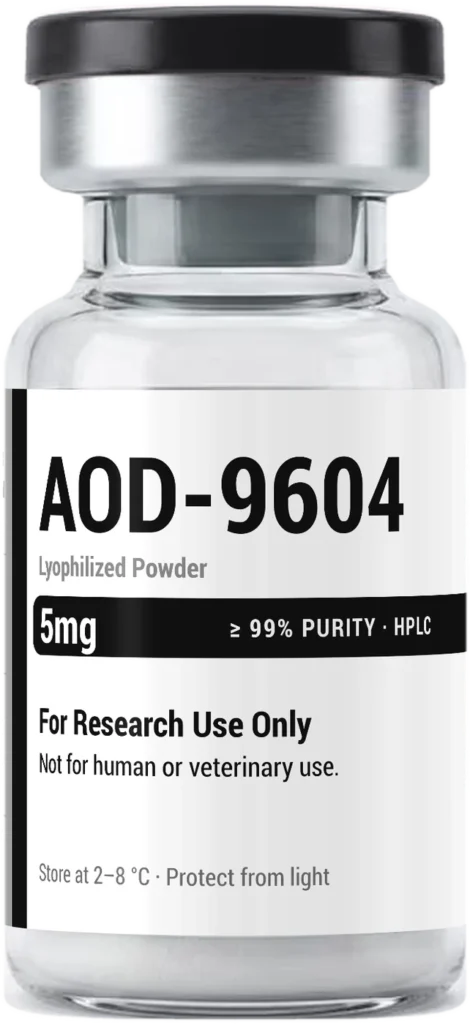
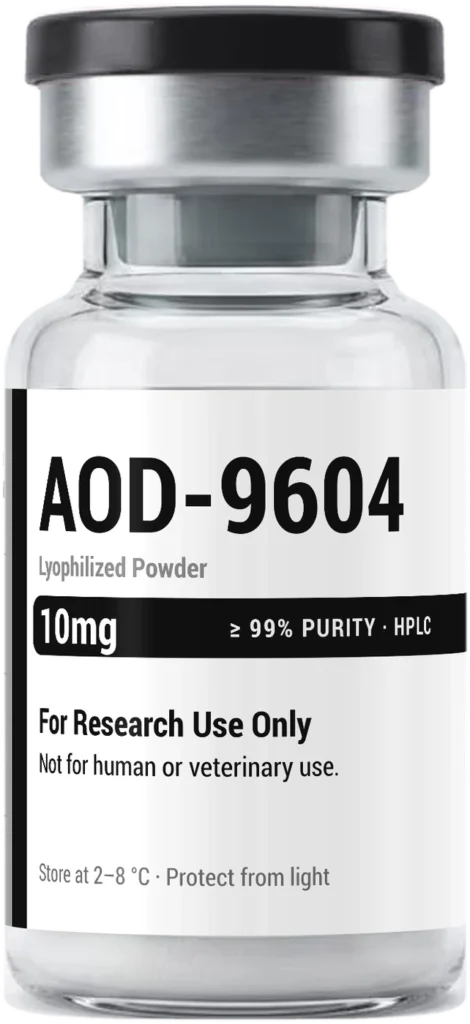
Vial label design and print may vary between batches. Product specifications remain unchanged.
At a glance
Strength
10mg per vial
Form
Lyophilised powder
Purity
≥ 99% (HPLC)
CAS number
221231-10-3
Molecular weight
1815.1 g/mol
Certificate of Analysis
Batch AD-10-01 · Prime Peptides UK
Metabolic
AOD-9604
Synthetic research peptide · 10mg · CAS 221231-10-3
£39.95 In stock · ready to shipper vial · £4.00 per mg
Choose strengthPrice per vial
AOD-9604 10mg is coming soon. It goes on sale as soon as its batch certificate is published - every vial we sell has a matching CoA.
Bank transferBitcoin Encrypted checkout · card details are never taken on this site
Multi-item discount. Add any 2 items for 4% off the whole order, 7% at 3, 10% at 4. Applied automatically at checkout.
Free
Free lab add-on. Bacteriostatic water is included with every peptide order at no extra cost.
Lab essentials tap to add to this order
RUOResearch Use Only. Not for human or veterinary use. By purchasing you confirm you are a qualified researcher and accept responsibility for safe, lawful handling.
Same-day dispatch
Orders before 3:00 PM leave the same working day, tracked, in plain packaging. Free UK delivery over £200.
Secure payment
Bank transfer or Bitcoin over an encrypted checkout. No card details are stored or handled on this site.
Batch tested
Every batch is HPLC and mass spectrometry tested, and its certificate is published before it ships.
AOD-9604 10mg≥99% HPLC · In stock
£39.95
Compound Overview
What Is AOD-9604 5mg?
AOD-9604 5mg is a research peptide format provided for laboratory and scientific research and for controlled use. AOD-9604 is a synthetic peptide linked to the C-terminal region of human growth hormone and has been studied experimentally, notably in the field of lipid metabolism and the pathways of adipose tissue. There are published animal and laboratory studies and historically, there has been a study of its potential clinical use.
The 5 mg designation refers to the amount of research material supplied, not to a recommended human dose. This product is designed specifically for research applications in properly supervised laboratories.
Sizes & Prices
AOD-9604 sizes and prices
Each size is supplied from its own tested batch with its own Certificate of Analysis. The size is the amount of research material in the vial; larger vials cost less per mg.
Size
Price
Per mg
Batch certificate
Choose
5mg
£24.95
£4.99
AD-05-01
10mg
£39.95
£4.00
AD-10-01
Technical Data
AOD-9604 Product Specifications
Technical Specification Sheet
AOD-9604 · RUO
Product
AOD-9604 5mg
Compound
AOD-9604
Research quantity
5mg
Compound type
Synthetic research peptide
Molecular formula
C78H123N23O23S2
Approximate molecular weight
1815.1 g/mol
Research classification
Investigational laboratory compound
Testing
Refer to the relevant batch documentation
Certificate of Analysis
Batch-specific Certificate of Analysis with every batch
Intended use
Laboratory and scientific research only
Human use
Not intended for human consumption or self-administration
Researchers should always check the label, batch documentation and supplier specifications for the exact physical presentation, testing status and storage conditions of the material received.
The Science
A Closer Look at AOD-9604 5 mg
AOD-9604 is a synthetic peptide developed from research into a region of human growth hormone associated with metabolic activity. Scientific publications commonly describe it as an analogue of the lipolytic domain of human growth hormone. Early experimental work investigated whether this smaller peptide fragment could influence lipid metabolism without reproducing every biological action associated with intact growth hormone.
PubChem lists AOD-9604 under CID 71300630 and reports a molecular formula of C78H123N23O23S2 with a computed molecular weight of approximately 1815.1 g/mol.
For laboratory buyers, AOD-9604 5mg refers specifically to a product containing 5 milligrams of research material. The strength identifies the supplied quantity rather than an indication of therapeutic potency, effectiveness or recommended use.
Researchers may select particular material quantities according to study design, analytical requirements, assay number and available laboratory protocols. Any experimental work should follow institutional procedures and appropriate scientific controls.
AOD-9604 was discovered during studies of the active parts of a human growth hormone molecule rather than studying the whole molecule. Experimental studies around the early 2000s characterised AOD-9604 in obese animal models and examined its association with adipose-tissue metabolism.
Experimental exposure to AOD-9604 has been reported to induce changes in weight gain and lipolytic activity in obese Zucker rats. An additional study was performed in obese mice that compared body-weight, body-fat and beta-adrenergic pathways. The results are of historical importance, but were obtained mainly in animal models and should not be reported as proven results in humans.
AOD-9604 was subsequently investigated in obesity-related development programmes. The compound subsequently entered a Phase IIa clinical trial, according to a 2004 publication.
The compound is thus not only a product of purely theoretical peptide chemistry, but also has a research history. However, there are two types of evidence – preclinical evidence, developmental evidence, and approved medical treatment – which are fundamentally different.
Laboratory Focus
Why AOD-9604 Appears in Metabolic Research
Much of the scientific interest regarding AOD-9604 is associated with lipid metabolism.
Metabolic Research
The biological mechanism by which fat, stored in the adipose tissue, is decomposed into free fatty acids and glycerol, is called "lipolysis". It is not controlled by a single pathway, but is regulated by a number of hormonal, neural and cellular signalling mechanisms.
Tissue Repair Models
AOD-9604 has been studied in preclinical studies for its effects on lipolytic activity, fat oxidation and adipose-tissue signalling. The experiments in obese mice indicated interactions with beta-adrenergic pathways and those in rats investigated metabolic responses in adipose tissue.
Receptor Signalling
This prompted the adoption of AOD-9604 in experimental discussions involving metabolism, peptide signalling and adipocyte biology, which explains the continued presence of this compound in these.
Preclinical Models
They fail to, however, rule out weight loss or metabolic benefits from the use of AOD-9604 in humans. Experimental model, methodology, age of the study and the difference between mechanistic results and clinically proven ones should be taken into account when researchers are evaluating literature.
Product Format
What the 5 mg Research Format Means
10mg
Nominal Research Quantity
The 5mg AOD-9604 format identifies the total nominal quantity of peptide research material associated with the product.
From a laboratory perspective, this distinction can matter because research requirements vary substantially between experiments. A small analytical project may have different material requirements from a multi-stage investigation involving repeated assays, comparison groups or several analytical techniques.
Consequently, the existence of different product quantities should primarily be understood as a laboratory procurement consideration. Researchers may assess the amount required according to factors including experimental design, number of analytical runs, sample preparation requirements, validation work and study scale.
The 5mg quantity should never be converted on a commercial product page into instructions for human or animal administration.
It also does not mean that a 5mg format is inherently better, weaker, safer or more suitable than another research quantity. Suitability depends on the legitimate laboratory protocol being followed.
Verification
Analytical Testing, Purity and Certificate of Analysis
Research compounds should be accompanied by enough documentation to allow laboratories to evaluate product identity and batch traceability.
Batch-Specific CoA
When assessing AOD-9604 5 mg UK research material, researchers should consider whether the supplier provides a clearly identifiable batch number and a corresponding Certificate of Analysis. Depending on the analytical programme used, documentation may include purity assessment, chromatographic data or other identity-related testing.
HPLC Analysis
High-performance liquid chromatography, commonly abbreviated HPLC, is frequently used in peptide analysis because it can separate components within a sample and assist with purity assessment. However, a purity figure alone does not provide every aspect of compound identity.
Identity vs Purity
Researchers should therefore review the actual analytical documentation rather than relying solely on marketing terminology such as “high purity”.
Any testing claim on a product page should correspond to testing actually completed for the relevant batch. A batch-specific COA provides greater traceability than generic documentation unrelated to the material being supplied.
Handling
Storage and Laboratory Handling
Laboratory Research
Correct storage is important for maintaining the integrity of peptide research material.
Environmental Conditions
AOD-9604 should be kept in its original labelled container until needed for proper laboratory use, exposure to excessive heat, moisture, direct light and contamination should be minimised as described in the documentation supplied with the product.
Labelling & Traceability
As many peptide storage recommendations can vary depending on the actual physical form and formulation, it is important for researchers to use the storage conditions indicated on the product label, Certificate of Analysis or supplier's accompanying information, and not a universal peptide storage assumption.
Laboratory Research
Handling in the laboratory should be done under suitable standard operating procedures, using clean equipment, with samples correctly identified and batch controlled. This is not preparation or administration advice, but rather it is guidance for preservation and management of research material.
Researchers evaluating AOD-9604 5 mg in the UK supplier should look beyond the product name alone.
Important considerations include clear identification of the compound, accurate strength labelling, batch traceability, access to analytical documentation, appropriate packaging and transparent research-use positioning. A supplier should also avoid presenting experimental findings as proven medical outcomes.
Researchers searching to purchase AOD-9604 5mg in the UK for legitimate laboratory purposes should therefore assess the supporting documentation associated with the exact batch rather than making a decision solely on price or promotional claims.
The UK regulatory distinction between a research compound and a medicine is also important. MHRA guidance states that unlicensed medicines do not hold a UK marketing authorisation and may not have undergone MHRA assessment. Research-labelled material should not be represented as an authorised medicine merely because scientific studies exist.
Analytical Records
Batch certificates for AOD-9604
Every order ships with the CoA matched to its batch number, and the analytical records
are published here - open the certificate before you order, or cross-check the one in
your parcel.
AOD-9604 identifies the research compound, while 5 mg describes the nominal quantity of material supplied and it does not represent a recommended dose, treatment schedule or level of effectiveness. The quantity is relevant primarily to laboratory procurement and experimental planning.
What is AOD-9604 derived from scientifically?
AOD-9604 is described in scientific literature as a synthetic analogue associated with the C-terminal lipolytic region of human growth hormone. Early studies examined whether this region could influence metabolic pathways independently of some broader actions of intact growth hormone.
Has AOD-9604 been investigated in scientific studies?
Yes. Different published research includes animal studies examining adipose-tissue metabolism, lipolysis, fat oxidation and related pathways. The compound also entered clinical development historically, with a Phase II investigation reported by 2004. These facts do not establish an approved therapeutic application.
Is AOD-9604 5 mg intended for human use?
No. The AOD-9604 5 mg product described here is supplied strictly as Research Use Only material. It is not intended for human consumption, self-administration, diagnosis or treatment.
What information should appear on an AOD-9604 COA?
Researchers should look for information that links the documentation to the supplied batch, such as compound identification, batch or lot details, analytical method information and reported test results. Documentation should be reviewed in context rather than treating a single purity percentage as complete product verification.
Is AOD-9604 an MHRA-approved medicine?
AOD-9604 should not be presented on a UK research-peptide page as an MHRA authorised medicine. The guidance from MHRA differentiates licensed medicines which have been assessed for UK marketing authorisation from unlicensed medicines where the product may not have been assessed by the MHRA. Prime Peptides UK therefore states that AOD-9604 5mg is for laboratory research purposes only.
PG
Medically & Scientifically Reviewed By
Dr. Priyanka Goel
Scientific & Medical Content Reviewer
Reviews research content against current published literature and UK regulatory guidance, ensuring compound information is accurate, referenced and presented for research use only.
AOD-9604 5mg is distributed exclusively for proper laboratory, analytical and scientific research. It is not intended for human consumption, including eating, drinking, self-administration, diagnostic use, or therapeutic use. The experimental and preclinical results referred to on this page cannot be interpreted as proven human health benefits or medical advice. Researchers have a responsibility to ensure handling and investigation are in accordance with institutional procedures and all UK requirements.