
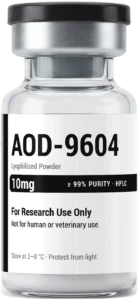
That distinction is important when looking at AOD-9604 research. The peptide has been investigated in laboratory models and in human studies, but the evidence does not support treating it as an established weight-management therapy. Much of the interest around AOD-9604 comes from earlier experimental findings, while later clinical research produced a less convincing picture.
What is AOD-9604?
AOD-9604 is a synthetic analogue based on the lipolytic region of human growth hormone. Rather than being the complete growth hormone molecule, it represents a smaller peptide sequence studied for its possible metabolic activity.
Researchers initially became interested in the compound because animal experiments suggested that it could affect fat breakdown. In one early study, AOD-9604 was administered to obese Zucker rats. The researchers reported reduced body-weight gain and increased lipolytic activity in adipose tissue. They also reported no adverse effect on insulin sensitivity under the conditions of that experiment.
Further work in obese mice examined possible links with beta-adrenergic pathways. AOD-9604 was associated with changes in body weight, body fat and expression of beta-3 adrenergic receptors in those models. These findings helped establish the biological questions that later research attempted to explore.
Animal findings, however, are not the same thing as evidence of effectiveness in people.
Why researchers became interested in it
The original research question was fairly specific: could a fragment of growth hormone influence fat metabolism without reproducing the full range of effects associated with growth hormone itself?
This led to studies looking at lipolysis, adipose tissue and metabolic responses. The idea was not simply about reducing body weight. Researchers were also interested in how the peptide might interact with pathways involved in fat mobilisation.
A 2004 review described AOD-9604 as a potential treatment for obesity and discussed its development alongside other experimental approaches to weight management.
For research purposes, this background matters because it explains why AOD-9604 continues to appear in discussions around peptide science. Its history is rooted in a genuine experimental programme rather than being a compound created solely for the current peptide market.
What happened in human research?
The human evidence complicates the overall understanding of AOD-9604’s effects.
AOD-9604 progressed into clinical investigation for obesity, including studies involving oral and intravenous administration. However, the results did not establish a meaningful weight-loss benefit compared with placebo.
The US Food and Drug Administration’s review of available information found that most identified studies did not demonstrate a weight-reduction benefit over placebo. One particularly important study enrolled 536 people with obesity. According to the FDA review, the study did not find a significant difference in weight loss after 12 weeks, which was the primary endpoint. Development for obesity was subsequently terminated.
That result puts some of the earlier animal findings into perspective. A compound can produce intriguing metabolic effects in rodents and still fail to produce the same practical outcome in a controlled human trial.
AOD-9604 and fat metabolism
The proposed relationship between AOD-9604 and fat metabolism remains one of the main reasons the peptide is studied.
Early laboratory experiments suggested increased lipolytic activity, meaning an increase in the breakdown of stored fat under the experimental conditions used. Research in mice also suggested the involvement of beta-adrenergic signalling.
It would be a mistake, though, to turn these findings into a simple statement that AOD-9604 causes fat loss in humans. Laboratory mechanisms provide useful clues, but they do not establish clinical effectiveness.
This is one area where research terminology matters. “Investigated for effects on lipolysis” is supported by the experimental literature. “Proven fat-burning treatment” is not.
Safety and research limitations
Safety is another area requiring caution. The available human evidence is limited, and the route of administration, formulation and study design can all affect how a peptide behaves.
In its assessment of AOD-9604 as a substance considered for compounding, the FDA noted limited safety information and raised concerns relating to potential immunogenicity, peptide-related impurities and difficulties with active pharmaceutical ingredient characterisation. The agency also noted reports of serious adverse events potentially associated with AOD-9604, while stating that causality was unclear.
This does not mean that every exposure to AOD-9604 will produce an adverse event. It does mean that there is not enough high-quality evidence to make broad safety assurances.
For laboratory research, peptide identity, purity, formulation and analytical characterisation therefore remain important considerations.
Where AOD-9604 sits in peptide research
AOD-9604 is best understood as an experimental peptide with a history of investigation in metabolic and obesity research.
Its development is interesting because the original concept was quite targeted: researchers wanted to investigate whether a fragment associated with the lipolytic region of growth hormone could influence fat metabolism without simply reproducing the effects of full-length growth hormone.
The early animal findings were promising enough to support further development, but the later human evidence did not establish the expected weight-loss effect. The FDA’s review therefore provides an important counterweight to claims that present AOD-9604 as a proven obesity treatment.
For researchers, that makes AOD-9604 useful as a case study in the progression from preclinical peptide research to human investigation. It illustrates why mechanistic findings, animal studies and clinical outcomes need to be considered separately.
The research picture today
AOD-9604 remains scientifically interesting, but its evidence base should be described accurately.
There is published research supporting investigation of its effects on adipose tissue and lipid metabolism, particularly from animal models. Human development for obesity, however, did not produce convincing evidence of clinically meaningful weight reduction, and development in that indication was discontinued.
For anyone reviewing AOD-9604 literature, the key point is simple: research interest does not equal established clinical efficacy.
The peptide’s history provides a useful example of why preclinical findings need to be tested carefully in controlled human studies. AOD-9604 moved from laboratory research into clinical development, but the clinical results did not confirm the weight-loss expectations generated by the earlier experimental work.
That distinction should remain central when assessing the current research profile of AOD-9604.
Published batch records
Every batch of AOD-9604 we have sold, each with its published Certificate of Analysis.
Research Use Only. AOD-9604 is supplied strictly for laboratory research. Nothing on this page is dosing guidance, medical advice, or a suggestion of human or veterinary use.