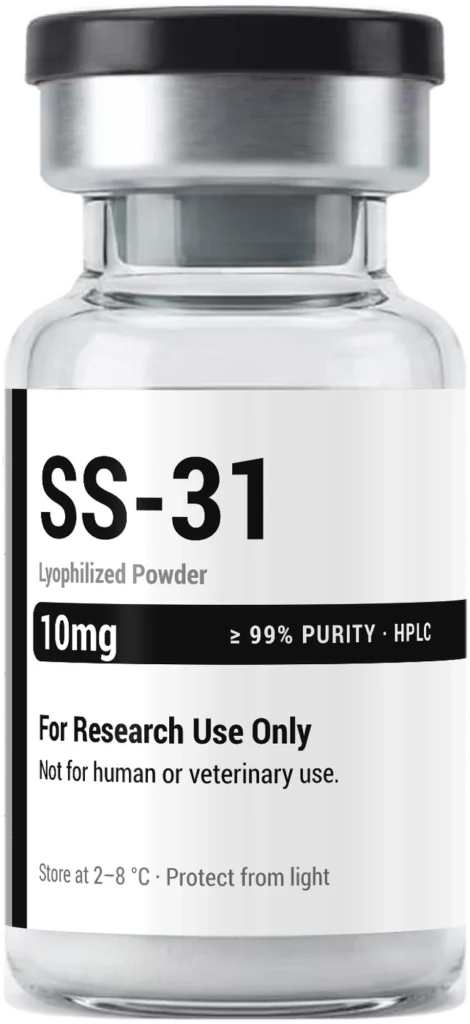
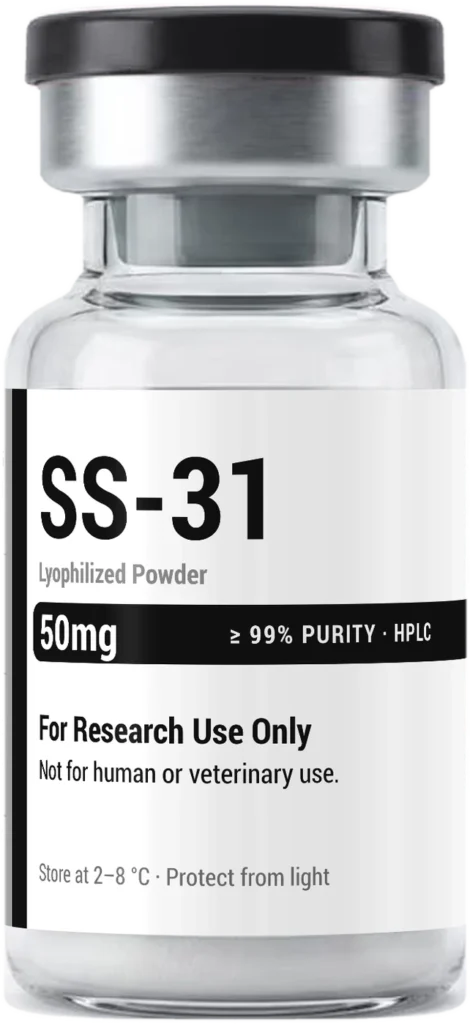
Vial label design and print may vary between batches. Product specifications remain unchanged.
At a glance
Strength
10mg per vial
Form
Lyophilised powder
Purity
≥ 99% (HPLC)
CAS number
736992-21-5
Molecular weight
639.8 g/mol
Certificate of Analysis
Batch SS-10-29 · Prime Peptides UK
Cellular & mitochondrial
SS-31
Synthetic research peptide · 10mg · CAS 736992-21-5
£39.95 In stock · ready to shipper vial · £4.00 per mg
Choose strengthPrice per vial
SS-31 10mg is coming soon. It goes on sale as soon as its batch certificate is published - every vial we sell has a matching CoA.
Bank transferBitcoin Encrypted checkout · card details are never taken on this site
Multi-item discount. Add any 2 items for 4% off the whole order, 7% at 3, 10% at 4. Applied automatically at checkout.
Free
Free lab add-on. Bacteriostatic water is included with every peptide order at no extra cost.
Lab essentials tap to add to this order
RUOResearch Use Only. Not for human or veterinary use. By purchasing you confirm you are a qualified researcher and accept responsibility for safe, lawful handling.
Same-day dispatch
Orders before 3:00 PM leave the same working day, tracked, in plain packaging. Free UK delivery over £200.
Secure payment
Bank transfer or Bitcoin over an encrypted checkout. No card details are stored or handled on this site.
Batch tested
Every batch is HPLC and mass spectrometry tested, and its certificate is published before it ships.
SS-31 10mg≥99% HPLC · In stock
£39.95
Compound Overview
What Is SS-31 10mg?
SS-31 10mg (Elamipretide) is a study dosage of the mitochondria-targeting tetrapeptide. It has been investigated because of its interaction with mitochondrial membranes, especially the phospholipid cardiolipin, and its use in experimental studies dealing with mitochondrial structure, bioenergetics and oxidative processes. The 10mg size form is the control unit, as it is the stated amount of research material provided for controlled investigation in the laboratory. SS-31 10mg is for scientific or analytical research purposes only, and is not provided for personal or therapeutic use.
In scientific literature SS-31 is called elamipretide and is a synthetic tetrapeptide. It has also been observed under research names such as MTP-131. Unlike some peptides studied mainly for their extracellular receptor signalling, SS-31 has been studied due to its mitochondrial association and specificity for the inner mitochondrial membrane.
Cardiolipin is a special phospholipid that is highly enriched in the inner mitochondrial membrane and is an important subject of research in SS-31. Cardiolipin participates in the organization of membranes and in the function of membrane proteins associated to cellular energy activities. As a result, experimental studies have looked at the potential that interactions between SS-31 and cardiolipin influence mitochondrial shape and function.
The 10mg designation is only for the amount of SS-31 research material provided in product format. It is not a recommended dose, concentration or indication of therapeutic potency. This format is designed for laboratories with a specific number of materials needed for experiments that have been suitably designed.
Sizes & Prices
SS-31 sizes and prices
Each size is supplied from its own tested batch with its own Certificate of Analysis. The size is the amount of research material in the vial; larger vials cost less per mg.
Size
Price
Per mg
Batch certificate
Choose
10mg
£39.95
£4.00
SS-10-29
50mg
£69.95
£1.40
SS-50-29
Technical Data
SS-31 Product Specifications
Technical Specification Sheet
SS-31 · RUO
Product Name
SS-31
Common Research Name
Elamipretide
Alternative Identifier
MTP-131
Compound Type
Synthetic mitochondria-targeting tetrapeptide
Strength
10mg, 50mg per vial
Research Focus
Mitochondrial biology and bioenergetics
Product Format
Laboratory research material
Documentation
Batch-specific Certificate of Analysis with every batch
Intended Use
Laboratory and scientific research only
Human Use
Not intended for human consumption or self-administration
CAS Number
736992-21-5
Amino-Acid Sequence
D-Arg-Dmt-Lys-Phe-NH2
Molecular Formula
C32H49N9O5
Molecular Weight
639.8 g/mol
Purity
≥99% by HPLC
Researchers should consult the documentation supplied with the specific batch for analytical results, storage requirements and other product-specific information rather than assuming specifications from general SS-31 literature.
Laboratory Focus
Why SS-31 Is Studied in Mitochondrial Research
Mitochondria do more than just produce energy. They are involved in cell metabolism, redox signalling and various processes that regulate cell function. Therefore, compounds that can interact with the mitochondria have emerged as an experimental field.
Mitochondrial Function
The characteristic of SS-31 is that the peptide has been found to be linked to cardiolipin in the inner mitochondrial membrane. Cardiolipin is involved in the organisation of cristae in the mitochondria and assists proteins associated with oxidative phosphorylation. Laboratory studies have therefore been investigated in models to study mitochondrial membrane organisation, electron transport, ATP related processes and oxidative stress.
Cellular Studies
In the context of this research, cellular studies and animal models have been used, as well as clinical research on elamipretide. The conclusions that can be drawn from one experiment, however, cannot just be transferred to another experiment. Findings from individual cells or preclinical models should not be reported as human findings.
Laboratory Research
The use of SS-31 should therefore be viewed as a compound currently in the process of investigation, and not as a compound with a proven therapeutic effectiveness.
Metabolic Research
One reason SS-31 attracts laboratory interest is that mitochondrial function intersects with many areas of biology. Researchers have used the compound to explore what happens when mitochondrial membranes, energy production or oxidative processes are altered under experimental conditions. A prominent area involves mitochondrial bioenergetics. Investigators may examine variables associated with electron transport, membrane function, oxygen consumption or ATP production. Other experimental work has considered oxidative processes and the relationship between mitochondrial organisation and reactive oxygen species. Cardiolipin biology provides another important research direction. Because this phospholipid is closely associated with mitochondrial membrane architecture, compounds that interact with cardiolipin can provide useful tools for investigating membrane-associated mechanisms and cristae organisation.
Interpreting Results
SS-31 has also appeared in research concerning mitochondrial dysfunction across different experimental disease models. Such studies help researchers formulate and test mechanistic hypotheses. They should not, however, be interpreted as demonstrating that research-grade SS-31 treats those conditions. Experimental findings and established clinical evidence remain separate categories of evidence.
Product Format
What Does the 10mg Format Mean for Laboratory Work?
10mg
Nominal Research Quantity
For SS-31 10mg in the UK searches, the strength needs to be understood as a product specification rather than a biological recommendation. A vial labelled 10mg identifies the total nominal quantity of research material supplied.
Laboratory material requirements differ substantially between projects. An analytical team conducting compound identification may have different requirements from researchers running several controlled assays. Likewise, study scale, number of experimental groups, replication strategy, analytical methodology and laboratory protocols can all influence the quantity of material required for a project.
A 10mg research format therefore provides a clearly defined material quantity that laboratories can incorporate into their own experimental planning and inventory systems. Researchers remain responsible for determining whether that quantity is appropriate for their protocol.
The 10mg label must not be interpreted as an administration instruction. Prime Peptides UK does not provide human dosing, cycling or self-administration guidance for SS-31 research material.
Verification
Identity, Purity Testing and Batch Documentation
The analytical documentation is especially vital when purchasing experimental peptides since it is not enough to have a product name to ensure identity and quality. Researchers should be able to relate the material received with the appropriate batch and supporting analytical data.
Batch-Specific CoA
Peptide analysis often uses high-performance liquid chromatography (HPLC) to evaluate the chromatographic purity. For identity or compositional assessment other analytical techniques could be used depending on the compound and testing programme. Researchers should review the Certificate of Analysis to understand how the results were obtained, rather than making assumptions.
Documentation & Transparency
A satisfactory COA for a batch of products should clearly indicate the batch and product and provide analytical results specific to that batch. Batch numbers also provide for traceability between physical research material and documentation.
Batch-Specific CoA
When a product is described as SS-31, it does not automatically mean that it is 31% pure. For the evaluation of SS-31 10mg, researchers should use the results obtained from the batch of SS-31 10mg being supplied and keep appropriate documentation in line with their lab quality procedures.
Handling
Storage and Laboratory Handling of SS-31
Labelling & Traceability
Research peptides must be handled in such a way that the integrity of the samples is maintained throughout storage and experimental use. SS-31 10mg should be kept in the original labeled package until needed for use and the batch identity and any accompanying documents should be kept for traceability.
Environmental Conditions
Temperature, moisture and light can influence the stability of laboratory materials. Researchers should therefore follow the storage conditions stated on the product label, supplier documentation or applicable Certificate of Analysis rather than applying a universal peptide-storage rule.
Contamination Control
Laboratories should also use appropriate contamination-control practices and established standard operating procedures when handling experimental materials. Any preparation required for a particular analytical method should be determined by the laboratory protocol and not by instructions intended for personal administration.
When evaluating an SS-31 10mg UK supplier, don't rely on the name of the product or the number of vials. Research materials that are clearly identified and have a batch traceability system with easy to access analytical documentation can be easier to use for controlled laboratory work.
Ensure that the supplier consistently lists the compound as SS-31/elamipretide, and specifies the amount of compound clearly and that they are able to provide information about testing made available for a specific batch. Packaging and storage information should also be easy to comprehend to aid laboratory inventory and sample management.
While the above information can be misleading for some suppliers, the key for researchers in the UK is to prioritise supplier transparency over claims of promotion. Statements of purity or testing are most helpful if they can be verified by actual analytical documentation.
SS-31 10mg made available by Prime Peptides UK is intended solely for research purposes and not to be used as a medicinal product.
Analytical Records
Batch certificates for SS-31
Every order ships with the CoA matched to its batch number, and the analytical records
are published here - open the certificate before you order, or cross-check the one in
your parcel.
SS-31 is a research name commonly associated with elamipretide. The compound has also appeared in scientific literature under identifiers including MTP-131. Researchers should nevertheless confirm the identity stated on the product documentation and relevant analytical records for the particular material they receive.
What exactly does 10mg mean on an SS-31 product?
The 10mg figure states the nominal quantity of SS-31 research material supplied in the product format. It does not describe a human dose, recommended experimental concentration or expected biological effect. Individual laboratories must establish their own experimental requirements according to validated protocols and study design.
Why is cardiolipin relevant to SS-31 research?
Cardiolipin is a specialised phospholipid found predominantly in the inner mitochondrial membrane and is important to mitochondrial membrane organisation. SS-31 research has focused partly on interactions involving cardiolipin, making mitochondrial membrane biology and associated bioenergetic processes significant areas of scientific investigation.
What evidence should I check when evaluating SS-31 10mg?
Start with product identity, batch number and the Certificate of Analysis supplied for the relevant batch. Review which analytical methods were actually performed and what results were reported. Researchers should distinguish documented batch results from broad marketing statements about peptide quality.
Is SS-31 10mg a medicine in the UK?
This SS-31 10mg product is sold strictly as laboratory research material and should not be treated as a medicine. Elamipretide itself has been subject to pharmaceutical and clinical development, including UK regulatory activity, but research-product status must not be confused with a marketing authorisation for a medicinal product.
Can SS-31 10mg be used for self-experimentation?
No. Prime Peptides UK just promotes SS-31 10mg for research and laboratories. Not for self-experimentation, human consumption, human injection, diagnosis or therapeutic use. This page thus does not contain dosing, administration, cycling or individual preparation instructions.
PG
Medically & Scientifically Reviewed By
Dr. Priyanka Goel
Scientific & Medical Content Reviewer
Reviews research content against current published literature and UK regulatory guidance, ensuring compound information is accurate, referenced and presented for research use only.
SS-31 10mg is only made available to the laboratory for research purposes. Not for human use, self-medication, diagnosis or therapy. References to mitochondrial biology, cardiolipin or experiments are meant to convey areas of scientific research and should not be taken as a statement of medical benefit. Researchers are responsible to conduct research in accordance with proper laboratory procedure, institutional requirements, and the documentation provided with the appropriate product batch.