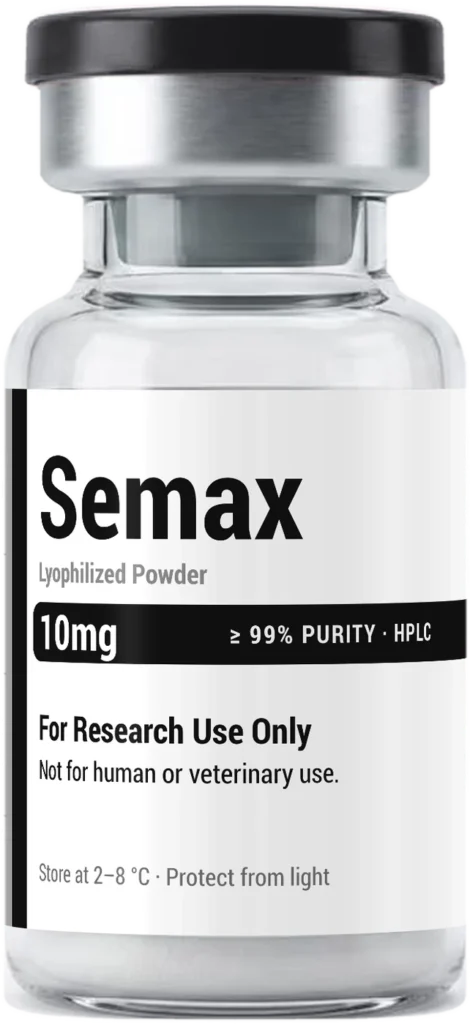
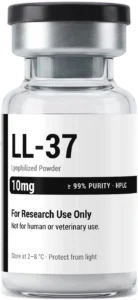
Vial label design and print may vary between batches. Product specifications remain unchanged.
At a glance
Strength
10mg per vial
Form
Lyophilised powder
Purity
≥ 99% (HPLC)
CAS number
80714-61-0
Molecular weight
810.9 g/mol
Certificate of Analysis
Batch SX-10-27 · Prime Peptides UK
Neuroactive & cognitive
Semax
Synthetic research peptide · 10mg · CAS 80714-61-0
£24.95 In stock · ready to shipper vial · £2.50 per mg
Semax 10mg is coming soon. It goes on sale as soon as its batch certificate is published - every vial we sell has a matching CoA.
Bank transferBitcoin Encrypted checkout · card details are never taken on this site
Multi-item discount. Add any 2 items for 4% off the whole order, 7% at 3, 10% at 4. Applied automatically at checkout.
Free
Free lab add-on. Bacteriostatic water is included with every peptide order at no extra cost.
Lab essentials tap to add to this order
RUOResearch Use Only. Not for human or veterinary use. By purchasing you confirm you are a qualified researcher and accept responsibility for safe, lawful handling.
Same-day dispatch
Orders before 3:00 PM leave the same working day, tracked, in plain packaging. Free UK delivery over £200.
Secure payment
Bank transfer or Bitcoin over an encrypted checkout. No card details are stored or handled on this site.
Batch tested
Every batch is HPLC and mass spectrometry tested, and its certificate is published before it ships.
Semax 10mg≥99% HPLC · In stock
£24.95
Compound Overview
What Is Semax 10mg?
Semax 10mg is a synthetic research peptide provided as a precise amount of substance for scientific and research purposes. The amino-acid sequence of the peptide is Met-Glu-His-Phe-Pro-Gly-Pro (MEHFPGP) and the peptide is often referred to in scientific literature as an ACTH-derived regulatory peptide. Studies of Semax have investigated the neurochemical signalling, gene expression and responses in experimental neurological models. The 10mg format refers to the amount of peptide material that is provided and is not a recommended dose.
Semax is a synthetic heptapeptide made up of 7 amino acids: Methionine, Glutamic acid, Histidine, Phenylalanine, Proline, Glycine and Proline. The amino acid sequence is written as MEHFPGP. It is structurally related to the ACTH (4-7) fragment and also with the Pro-Gly-Pro sequence and has been studied as a regulatory peptide in experimental studies.
Semax is a peptide derivative which is shorter compared to the naturally-occurring full-length adrenocorticotropic hormone. Its structure and biological activity have prompted research into its interactions with a number of biochemical and neurological processes. Published experimental studies include work on Neurotransmitter Systems, Neurotrophic signalling, inflammatory gene expression and models of cerebral ischaemia.
Semax 10mg is a particular product with 10 milligrams of research material. The strength is a measure of the amount provided and not of concentration or recommended experimental dosage. Laboratory requirements should always be pre-determined by an established protocol and appropriate scientific methodology.
Technical Data
Semax Product Specifications
Technical Specification Sheet
SEMAX · 10MG · RUO
Product Name
Semax 10mg
Compound
Semax
Peptide Sequence
Met-Glu-His-Phe-Pro-Gly-Pro (MEHFPGP)
Strength
10mg
Peptide Type
Synthetic heptapeptide
Research Classification
Experimental / research peptide
Format
Laboratory research material
Testing
Refer to batch-specific analytical documentation
COA
Batch-specific Certificate of Analysis with every batch
Intended Use
Laboratory and scientific research only
Human Use
Not intended for human consumption or self-administration
CAS Number
80714-61-0
Molecular Formula
C37H51N9O10S
Molecular Weight
810.9 g/mol
Purity
≥99% by HPLC
The free peptide is listed in PubChem with the molecular formula C37H51N9O10S and a molecular weight of approximately 813.9 g/mol. Salt forms can have different reported formulae and molecular weights, so analytical documentation should identify the exact material supplied.
The Science
Scientific Background of Semax
Semax emerged from research into short fragments and analogues associated with adrenocorticotropic hormone. Rather than reproducing the complete ACTH molecule, its seven-amino-acid structure combines the ACTH(4–7)-related sequence Met-Glu-His-Phe with Pro-Gly-Pro.
This structural design has made Semax relevant to research examining peptide-mediated signalling within neurological systems. Experimental studies have explored its relationship with dopaminergic and serotonergic pathways. For example, rodent research has reported changes involving serotonergic activity and modulation of dopamine-associated responses under specific experimental conditions.
Other research has focused on molecular events following experimentally induced cerebral ischaemia. Transcriptomic studies in rats have examined changes in genes connected with immune responses, cytokine signalling and other biological processes after exposure to Semax. Additional work has investigated proteins associated with inflammation, cellular stress and recovery pathways.
Research Context
These findings provide research questions rather than established therapeutic conclusions. Much of the mechanistic evidence available for Semax comes from animal, cellular or other experimental models, and results from such models cannot automatically be translated into effects in people.
Laboratory Focus
Why Is Semax Studied in Laboratory Research?
The range of biological systems the peptide allows researchers to explore as an experimental compound is one reason Semax continues to attract scientific interest. Neurological research has looked at how peptide signalling may interact with neurotransmitter pathways and molecular responses to cellular stress.
Neurological Pathways
Dopamine and serotonin systems have been investigated in rodent experiments, including measurements of neurotransmitter metabolites and responses to other experimental compounds. These studies can help researchers investigate whether regulatory peptides influence established neurochemical pathways and under what conditions those effects occur.
Inflammatory Signalling
A separate research area involves gene regulation. Experimental cerebral ischaemia models have been used to study Semax-associated changes in transcription, including genes involved in immune and inflammatory processes. Researchers have also investigated neurotrophin-related signalling and proteins connected to cellular responses following experimentally induced neurological injuries.
Preclinical Models
Semax therefore provides a research tool for examining interconnected molecular processes rather than a compound with one fully established mechanism. Interpretation requires attention to the experimental model, methodology, concentration, endpoint and study limitations.
Product Format
Understanding the Semax 10mg Research Format
10mg
Nominal Research Quantity
The 10mg designation on Semax 10mg UK research material describes the total quantity of peptide supplied in the product. It does not establish an appropriate dose, treatment amount or administration schedule.
Quantity matters in laboratory procurement because different projects require different amounts of research material. A researcher conducting a limited analytical experiment may have different material requirements from a laboratory planning multiple assays, replicate experiments or a broader sequence of controlled investigations.
The suitability of a 10mg format therefore depends on factors such as experimental design, number of planned assays, analytical methodology, validation requirements and laboratory protocol. Researchers should calculate material requirements within their own documented experimental framework rather than interpreting the labelled strength as an instructions for use.
This distinction is particularly important when comparing different Semax product formats. A larger quantity should not be described as more effective or scientifically superior; it simply represents a different amount of research material.
Verification
Semax Quality Testing, Purity and Certificate of Analysis
Analytical documentation is an important consideration when sourcing Semax for controlled research. A product name and stated quantity alone do not provide sufficient information about the identity or analytical characteristics of a research peptide.
Batch-Specific CoA
For peptide analysis, chromatographic purity can be assessed by high-performance liquid chromatography (HPLC) and other analytical methods can provide information on molecular identification. The specific tests performed must be confirmed by the paperwork provided for the relevant batch, and not inferred from general remarks concerning peptide testing.
Identity vs Purity
Researchers can obtain information related to a single production lot via abatch-specific Certificate of Analysis (COA). Depending on the analytical programme, this may include batch identification, reported purity results, test methodology and other quality-control information.
Documentation & Transparency
Researchers evaluating Semax 10mg should therefore look beyond headline purity claims. Traceable batch numbers, accessible analytical documentation and clear product identification provide a more meaningful basis for assessing whether research material is appropriate for a particular laboratory workflow.
Handling
Storage and Laboratory Handling
Environmental Conditions
Controlled storage is important when handling peptide research materials in a laboratory, noting that they are sensitive to environmental conditions. Semax 10mg must be stored according to the supplier’s product documentation and any batch-specific handling instructions.
Environmental Conditions
When handling peptide material, researchers should consider the temperature, illumination, and moisture, as well as the state of the original container. Samples should be stored so that they are not exposed to unnecessary environmental factors.
Contamination Control
Laboratories should also use their normal procedures for sample identity, contamination control, inventory management and sample control. Storage requirements depend on the product format, packaging and physical state, and therefore directions may differ from product to product and from supplier to supplier, and should be followed instead of general peptide storage advice.
Researchers comparing Semax 10mg UK suppliers should assess more than just product availability. Clear identification of the compound, stated quantity, analytical documentation and traceable batch information are important factors when evaluating research material.
A supplier should make the research-only status of Semax clear and provide enough information for laboratories to understand what material they are sourcing. Where testing is referenced, researchers should look for documentation relating to the actual batch rather than relying exclusively on broad statements about quality.
Packaging and storage information also matter because laboratory materials need to remain identifiable and appropriately managed throughout their lifecycle. For organisations looking to buy Semax 10mg UK for legitimate laboratory research, transparent specifications, COA availability, batch traceability and clear UK dispatch information can provide useful criteria when comparing suppliers.
Analytical Records
Batch certificates for Semax
Every order ships with the CoA matched to its batch number, and the analytical records
are published here - open the certificate before you order, or cross-check the one in
your parcel.
The 10mg figure identifies the total quantity of Semax research material supplied in the product. It is a product specification rather than a human dosage or administration recommendation. Laboratories may require different material quantities depending on the scale and design of their experiments, number of assays and analytical procedures.
What is the amino-acid sequence of Semax?
Semax is a seven-amino-acid peptide with the sequence Met-Glu-His-Phe-Pro-Gly-Pro, commonly abbreviated as MEHFPGP. PubChem identifies Semax as ACTH(4–7), Pro-Gly-Pro-. This defined sequence is useful when confirming compound identity and reviewing scientific literature or analytical documentation relating to the peptide.
What areas of Semax research have been investigated?
Published experimental literature has examined Semax in relation to neurotransmitter systems, gene expression, inflammatory signalling, neurotrophin-related pathways and models of cerebral ischaemia. A substantial proportion of mechanistic evidence comes from rodent or cellular research. These findings should therefore be interpreted as experimental observations rather than established clinical benefits.
Why is a batch-specific COA relevant when sourcing Semax?
For a specific batch, the 'Certificate of Analysis' links the analysis data to the particular production batch being delivered. Depending on the testing performed, it can report information such as batch identity, analytical methodology and purity measurements. Researchers should review the actual COA rather than assuming that general quality statements apply identically to every batch.
Is Semax 10mg a medicine in the UK?
This Semax 10mg product is offered as laboratory research material and should not be presented as a UK-authorised medicinal product. The MHRA provides official services for checking information related to medicines and marketing authorisations in the UK. Research-product descriptions should remain clearly separate from claims concerning authorised therapeutic use.
How should a laboratory choose between Semax quantities?
The amount of research material used is determined by the nature of the study to be conducted, not potency or effectiveness. The number of experiments, replicates, assays and overall scale of the project may be a consideration. The 10mg size just provides a fixed dose that can be compared to a known laboratory procedure.
PG
Medically & Scientifically Reviewed By
Dr. Priyanka Goel
Scientific & Medical Content Reviewer
Reviews research content against current published literature and UK regulatory guidance, ensuring compound information is accurate, referenced and presented for research use only.
Semax 10mg is only available as a research laboratory compound. Not for human consumption, self-administration, diagnostic or therapeutic. The information found on this page relates to the product and the scientific context of the research and should not be considered medical, dosage or treatment information.