
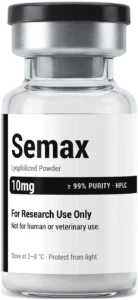
What makes Semax interesting from a research perspective is that its proposed activity does not appear to come from simply acting as a conventional stimulant. Research has instead looked at its influence on neurotrophic signalling, inflammatory responses, neurotransmitter systems and processes involved in neuronal protection.
Much of the published work has come from Russian research groups, where Semax has been investigated in neurological settings, including ischaemic stroke. There is also a body of laboratory research looking at memory, learning, neuroprotection and changes in gene expression. The evidence is therefore quite broad in terms of research subjects, although it is important not to treat findings from animal or experimental studies as proof of the same effect in healthy people.
What is Semax?
Semax is often described as an analogue of the ACTH (4-10) region of adrenocorticotropic hormone. Its structure is slightly more complicated than that description suggests, as the peptide contains the ACTH-derived sequence alongside a C-terminal Pro-Gly-Pro section. Researchers have examined different parts of the molecule to understand which regions may contribute to its biological activity.
One area of interest has been the peptide’s apparent effects on neurotrophic factors. In animal research, Semax has been associated with changes in the expression of BDNF and its receptor, TrkB, particularly in brain regions involved in learning and memory.
That does not mean Semax simply “boosts BDNF” in a predictable way. Biological signalling is far more complex than these factors, with results varying based on the experimental model, dose, timing, and the tissue being investigated.
Why is Semax being researched?
Semax’s main interest is its potential neuroprotective and neuromodulatory effects.
Several experimental studies have examined how the peptide behaves when brain tissue is exposed to conditions such as ischaemia. In a rat model of cerebral ischaemia-reperfusion, Semax was associated with changes in proteins involved in inflammation, cell death and recovery. The researchers reported increased active CREB alongside reductions in MMP-9, c-Fos and active JNK, suggesting that several cellular pathways may be affected rather than one isolated mechanism.
Other work has looked at inflammatory signalling. Research using an experimental stroke model found that Semax suppressed the induction of various pro-inflammatory gene transcripts following temporary cerebral ischaemia.
These findings help explain why Semax continues to attract interest in neurological research. They also demonstrate why it is challenging to simplify its proposed effects into a single claim, such as “brain booster” or “nootropic.”
Semax and cognitive research
Memory and learning are another part of the Semax literature.
Earlier research described effects on learning processes and cognitive performance, while laboratory studies have investigated changes in neurotrophic signalling in the hippocampus. The hippocampus is particularly relevant because of its role in memory formation and learning.
There is also experimental evidence connecting Semax with the dopaminergic system. In one animal study, researchers investigated the peptide in rats with chemically induced damage to dopamine-producing pathways. Semax reduced some of the behavioural disturbances observed in that model, with the authors suggesting that both dopaminergic modulation and neurotrophic activity could be involved.
Again, these are research observations rather than a basis for assuming that Semax will improve concentration, motivation or memory in a healthy person.
Research into stroke and neurological recovery
Ischaemic stroke is one of the areas where Semax has been studied in human subjects as well as experimental models.
Clinical research published in the Russian medical literature has investigated Semax during acute and recovery stages following ischaemic stroke. One study involving 110 patients examined Semax alongside rehabilitation and measured factors including plasma BDNF, motor performance and the Barthel Index. The researchers reported increased BDNF levels in the Semax groups and improvements in functional measures during rehabilitation.
Earlier clinical work also examined Semax during the acute phase of hemispheric ischaemic stroke, including neurological outcomes and electrophysiological measurements.
These studies are useful when considering why Semax has attracted medical research interest, but they should be viewed within the wider evidence base. The published clinical literature is not equivalent to the large, internationally established evidence base behind standard stroke treatments.
Potential mechanisms under investigation
There is no single confirmed mechanism that explains every reported effect of Semax.
Research has pointed towards several possibilities, including changes in neurotrophic signalling, inflammatory pathways and neurotransmitter-related processes. BDNF and TrkB have received particular attention, while experimental stroke studies have also identified changes involving CREB and inflammatory or cell-death pathways.
There has even been research into Semax’s interaction with metal ions. One laboratory study found that Semax can bind copper and reported reduced copper-induced cellular toxicity in cultured cell models. This is an intriguing biochemical finding, although it should not be interpreted as evidence that Semax prevents neurodegenerative disease in humans.
What should researchers keep in mind?
Semax has a sizeable research history, but the quality and type of evidence vary considerably between studies. Some findings come from cell cultures or animal models, while others come from relatively small clinical studies. Results from one setting cannot automatically be transferred to another.
It is also worth separating research interest from established medical use. Semax has been used and studied clinically in Russia, particularly in connection with neurological conditions, but its research status and regulatory position are not the same across countries.
For UK-based readers, Semax should therefore be approached as a research peptide rather than assumed to be an approved treatment simply because clinical studies have been published.
The research picture
Semax remains an unusual peptide in neurological research. Its origins in an ACTH-derived sequence, its effects on neurotrophic signalling and the range of experimental work around inflammation and neuronal protection make it a useful subject for further investigation.
The more interesting question is arguably not whether Semax is a general-purpose “nootropic”, but how its different biological effects fit together. Work involving BDNF, dopamine, inflammatory signalling and cellular stress provides several possible pieces of that picture, although considerably more research would be needed to establish how reproducible these effects are across different populations and clinical settings.
For research purposes, Semax is best viewed as a peptide with documented biological activity and a particular history of neurological investigation, rather than as a substance with established benefits for everyday cognitive performance. That distinction matters when interpreting both the older clinical literature and newer experimental findings.
Published batch records
Every batch of Semax we have sold, each with its published Certificate of Analysis.
| Batch | Size | Purity (HPLC) | Tested | Certificate |
|---|---|---|---|---|
| SX-10-27 Current stock | 10mg | ≥99.0% | Oct 2026 | View CoA |
Research Use Only. Semax is supplied strictly for laboratory research. Nothing on this page is dosing guidance, medical advice, or a suggestion of human or veterinary use.