Free lab add-on. Bacteriostatic water is included with every peptide order at no extra cost.
Lab essentials tap to add to this order
RUOResearch Use Only. Not for human or veterinary use. By purchasing you confirm you are a qualified researcher and accept responsibility for safe, lawful handling.
Same-day dispatch
Orders before 3:00 PM leave the same working day, tracked, in plain packaging. Free UK delivery over £200.
Secure payment
Bank transfer or Bitcoin over an encrypted checkout. No card details are stored or handled on this site.
Batch tested
Every batch is HPLC and mass spectrometry tested, and its certificate is published before it ships.
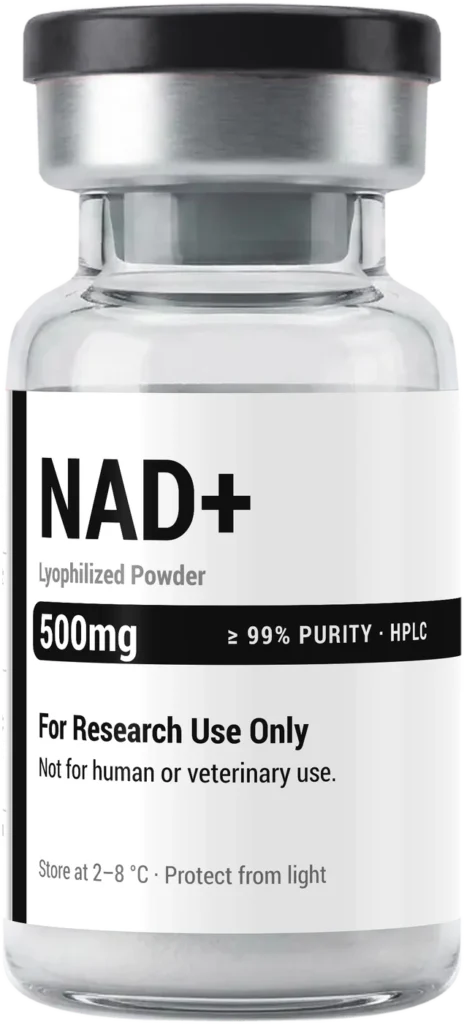
NAD+ 500mg≥99% HPLC · In stock
£54.95
Compound Overview
What Is NAD+ 500mg?
NAD+ 500mg is a research-grade format of the naturally occurring coenzyme, which plays a role in enzyme-dependent signalling processes, energy metabolism and redox chemistry in the cell. The 500mg quantity can be used to supply a specified amount to research laboratories for suitable analysis and experimental work. NAD+ is not a peptide, but rather a dinucleotide coenzyme that is found in all living cells. The products provided by Prime Peptides UK are for the sole purpose of scientific and laboratory research and NOT for any human or therapeutic purposes.
NAD+ is the oxidised form of nicotinamide adenine dinucleotide, a molecule present in all living cells that serves mainly as a cofactor in many biochemical reactions. According to ChEBI, NAD+ is involved in biochemical redox reactions, playing a part in the transfer of electrons between reactions.
NAD+ is not an amino acid peptide, unlike many other products included in research peptide catalogues. Its chemical structure comprises two nucleotide components linked by phosphate groups. The distinction is relevant when designing laboratory investigations because its chemical behaviour, analytical characterisation and laboratory applications differ from those of peptide compounds.
In NAD+, 500mg mark indicates the total amount of NAD+ research material present in the product. It does not indicate a suggested dose or an amount acceptable for administration to humans or animals.
Sizes & Prices
NAD+ sizes and prices
Each size is supplied from its own tested batch with its own Certificate of Analysis. The size is the amount of research material in the vial; larger vials cost less per mg.
Size
Price
Per mg
Batch certificate
Choose
500mg
£54.95
£0.11
NAD-500-22
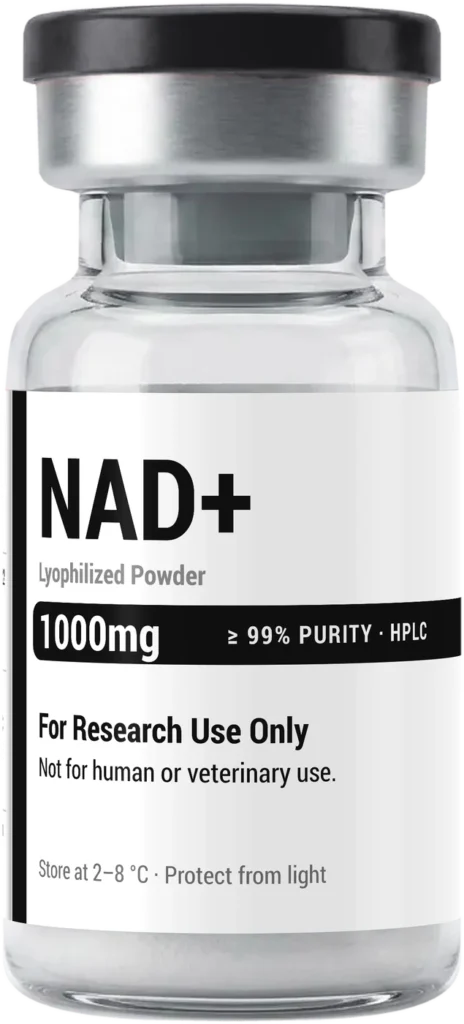
1000mg
£94.95
£0.09
NAD-1000-22
Technical Data
NAD+ Product Specifications
Technical Specification Sheet
NAD+ · RUO
Product
NAD+
Full name
Nicotinamide adenine dinucleotide
Oxidation state
NAD+ / oxidised NAD
Research quantity
500mg or 1000mg per vial
Compound class
Dinucleotide coenzyme / cellular metabolite
Peptide
No
CAS reference
53-84-9
Molecular formula
C21H27N7O14P2
Molecular weight
663.4 g/mol
Intended purpose
Laboratory and scientific research only
Human use
Not intended for human consumption or administration
Structure
Pyridine-nucleotide coenzyme (not a peptide)
Physical form
Lyophilised powder
Purity
≥99% by HPLC
Figures are for NAD+ in its oxidised form (CAS 53-84-9, C21H27N7O14P2, 663.4 g/mol), as stated on the batch Certificate of Analysis. NAD+ is a cellular cofactor, not a peptide.
The Science
NAD+ in Cellular Biochemistry
NAD+ plays a pivotal role in cellular metabolism due to its ability to undergo reversible oxidation/reduction reactions. In simple words, NAD+ can be reduced in biochemical reactions, and it can be turned back into its reduced form, NADH. These interwoven forms enable NAD chemistry to interact with metabolic pathways in which electrons will need to be passed from one reaction to another.
The role of NAD biology is not limited to traditional redox biology. The study of NAD+ as a substrate for a range of NAD-consuming enzymes and in larger cellular signalling pathways has also been looked at. These have sparked much laboratory interest in NAD metabolism, synthesis, consumption and homeostasis.
While this approach does not imply the findings from cellular or experimental systems will automatically result in clinical effects, such effects are possible. Laboratory observations have to be explained with reference to the experimental model and not as evidence that providing external NAD+ has a specific health benefit in humans.
For research purposes, NAD+ therefore represents a useful biochemical compound for studying metabolism and enzyme-dependent cellular processes rather than a product for which therapeutic effects should be assumed.
Laboratory Focus
Why NAD+ Is Studied in Laboratory Research
One major area of investigation involves cellular energy metabolism. NAD+/NADH redox cycling is linked with metabolic reactions in which chemical energy is transferred, making the NAD system relevant to investigations of mitochondrial and cytosolic metabolism.
Metabolic Research
Researchers also examine the way cells maintain NAD availability. NAD can be synthesised or recycled through biochemical pathways involving precursor molecules, while different enzymatic processes consume or regenerate NAD-related metabolites. Studying these relationships can help researchers understand how metabolic state influences cellular chemistry.
Receptor Signalling
Other laboratory investigations consider NAD-dependent enzymes and signalling pathways. Because NAD+ serves both as a redox cofactor and as a substrate in specific enzymatic reactions, variations in cellular NAD availability can form part of studies involving gene regulation, stress responses, metabolic adaptation and other biological processes.
Cellular Studies
The scientific literature surrounding NAD biology is broad, but results vary substantially by experimental system. Therefore, findings derived from cultured cells, isolated enzymes, or animal models should be clearly distinguished from established evidence regarding clinical use.
Product Format
Understanding the 500mg Research Format
500mg
Nominal Research Quantity
500mg NAD+ is a type of formulation that specifies the quantity of research material being provided, not the strength of a drug. This distinction should be taken into account with particular care in the case of NAD+, since the quantities found commercially in a product do not represent administration recommendations.
A 500mg amount might be applicable to laboratories with an experimental design that requires more material than a smaller research design. Material requirements may vary with the number of analytical runs, replicates, controls, assay design, and the size of the investigation.
It is not permitted to measure the requirement of the material in accordance with some experimental method – material requirements should be measured with the validated experimental protocol used by the researcher. It is not possible to rely on the concentration that appears on a product label alone to extrapolate scientific assays. The concentration on a product label might differ from that in scientific assays; understanding the specific scientific assay and methodology is necessary before relying on it.
Therefore, before using the information from the NAD+ 500mg UK search, users should take into account the amount and source of the laboratory materials. The page intentionally does not contain instructions for administration, injection or therapeutic preparation.
Verification
Identity, Analytical Testing and Certificate of Analysis
Analytical documentation is an important consideration when sourcing NAD+ or other laboratory research compounds. Researchers should be able to distinguish a product's stated identity from independently obtained analytical results.
Batch-Specific CoA
A Certificate of Analysis (COA) can provide batch-specific information such as product identification, batch or lot number, analytical methodology and reported test results. The information presented is based on tests performed on a specific batch of material.
HPLC Analysis
Chromatographic techniques, such as HPLC, may be used in the characterisation or purity assessment of suitable research materials, while other analytical approaches may be required for identity confirmation. No specific purity percentage should be assumed unless it appears on verified documentation relating to the supplied batch.
Identity vs Purity
Researchers evaluating NAD+ 500mg should therefore review the available COA and supporting documentation rather than relying solely on generic statements such as “high purity” or “research grade”. Batch traceability and clearly presented analytical data provide substantially more useful information.
Handling
Storage and Laboratory Handling of NAD+
Documentation First
Good biochemical research material storage is significant for preserving the integrity of materials. Handling of NAD+ should be done in accordance with the instructions provided with the actual product supplied, as the procedure may vary depending on the physical form, packaging and manufacturer's documentation.
Environmental Conditions
Research materials should be protected in the laboratory from unnecessary contamination, moisture, excessive light or inappropriate temperatures (as identified in the relevant product documentation) that could cause instability.
Labelling & Traceability
The material should be clearly labelled and traceable to batch details. Standard operating procedures for the laboratory should be followed for handling, inventory control and disposal.
Reconstitution Practice
Where general instructions are available online, they should include any specific instructions from the supplier and/or details related to the batch. Only laboratory material management is discussed in this section and no instructions are given for preparation or administration to humans or animals.
When assessing an NAD+ 500 mg research product in the UK, laboratories should consider more than the quantity stated on the listing. Clear compound identification, traceable batches, accessible analytical documentation and appropriate product labelling all contribute to informed procurement.
Researchers comparing UK research-compound suppliers should look for straightforward information about what is actually supplied and should avoid treating marketing terminology as a substitute for analytical evidence.
Where a Certificate of Analysis is provided, it should be associated with the relevant batch wherever practical rather than presented as generic evidence applying indefinitely to every unit sold.
The 500mg format may suit some laboratory procurement requirements, while another material quantity may suit others. Selection should therefore follow the laboratory's experimental plan, analytical needs and internal protocols rather than assumptions that a larger quantity is inherently more effective or superior.
Analytical Records
Batch certificates for NAD+
Every order ships with the CoA matched to its batch number, and the analytical records
are published here - open the certificate before you order, or cross-check the one in
your parcel.
No. NAD+ is nicotinamide adenine dinucleotide, a naturally occurring dinucleotide coenzyme rather than a peptide. ChEBI classifies NAD as a fundamental metabolite and coenzyme, while NAD+ refers specifically to its oxidised form. It may nevertheless appear in catalogues alongside peptides and other biochemical research compounds.
What does NAD+ 500mg mean?
The 500mg figure describes the stated quantity of NAD+ research material supplied in the product format. It is not a dosage recommendation and should not be interpreted as guidance for human or animal administration.
What is the difference between NAD+ and NADH?
NAD+ represents the oxidised form of nicotinamide adenine dinucleotide. NADH is its reduced counterpart. Their reversible relationship is central to numerous biochemical redox reactions and allows reducing equivalents to be transferred during cellular metabolic processes. ChEBI specifically defines NAD+ as the oxidised form involved in electron-transfer reactions.
Why do researchers investigate NAD+?
The different researchers study NAD+ because it participates in fundamental cellular metabolism and acts as a cofactor or substrate in numerous biochemical processes. Research areas include redox biology, metabolic pathways, NAD synthesis and recycling, enzyme activity and cellular signalling. Findings depend on the model and should not automatically be interpreted as human therapeutic benefits.
What should I check on an NAD+ Certificate of Analysis?
Check that the COA for the relevant product or batch is correct and check information such as sample identity, lot or batch reference, method of analysis and stated results. A batch-specific analytical documentation must not replace a general claim for purity.
Is NAD+ 500mg intended for human use?
In this context, NAD⁺ 500 mg is intended to be used in a research laboratory. NAD+ 500mg is not recommended for self-administration as a medicine, treatment, dietary supplement, or product. The information on this page is not intended to be used for dosing or as medical advice.
PG
Medically & Scientifically Reviewed By
Dr. Priyanka Goel
Scientific & Medical Content Reviewer
Reviews research content against current published literature and UK regulatory guidance, ensuring compound information is accurate, referenced and presented for research use only.
NAD+ 500mg is only for use in laboratory, analytical and scientific studies. This product is not intended for use in human medicine, self-administration, diagnosis, or therapy. No indication of human or animal dose should be made from the quantity of the product. This information is provided to contextualise scientific and research-based information only and is not medical advice. Researchers must conduct their research in accordance with proper laboratory procedures, as well as the relevant regulations and documentation provided with the specific batch of the product.