
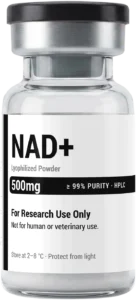
What makes NAD+ intriguing is its involvement in several basic processes that cells rely on every day. It is involved in energy metabolism, participates in oxidation and reduction reactions, and is also involved in cellular signalling and DNA repair. NAD+ does not have a single role; instead, it lies at the centre of a number of interconnected biological pathways.
That wide-ranging participation is one of the reasons researchers consider NAD+ a valuable subject of study.
What is NAD+?
NAD+ is found in two main forms, NAD+ and NADH. These forms are interconvertible with each other during the normal metabolism of cells.
NAD+ acts as an electron carrier in reactions that extract energy from nutrients. So NAD+ is the form that accepts electrons and becomes NADH. NADH can then be used in processes that eventually lead to the production of ATP, the energy currency used by cells.
However, this is only a partial view.
Several enzyme systems also consume NAD+. Some of the most famous are the sirtuins and PARP enzymes. Sirtuins are involved in cellular signalling and metabolic regulation, while PARP proteins are important for the cellular response to DNA damage.
Thus, alterations in NAD+ availability might influence not only energy metabolism.
NAD+ and cellular energy
One of the most established areas of NAD+ research concerns mitochondrial and cellular energy metabolism.
Mitochondria require a constant supply of NAD+ and NADH to allow the movement of electrons through metabolic pathways. Thus, the balance between these two forms is important for the normal production of energy.
Changes in NAD+ metabolism under different physiological conditions, such as ageing, metabolic stress and cellular damage, have been studied. Various enzyme systems also consume NAD+. Some of the best known are sirtuins and the PARP enzymes. Sirtuins are involved in cell signalling and metabolic regulation. PARP proteins are involved in the cell response to DNA damage.
Thus, changes in NAD+ availability may affect more than just energy metabolism. Researchers are particularly interested in whether alterations in NAD+ availability are a cause, consequence or contributing factor in some of these changes.
This distinction is important to remember. The fact that NAD+ participates in a biological pathway does not automatically mean that increasing NAD+ will produce a specific outcome. The relationship is considerably more complicated than that.
NAD+ and ageing research
NAD+ has attracted considerable attention in ageing research.
Studies in different model organisms have reported age-related changes in NAD+ metabolism. This has led to interest in whether restoring or maintaining NAD+ availability could influence some processes associated with ageing.
A number of experimental approaches have been investigated, including NAD+ itself and compounds that act as NAD+ precursors. Examples are nicotinamide riboside (NR) and nicotinamide mononucleotide (NMN), both of which have received much research interest.
These compounds are not interchangeable with NAD+, and research findings involving one should not automatically be applied to another.
The wider research question is whether changes in NAD+ metabolism can influence cellular resilience, mitochondrial function and other biological processes that alter with age. Much of this work remains experimental, with findings varying depending on the model, tissue and experimental conditions.
DNA repair and cellular signalling
Another reason that NAD+ is in the limelight is its link to DNA repair.
PARP enzymes require NAD⁺ to participate in specific DNA repair mechanisms. In extreme stress conditions for the cell, the PARP enzymes can become hyperactivated and deplete the cell’s NAD+.
NAD+ molecules are also involved in the activity of a family of enzymes called sirtuins. These enzymes play a role in gene expression, metabolism, and the stress response, among other functions.
Researchers often describe these pathways together to highlight the various functions of NAD+ beyond energy metabolism. Researchers often describe these pathways together to highlight the various functions of NAD+ beyond energy metabolism. Its availability can affect the activity of enzymes, and enzyme activity can affect the amount of NAD+ available in cells.
The reasons for studying NAD+ in the laboratory are diverse.
NAD+ research covers a surprisingly wide field. Depending on the project, researchers may be interested in:
- cellular energy metabolism
- mitochondrial function
- oxidative and metabolic stress
- DNA damage responses
- enzyme activity
- ageing-related cellular changes
- NAD+ synthesis and recycling
- interactions between NAD+ and NAD+-dependent enzymes
Laboratory work may also examine how NAD+ levels change in particular tissues or under specific experimental conditions.
For this reason, NAD+ is relevant to basic biochemical research as well as more specialised studies looking at metabolism, cellular ageing and disease mechanisms.
NAD+ availability and metabolism
Cells do not simply obtain NAD+ from one source. NAD+ can be produced and recycled through several metabolic pathways.
This network is very regulated. The factors affecting NAD+ metabolism include tissue type, metabolic state and cellular demand.
The salvage pathway is especially important. It allows cells to recycle certain B3 vitamin-related compounds back into NAD+. Other pathways can also be involved in NAD⁺ synthesis.
Therefore, researchers will often look at the broader NAD+ system instead of treating NAD+ concentration as a stand-alone measurement. To fully understand total NAD+, it is necessary to analyse NADH, associated metabolites, enzyme activity and flux.
Current research questions
Studies are being done to understand the changes in NAD+ metabolism with ageing, how NAD+ pools are maintained in various tissues and whether manipulation of NAD+ related pathways can alter certain cellular processes.
It is also interested in the relationship between NAD+ metabolism and conditions of metabolic dysfunction, mitochondrial stress and compromised cellular repair mechanisms.
Researchers actively investigate NAD+, particularly because some experimental results raise questions that measuring NAD+ levels alone cannot answer.
Results from studies are not always consistent across experimental models. “Studies in cultured cells and animals do not always translate into human outcomes. Clinical relevance of laboratory model observations must be verified with human research.
NAD+ as a research subject
NAD+ is best understood as a central metabolic cofactor rather than a single-purpose compound. Its involvement in energy production, enzyme activity, DNA repair and cellular signalling provides researchers several different reasons to investigate it.
That complexity is also what makes NAD+ research so fascinating. Altering one part of NAD+ metabolism can potentially affect several connected pathways at the same time.
Therefore, for research purposes, the most useful approach is to consider NAD+ in context: its relationship with NADH, precursor pathways, NAD+-dependent enzymes and the biological system under study.
As the research field advances, the major questions likely to be addressed will be when alterations in NAD+ metabolism are relevant, why they occur, and what mechanisms are responsible for the effects seen in experimental models.
Published batch records
Every batch of NAD+ we have sold, each with its published Certificate of Analysis.
Research Use Only. NAD+ is supplied strictly for laboratory research. Nothing on this page is dosing guidance, medical advice, or a suggestion of human or veterinary use.