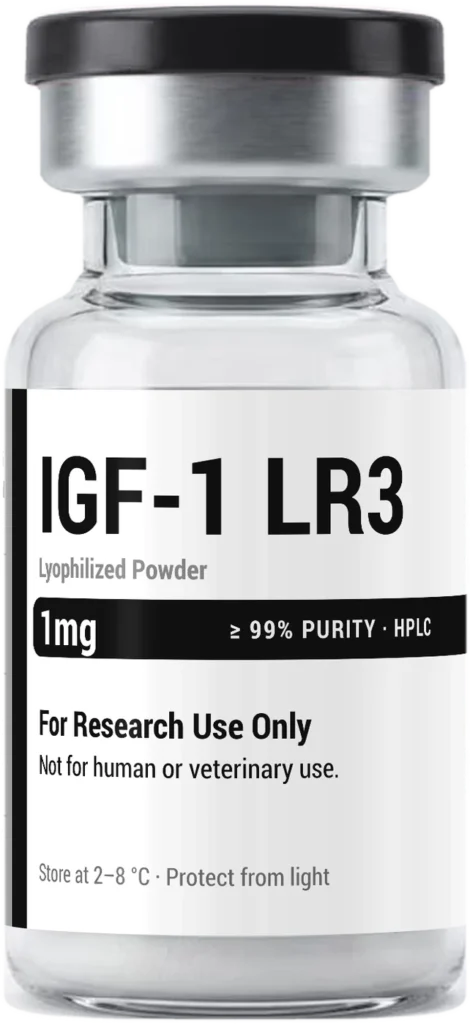
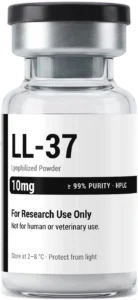
Vial label design and print may vary between batches. Product specifications remain unchanged.
At a glance
Strength
1mg per vial
Form
Lyophilised powder
Purity
≥ 99% (HPLC)
CAS number
946870-92-4
Molecular weight
9111.6 g/mol
Certificate of Analysis
Batch IGF-1-14 · Prime Peptides UK
Storage
Follow product documentation and laboratory SOPs
Growth hormone secretagogues
IGF-1 LR3
Synthetic research peptide · 1mg · CAS 946870-92-4
£39.95 In stock · ready to shipper vial · £39.95 per mg
IGF-1 LR3 1mg is coming soon. It goes on sale as soon as its batch certificate is published - every vial we sell has a matching CoA.
Bank transferBitcoin Encrypted checkout · card details are never taken on this site
Multi-item discount. Add any 2 items for 4% off the whole order, 7% at 3, 10% at 4. Applied automatically at checkout.
Part of a stack. IGF-1 LR3 is in the Growth & Performance Stack (CJC-1295 DAC 10mg · Ipamorelin 10mg · IGF-1 LR3 1mg).
Free
Free lab add-on. Bacteriostatic water is included with every peptide order at no extra cost.
Lab essentials tap to add to this order
RUOResearch Use Only. Not for human or veterinary use. By purchasing you confirm you are a qualified researcher and accept responsibility for safe, lawful handling.
Same-day dispatch
Orders before 3:00 PM leave the same working day, tracked, in plain packaging. Free UK delivery over £200.
Secure payment
Bank transfer or Bitcoin over an encrypted checkout. No card details are stored or handled on this site.
Batch tested
Every batch is HPLC and mass spectrometry tested, and its certificate is published before it ships.
IGF-1 LR3 1mg≥99% HPLC · In stock
£39.95
Compound Overview
What Is IGF-1 LR3 1mg?
IGF-1 LR3 1mg is a laboratory research variant of IGF-1 analogue, long R3 insulin-like growth factor, a modified version of IGF-1 that has been employed in research on the IGF signalling system. It has a different structure than natural IGF-I, and it has been thoroughly researched regarding its interactions with IGF-I as well as its detailed studies on insulin-like growth factor binding proteins (IGFBPs). This 1mg format is for controlled laboratory and scientific use in the UK only and is for identifying the quantity of research material supplied.
Insulin-like growth factor-I LR3 (also known as insulin like growth factor-I Long R3 or LR3 IGF-I) is a naturally occurring peptide which is part of a complicated biological system of IGF receptors, IGF binding proteins, and IGF-I. Researchers created IGF-1 LR3 as a variant that they could use in their studies of this type of signalling.
Long R3 IGF-I has an arginine substitution at position 3 and an extra 13-amino-acid extension at the N-terminus. These changes have previously been published in scientific literature and have been found to significantly affect its interaction with IGF-binding proteins (IGFBP) compared to native IGF-I.
The 1mg designation only applies to the amount of IGF-1 LR3 research material that has been provided in the product format. This designation does not represent a dosage, a method of administration, or an indication of therapeutic potency.
A defined format of 1mg can be useful for the laboratory as it has a clearly defined amount available to consider when planning analytical work, assay requirements and experimental material allocation.
Technical Data
IGF-1 LR3 Product Specifications
Technical Specification Sheet
IGF-1 LR3 · 1MG · RUO
Product
IGF-1 LR3 1mg
Alternative name
Long R3 IGF-I / LR3 IGF-I
Compound class
IGF-I analogue / research peptide
Quantity
1mg
Structural feature
Arg substitution at position 3 plus 13-amino-acid N-terminal extension
Research area
IGF signalling and IGF-binding protein research
Documentation
Refer to current batch documentation/COA
Intended use
Laboratory and scientific research only
Human use
Not intended for human consumption or administration
Storage
Follow product documentation and laboratory SOPs
CAS Number
946870-92-4
Amino-Acid Sequence
83 amino acid analogue of human IGF-1 (Arg3, 13 aa N-terminal extension)
Molecular Formula
C400H625N111O115S9
Molecular Weight
9111.6 g/mol
Purity
≥99% by HPLC
Researchers should consult the documentation supplied with the individual batch rather than assuming analytical specifications from information published for another batch.
The Science
Scientific Background of Long R3 IGF-I
The IGF system can be composed of multiple peptides. It contains IGF-I, IGF-II, a family of receptors to which IGFs bind and proteins that regulate the activity and availability of IGFs in biological systems. Thus, this network has turned into an established topic of biochemical, cellular and molecular studies.
IGF-1 LR3 is useful for scientific applications because it is not the same as endogenous IGF-I. It is modified in its structure to allow the researchers to have a model to study certain aspects of IGF biology in an experimental setting.
It is important to note that there is a difference between IGF binding proteins. Experimental studies have demonstrated a significantly decreased affinity of Long R3 IGF-I to IGFBPs compared to native IGF-I. This property enables scientists to research the questions of receptor signalling and the regulatory effect of binding proteins.
Research Context
The IGF-1 LR3 has been used in research that has been based on cell-based experiments, receptor studies, animal models, analytical detection and peptide metabolism investigations. These studies do not constitute evidence for an approved therapeutic use but can give experimental data. Laboratory or animal systems cannot be reliably extrapolated to humans.
Laboratory Focus
Why Is IGF-1 LR3 Studied in Laboratories?
One of the key factors to the study of IGF-1 LR3 is its altered interactions with the IGF signalling network. An analogue which is structurally similar to native IGF-I can be compared to the native molecule to study the effects of molecular changes on binding, signalling and experimental biological effects.
Metabolic Research
Long R3 IGF-I has been studied in various contexts such as IGF-I receptor activity, IGFBP interactions, cellular responses, developmental models and peptide metabolism. Analytical researchers have also explored strategies that would allow the identification of Long R3 IGF-I from endogenous IGF-I as well as metabolites generated under experimental conditions.
Laboratory Research
The examples of such work show an important principle in peptide research, namely, altering part of the molecular structure can provide a tool to investigate the role of specific components of a biological pathway.
Tissue Repair Models
However, scientific literature must be carefully read. Results may differ significantly in single cells and tissues and from different animal models. The results are affected by experimental conditions.
Growth Hormone Axis
With this in mind, IGF-1 LR3 should be called an investigational research compound - not a product that is proven to benefit humans. The relevance of this page is restricted to the laboratory investigation of IGF-related biology.
Product Format
Understanding the IGF-1 LR3 1mg Research Format
1mg
Nominal Research Quantity
The 1mg format indicates the total nominal quantity of research material associated with the product. It does not describe an appropriate dose, concentration for a particular experiment or recommended level of biological exposure.
This distinction matters because laboratories design experiments differently. One project may involve analytical identification or method development, while another may investigate receptor interactions or cellular pathways. Material requirements can therefore vary according to the number of assays, replicates, controls, analytical techniques and overall scale of the study.
A 1mg research vial may be selected where that quantity fits an institution's planned laboratory workflow. Researchers remain responsible for determining experimental concentrations and protocols according to validated scientific methods, relevant literature and their organisation's standard operating procedures.
Prime Peptides UK does not present the 1mg format as medically stronger, more effective or preferable to another quantity. It is simply a defined 1mg supply format for research purposes.
Verification
Quality Testing, Identity and Certificate of Analysis
Analytical documentation is particularly important when sourcing compounds for laboratory investigation. Researchers need confidence that the material being evaluated can be associated with a clearly identified product and batch.
Batch-Specific CoA
A Certificate of Analysis (COA) can provide useful information about the corresponding batch, analytical results and testing methods. Where high-performance liquid chromatography (HPLC) has been performed, it can provide information concerning chromatographic purity. Other analytical techniques may be used to support molecular identity, depending on the testing programme.
HPLC Analysis
Purity and identity should not be treated as interchangeable terms. A reported chromatographic purity result alone does not establish every characteristic of a research material.
Identity vs Purity
When evaluating IGF-1 LR3 1mg, laboratories should therefore review the actual documentation accompanying or associated with the current batch. Useful checks include product identity, batch or lot number, analytical method, reported results and whether documentation can be traced to the material supplied.
Researchers should never assume that results from one production batch automatically apply to another.
Handling
Storage and Laboratory Handling
Environmental Conditions
Environmental conditions can have an impact on peptide research materials and storage should be controlled within a suitable laboratory quality system.
Contamination Control
All IGF-1 LR3 1mg should be stored in the original, appropriately labeled packaging, under the conditions described in the current product documentation from the supplier. Where appropriate, exposure of unnecessary light, moisture, contamination and inappropriate temperatures should be minimised in the laboratory.
Labelling & Traceability
Research peptides used by personnel should be handled according to the standard operating procedures of their organisation for Identification, Inventory Control, Contamination Prevention and Storage Monitoring.
Documentation First
The information on this page is not intended to give instructions for the preparation of IGF-1 LR3 for injection, self-injection or other human uses. Instead, use an authorised laboratory protocol for any experimental preparation.
Researchers comparing IGF-1 LR3 1mg UK suppliers should look beyond the product name displayed on a website. When selecting research material for laboratory work, it is crucial to clearly identify and provide supporting analytical information.
Before ordering, ensure that the supplier has clear information on the strength of the product, identifiable batch details, relevant testing paperwork, access to the COA where available, adequate packaging and explicit storage instructions. The distinction between laboratory material and a medicinal product should also be unambiguous.
For UK organisations sourcing IGF-1 LR3 research peptide, transparent research-use labelling is particularly important. A research product should not be presented as though it were an MHRA-authorised medicine or supported by established clinical indications.
Prime Peptides UK positions IGF-1 LR3 1mg exclusively as research material, not as a product for personal, therapeutic or diagnostic use.
Analytical Records
Batch certificates for IGF-1 LR3
Every order ships with the CoA matched to its batch number, and the analytical records
are published here - open the certificate before you order, or cross-check the one in
your parcel.
The 1mg figure identifies the quantity of IGF-1 LR3 research material supplied in this product format. It is a product specification rather than a recommended experimental concentration or human dose. Individual laboratories determine their material requirements according to study design, analytical methods and approved research protocols.
How is IGF-1 LR3 different from native IGF-I?
Long R3 IGF-I is structurally modified. It incorporates an arginine substitution at position 3 together with a 13-amino-acid N-terminal extension. Research has demonstrated that the analogue has substantially reduced affinity for IGF-binding proteins compared with native IGF-I, making this relationship an important subject of experimental investigation.
Is IGF-1 LR3 1mg approved for human use in the UK?
This IGF-1 LR3 1mg product is supplied as laboratory research material and is not intended for human consumption or self-administration. It should not be treated as an MHRA-authorised medicine. UK rules governing medicines are distinct from the supply of materials genuinely intended and presented for laboratory research.
What information should I examine on an IGF-1 LR3 COA?
Start by checking that the COA corresponds to the exact compound and batch supplied. Researchers can then review the batch identifier, analytical techniques stated on the document and reported analytical results. Where HPLC or another technique is listed, its result should be interpreted within the scope and limitations of that particular analytical method.
Why might a laboratory select a 1mg research format?
Experimental material requirements depend on the nature and scale of a project. Analytical method development, cellular assays, comparative studies and other controlled investigations can have different material requirements. A 1mg format simply provides a defined quantity from which a laboratory can plan its work; it does not indicate an appropriate biological or clinical dose.
What research has involved Long R3 IGF-I?
The published literature has explored the biological studies of Long R3 IGF-I, IGF receptor biology, interaction with IGF-binding proteins, cellular and developmental models, animal experiments, and peptide metabolism and analytical detection. Much of this evidence is based on experimental and/or preclinical studies. Therefore, it must be understood in the context of its original research setting, and not as evidence of therapeutic effects in humans.
PG
Medically & Scientifically Reviewed By
Dr. Priyanka Goel
Scientific & Medical Content Reviewer
Reviews research content against current published literature and UK regulatory guidance, ensuring compound information is accurate, referenced and presented for research use only.
IGF-1 LR3 1mg is for legitimate laboratory, analytical and scientific research purposes only. It is not provided for human consumption, self-administration, diagnosis or therapeutic use or treatment. The information contained here is describing the compound and its research history and does not provide any medical advice.