
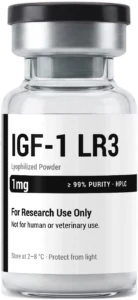
Rather than treating IGF-1 LR3 as simply a longer-lasting version of IGF-1, it is more useful to look at it as an engineered research analogue with its own pharmacological characteristics. Studies have examined its interaction with the IGF-1 receptor, downstream signalling, cellular growth processes and metabolic effects. Researchers have conducted much of this work in cell and animal models, so they should not automatically transfer the findings to humans.
What is IGF-1 LR3?
Native IGF-1 is a single-chain peptide involved in growth, development, metabolism and tissue regulation. In the circulation, IGF-1 is normally associated with several binding proteins, which influence how much free IGF-1 is available to interact with receptors. This binding system is an important part of normal IGF-1 biology.
IGF-1 LR3 was developed by making structural changes to the native IGF-1 molecule. One important modification is the substitution of glutamic acid with arginine at position 3. The molecule also contains an additional N-terminal extension. These changes substantially reduce its affinity for IGF-binding proteins compared with native IGF-1.
That altered binding behaviour is particularly relevant when researchers examine IGF-1 receptor activity under controlled experimental conditions.
How does it work?
The main receptor of interest is the insulin-like growth factor-1 receptor, or IGF-1R. This is a receptor tyrosine kinase found on the surface of many types of cells. When IGF-1R is activated, a number of intracellular signalling pathways can be switched on.
Two of the better-known pathways are PI3K-Akt and MAPK/ERK. They are involved in processes including protein synthesis, cellular growth, survival and regulation of cell behaviour. Research into IGF-1 signalling has shown that receptor activation can connect with several adaptor proteins and downstream signalling routes rather than acting through a single simple pathway.
IGF-1 LR3 can activate IGF-1R. Experimental work has also used the analogue specifically because its reduced interaction with IGF-binding proteins can help researchers examine IGF-1 receptor signalling without the same level of interference from binding proteins.
In more recent experimental work, LR3-IGF-1 stimulation was shown to increase Akt phosphorylation in mouse brain tissue, providing evidence of canonical IGF-1R pathway activation in that model.
Why is the LR3 modification important?
This is probably the most useful point to understand about the compound.
IGF-binding proteins strongly influence native IGF-1 in biological systems. IGF-1 LR3 has a much lower affinity for these proteins. Earlier research reported a greater than 100-fold reduction in binding-protein affinity while retaining affinity for IGF-1R.
This does not mean that LR3 simply becomes “100 times stronger. ” That would be an oversimplification. In experimental receptor assays, Long R3 IGF-1 was not necessarily more potent than recombinant human IGF-1 at activating IGF-1R. However, its altered interaction with binding proteins may change its availability and behaviour in biological systems.
For research purposes, that distinction matters. Receptor potency, circulation, binding-protein interaction and biological response are related, but they are not interchangeable measurements.
Areas being investigated
IGF-1 LR3 has appeared in experimental research involving cell growth, metabolism, muscle-related biology and signalling pathways.
Muscle research is one area where the compound has received attention. IGF-1 signalling is connected with anabolic and growth-related processes, and animal studies have investigated whether LR3-IGF-1 can influence muscle mass and function. Results have not always pointed in the same direction, which is a useful reminder that biological effects depend heavily on the model being used.
For example, research involving a mouse model of cancer cachexia found that Long R3 IGF-1 influenced muscle measurements, but the study also reported adverse findings, including reduced grip strength and body weight in treated animals.
Other experimental work has looked at LR3-IGF-1 in the brain. A recent mouse study examined long-term intranasal administration and found evidence of altered IGF-1R-related signalling, while the treatment did not produce a clear preservation of cognitive function in the disease model used.
These examples show why research around IGF-1 LR3 needs to be read in context. A result in one animal model does not establish a human therapeutic effect.
Research considerations and limitations
IGF-1 biology is complicated. The same signalling systems involved in normal growth and tissue maintenance can also influence cell proliferation and survival. IGF-1R signalling has therefore been extensively studied in cancer biology as well as normal physiology. Recent reviews continue to examine the relationship between IGF-1R signalling, receptor internalisation and tumour biology.
There is also a practical distinction between an experimental compound and an approved medicine. IGF-1 LR3 is widely discussed in research and online peptide communities, but that should not be confused with established clinical use. A recent review of performance-enhancing peptides noted that compounds marketed as “research” peptides, including IGF-1 LR3, are often used outside controlled research settings despite limited clinical evidence. Reported concerns include metabolic and endocrine effects, fluid retention, musculoskeletal symptoms and injection-site reactions.
For laboratory work, factors such as peptide purity, concentration, experimental model, exposure time and assay design can all affect the results. Comparing findings between studies, therefore, requires some care.
IGF-1 LR3 in peptide research
IGF-1 LR3 remains interesting because it provides researchers with a modified form of IGF-1 that behaves differently from the native molecule while retaining activity at IGF-1R. Its reduced affinity for IGF-binding proteins makes it particularly useful in experimental systems where researchers want to investigate IGF-1 receptor signalling with fewer binding-protein effects.
The research picture is not simply about muscle growth or increased anabolic activity. IGF-1 signalling reaches into cell survival, metabolism, growth and proliferation, which makes the system considerably broader than the claims often associated with IGF-1 LR3 online.
For that reason, IGF-1 LR3 is best understood as a research compound used to investigate IGF-related biology, receptor signalling and downstream cellular responses. Current evidence includes laboratory and animal research, while questions around long-term effects, appropriate clinical applications and human safety require much more evidence.
Published batch records
Every batch of IGF-1 LR3 we have sold, each with its published Certificate of Analysis.
| Batch | Size | Purity (HPLC) | Tested | Certificate |
|---|---|---|---|---|
| IGF-1-14 Current stock | 1mg | ≥99.0% | Oct 2026 | View CoA |
Research Use Only. IGF-1 LR3 is supplied strictly for laboratory research. Nothing on this page is dosing guidance, medical advice, or a suggestion of human or veterinary use.