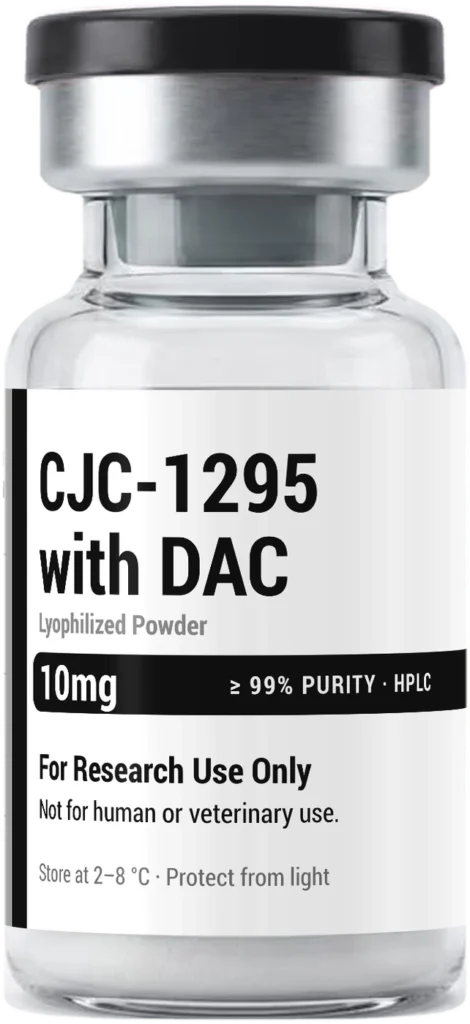
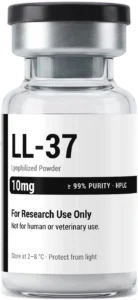
Vial label design and print may vary between batches. Product specifications remain unchanged.
At a glance
Strength
10mg per vial
Form
Lyophilised powder
Purity
≥ 99% (HPLC)
CAS number
863288-34-0
Molecular weight
3647.2 g/mol
Certificate of Analysis
Batch CD-10-09 · Prime Peptides UK
Growth hormone secretagogues
CJC-1295 With DAC
Synthetic research peptide · 10mg · CAS 863288-34-0
£54.95 In stock · ready to shipper vial · £5.50 per mg
CJC-1295 With DAC 10mg is coming soon. It goes on sale as soon as its batch certificate is published - every vial we sell has a matching CoA.
Bank transferBitcoin Encrypted checkout · card details are never taken on this site
Multi-item discount. Add any 2 items for 4% off the whole order, 7% at 3, 10% at 4. Applied automatically at checkout.
Part of a stack. CJC-1295 With DAC is in the Growth & Performance Stack (CJC-1295 DAC 10mg · Ipamorelin 10mg · IGF-1 LR3 1mg).
Free
Free lab add-on. Bacteriostatic water is included with every peptide order at no extra cost.
Lab essentials tap to add to this order
RUOResearch Use Only. Not for human or veterinary use. By purchasing you confirm you are a qualified researcher and accept responsibility for safe, lawful handling.
Same-day dispatch
Orders before 3:00 PM leave the same working day, tracked, in plain packaging. Free UK delivery over £200.
Secure payment
Bank transfer or Bitcoin over an encrypted checkout. No card details are stored or handled on this site.
Batch tested
Every batch is HPLC and mass spectrometry tested, and its certificate is published before it ships.
CJC-1295 With DAC 10mg≥99% HPLC · In stock
£54.95
Compound Overview
What Is CJC-1295 with DAC 10mg?
CJC-1295 with DAC 10mg is a laboratory research peptide that is supplied in a controlled amount of 10mg. The synthetic growth hormone-releasing hormone (GHRH) analogue CJC-1295 has been created and the Drug Affinity Complex (DAC) modification has been engineered to modify the pharmacokinetic behavior of CJC-1295 in experimental models. This product is for laboratory and scientific research only, and not for human use.
CJC-1295 is a synthetic peptide based on the biological activity of the growth hormone-releasing hormone or GH-RH. It has been studied mainly due to the modifications made to the peptide to enhance stability and persistence in comparison to similarly acting peptides of shorter duration.
The key characteristic of this version is the Drug Affinity Complex (DAC). This chemical modification allows the compound to covalently bind to circulating albumin in experimental conditions. The effect of this property on peptide stability, exposure and biological activity in time has been studied.
Therefore, it is important to differentiate CJC-1295 with DAC from CJC-1295 (1-29) without DAC and Modified GRF (1-29), which are more commonly referred to as research materials. The names are used interchangeably, but they are not necessarily the same research compounds.
The 10mg designation is only for the amount of research material provided. Not a human dose or administration recommendation. The format clearly specifies the amount of material required for the laboratory, which can be used in an analytical or experimental procedure.
Technical Data
CJC-1295 With DAC Product Specifications
Technical Specification Sheet
CJC-1295 WITH DAC · 10MG · RUO
Product Name
CJC-1295 with DAC 10mg
Compound Type
Synthetic peptide
Strength
10mg
Modification
Drug Affinity Complex (DAC)
Format
Research peptide material
Research Classification
Experimental GHRH analogue
Testing
Refer to batch-specific analytical documentation
COA
Batch-specific Certificate of Analysis where provided
Intended Use
Laboratory and scientific research only
Human Use
Not intended for human consumption or administration
CAS Number
863288-34-0
Amino-Acid Sequence
Mod GRF 1-29 conjugated to a Drug Affinity Complex (maleimidopropionic acid)
Molecular Formula
C165H269N47O46
Molecular Weight
3647.2 g/mol
Purity
≥99% by HPLC
Researchers should consult the documentation accompanying the individual batch for analytical results and product-specific storage requirements rather than assuming that specifications are identical between batches.
The Science
Scientific Background: CJC-1295 and the DAC Modification
Natural GHRH participates in signalling associated with growth hormone secretion but has relatively short biological persistence. Scientific development of GHRH analogues has therefore explored structural modifications capable of changing stability while retaining activity at relevant receptors.
CJC-1295 emerged from this area of peptide research. A particularly important aspect of its design was the addition of a reactive group known as a Drug Affinity Complex. In experimental systems, this modification was developed to bind the peptide to albumin, a circulating protein with a substantially longer biological lifespan than many unmodified peptides.
This albumin-binding approach attracted scientific interest because it offered researchers a way to investigate whether peptide exposure could be prolonged without simply studying repeated short-lived signalling events.
Published research has examined CJC-1295 in relation to GHRH receptor activity, growth hormone-related signalling and downstream changes involving insulin-like growth factor-1 (IGF-1). However, research observations should be interpreted within the design and limitations of the individual study.
Research Context
CJC-1295 with DAC remains an investigational research compound rather than an approved medicine for routine therapeutic use in the UK.
Laboratory Focus
Why Is CJC-1295 with DAC Studied?
One reason researchers investigate CJC-1295 with DAC is that it provides a model for studying how molecular modifications can alter peptide behaviour. Adding an affinity component to a peptide can change how long it lasts, where it goes, and how it interacts with biological systems. This makes the compound important in more than one signalling pathway.
Growth Hormone Axis
Laboratory and experimental literature has explored areas including GHRH receptor signalling, growth hormone dynamics, IGF-1-related responses and peptide pharmacokinetics. The compound has also contributed to broader scientific questions surrounding albumin binding and the extension of peptide activity.
Ageing & Cellular Research
These research areas should not be interpreted as evidence that CJC-1295 with DAC provides particular health, bodybuilding, anti-ageing or performance outcomes in people.
Laboratory Research
The distinction is particularly important when discussing experimental peptides online. A biological response observed under controlled research conditions does not automatically establish clinical safety, effectiveness or an appropriate therapeutic application.
Laboratory Research
For UK laboratories, CJC-1295 with DAC should consequently be treated as experimental research material whose characteristics require controlled investigation and appropriate analytical documentation.
Product Format
Understanding the 10mg Research Format
10mg
Nominal Research Quantity
For this product, 10mg describes the total nominal quantity of CJC-1295 with DAC research material supplied in the vial. It does not indicate a recommended experimental concentration, human dosage or administration schedule.
A laboratory may choose a 10mg research format if that material quantity aligns with its planned workflow. Requirements can differ considerably depending on the number of experiments, analytical techniques, assay design, controls, replicates and overall scale of a project.
For example, a research group conducting several analytical stages may have different material requirements than a laboratory performing a limited characterisation experiment. Consequently, vial strength alone should not be used to determine how a compound is incorporated into a study.
Researchers should calculate material requirements independently according to their validated protocols and institutional procedures.
This makes the 10mg format primarily a supply specification. It provides a clearly defined quantity that researchers can account for when planning laboratory inventory and experimental resources.
Verification
Quality Testing, Identity and Batch Documentation
The knowledge of the material to be studied is essential for research on synthetic peptides. When assessing CJC-1295 in the UK products, therefore, analytical documentation is an important consideration.
Batch-Specific CoA
A Certificate of Analysis (COA) must be linked to a specific batch of product and not be a generic document. The COA contains information that can be used by researchers to identify the batch of plants, to verify analytical results, and to determine when a plant was tested and what method was used to assess the material.
HPLC Analysis
Peptide analysis and evaluation of chromatographic purity are commonly done using high-performance liquid chromatography (HPLC). Other analytical methods might be available for the study of molecular identity or other properties. It is important to remember that purity and identity are distinct analytical questions and that a purity result does not necessarily imply the complete identity of the molecule.
Documentation & Transparency
If independent testing is indicated, the researchers should verify with the actual batch documentation of the product to determine what was tested and the analytical method used.
Clear batch records also help to ensure traceability in the laboratory, in the material in the laboratory, in the analysis and experimental processes.
Handling
Laboratory Storage and Material Handling
Environmental Conditions
Peptide research materials can be sensitive to environmental conditions, so storage should be based on the documentation supplied for the specific product. Laboratories should retain CJC-1295 with DAC 10mg in its original labelled packaging where appropriate and follow the stated temperature requirements.
Contamination Control
Exposure to excessive heat, moisture, and light should be minimised when the supplier's documentation identifies these factors as stability considerations. Appropriate laboratory practice also requires measures to reduce accidental contamination and unnecessary environmental exposure.
Labelling & Traceability
Researchers should maintain clear batch identification throughout storage and handling. Any laboratory preparation should follow established institutional SOPs and the requirements of the experimental protocol.
Documentation First
Product information for research handling should not be interpreted as instructions for preparation, injection or human administration.
When assessing a UK peptide supplier, it's important to investigate further than the vial strength and the name of the product. This is of specific importance for CJC related materials, where the DAC and without DAC variants are not interchangeable.
Laboratories are advised to carefully read the product description, strength, batch information and analytical documentation available prior to sourcing CJC-1295 with DAC 10mg. A batch-specific CoA can provide greater transparency about the material supplied.
Other factors to consider when comparing research peptide suppliers include packaging information, labelling, traceability, storage instructions, and supplier contact details.
Inconsistencies in procurement and inventory planning across different geographies do not justify relying on dispatch in the UK instead of carrying out scientific due diligence. The researchers themselves are responsible for verifying that the material and supporting documentation are suitable for the laboratory use they plan to make of it.
Analytical Records
Batch certificates for CJC-1295 With DAC
Every order ships with the CoA matched to its batch number, and the analytical records
are published here - open the certificate before you order, or cross-check the one in
your parcel.
DAC stands for Drug Affinity Complex. In CJC-1295, this modification was developed to facilitate binding to albumin in experimental biological environments. Researchers have studied this approach as a means of altering the persistence and pharmacokinetic characteristics of a peptide. It is also an important feature for correctly identifying which CJC-related research compound is being examined.
What exactly does CJC-1295 with DAC 10mg mean?
The 10mg figure identifies the nominal quantity of research peptide material supplied in the product format. It is a product specification rather than a recommended dose. Laboratories determine material requirements according to their own experimental design, analytical methods and validated protocols.
Is CJC-1295 with DAC the same as CJC-1295 without DAC?
No, DAC modification distinguishes these research materials and it contains versions designed to bind to albumin and exhibit specific pharmacokinetic properties. Therefore, it is essential for researchers to verify the exact identity of the molecule rather than simply assuming that all products sold under the name CJC-1295 are identical.
What should I look for on a CJC-1295 with DAC COA?
Confirm the batch number of the product matches the Certificate of Analysis. Useful information may include chemical identity, claimed purity result, analytical method, test date and other batch specific results. Researchers should distinguish between tests evaluating purity and those used to support molecular identity.
Why might researchers choose a 10mg vial?
A laboratory may select a 10mg format when that quantity corresponds with its anticipated material requirements. The quantity analytical techniques, controls, and repetitions. An experimental methodology or suitable concentration are not established by the vial quantity alone.
Is CJC-1295 with DAC 10mg approved for human use in the UK?
It is for research only, not for human use or self-administration. Researchers should differentiate between the scientific research of an experimental peptide and its authorised therapeutic use. Medicinal products in the UK are regulated by the Medicines and Healthcare products Regulatory Agency (MHRA) under the regulatory framework.
PG
Medically & Scientifically Reviewed By
Dr. Priyanka Goel
Scientific & Medical Content Reviewer
Reviews research content against current published literature and UK regulatory guidance, ensuring compound information is accurate, referenced and presented for research use only.
CJC-1295 with DAC 10mg is only available for laboratory research use. Not for use in humans, self-administration, diagnosis or therapy. The scientific data shown here are only for research context and product attributes, and are not to be considered as medical or dosage information or treatment recommendations.