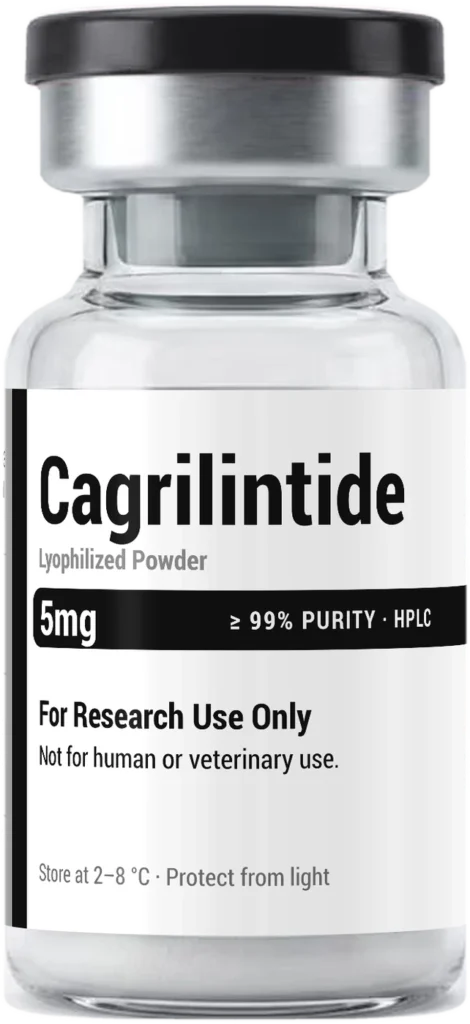
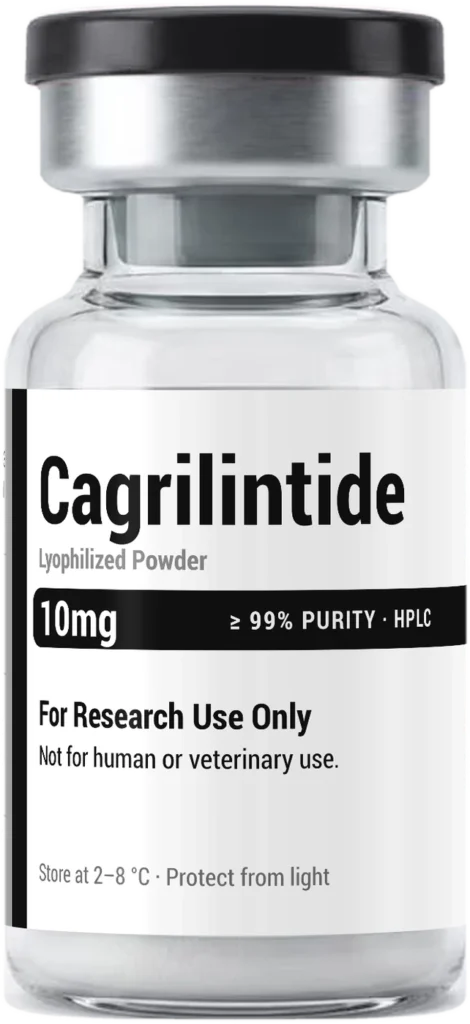
Vial label design and print may vary between batches. Product specifications remain unchanged.
At a glance
Strength
10mg per vial
Form
Lyophilised powder
Purity
≥ 99% (HPLC)
Certificate of Analysis
Batch CGL-10-05 · Prime Peptides UK
Metabolic
Cagrilintide
Synthetic research peptide · 10mg
£45.95 In stock · ready to shipper vial · £4.60 per mg
Choose strengthPrice per vial
Cagrilintide 10mg is coming soon. It goes on sale as soon as its batch certificate is published - every vial we sell has a matching CoA.
Bank transferBitcoin Encrypted checkout · card details are never taken on this site
Multi-item discount. Add any 2 items for 4% off the whole order, 7% at 3, 10% at 4. Applied automatically at checkout.
Free
Free lab add-on. Bacteriostatic water is included with every peptide order at no extra cost.
Lab essentials tap to add to this order
RUOResearch Use Only. Not for human or veterinary use. By purchasing you confirm you are a qualified researcher and accept responsibility for safe, lawful handling.
Same-day dispatch
Orders before 3:00 PM leave the same working day, tracked, in plain packaging. Free UK delivery over £200.
Secure payment
Bank transfer or Bitcoin over an encrypted checkout. No card details are stored or handled on this site.
Batch tested
Every batch is HPLC and mass spectrometry tested, and its certificate is published before it ships.
Cagrilintide 10mg≥99% HPLC · In stock
£45.95
Compound Overview
Cagrilintide 10 mg is a synthetic, long-acting amylin analogue supplied as a research material for laboratory use. It is used in research exploring amylin and calcitonin receptor signalling, appetite-related pathways and wider metabolic processes.
Cagrilintide has become an interesting target in peptide research, as it was designed to provide more prolonged activity than naturally occurring amylin. Scientists have learned how its effects on pathways related to feeling full, food consumption, and metabolic control led them to study how this signalling can interact with other biological systems.
The 10 mg format provides a larger defined quantity for laboratories that require a suitable amount of research material for their proposed experimental work. For research use only and should be used in accordance with established laboratory procedures.
What is cagrilintide?
Cagrilintide is a peptide hormone secreted by the pancreatic beta cells. Cagrilintide is a long-acting amylin analogue. Amylin is secreted in concert with insulin after meals and serves to modulate several processes involved in food intake and digestion.
Natural amylin has a short duration of action, which has encouraged research into longer-acting analogues. Cagrilintide was developed with structural modifications intended to extend its activity and make it suitable for studying sustained amylin-related signalling.
Research has described cagrilintide as an agonist of amylin and calcitonin receptor complexes. This receptor activity is relevant to studies investigating satiety, food intake and metabolic responses.
Cagrilintide 10mg for Laboratory Research
The 10 mg product is intended for researchers who need a defined quantity of cagrilintide for controlled laboratory studies.
Potential research areas include:
Amylin receptor signalling
Calcitonin receptor-related pathways
Satiety and appetite mechanisms
Food-intake regulation
Metabolic signalling
Peptide-receptor interactions
Comparative studies of amylin analogues
Preclinical research involving metabolic pathways
The amount required for an experiment will depend entirely on the research model, protocol and analytical objectives. The 10 mg product size should therefore be viewed as a quantity of research material, rather than as a recommended experimental dose.
How Cagrilintide Relates to Amylin
Amylin is involved in signalling pathways that help to regulate events after food consumption. It may help promote feelings of fullness and affect the rate at which food leaves the stomach.
Cagrilintide enables researchers to investigate these pathways with a longer-acting amylin analogue. This may be useful for studying receptor activity for a longer experimental period or for comparing different peptide structures.
There is a difference between native amylin and cagrilintide. Cagrilintide is more than a big dose of natural amylin. It is a specifically modified peptide analogue with its own structural and pharmacological properties.
Research Into Appetite and Metabolic Signalling
One of the main areas of interest surrounding cagrilintide is the relationship between amylin signalling, satiety and food intake.
In clinical research, once-weekly cagrilintide has been investigated at several doses. A phase 2 dose-finding study evaluated doses ranging from 0.3 mg to 4.5 mg and reported dose-related reductions in body weight, with gastrointestinal events among the commonly reported adverse events.
More recent research has continued to investigate cagrilintide at 2.4 mg in phase 3 development. This work is separate from the supply of a 10 mg research product. The clinical doses studied should not be interpreted as instructions for using a research-grade product.
For laboratory researchers, these studies provide background information about the biological pathways being investigated, while individual experiments still require their own validated protocols.
Cagrilintide and Combination Research
Cagrilintide has also been studied in combination with semaglutide, a GLP-1 receptor agonist. This combination is called CagriSema and is being investigated because the two compounds work possibly through different but complementary biological pathways.
It is important to conduct combination studies to understand how different receptor systems can affect related metabolic processes. But it’s not a simple extrapolation from combination study data to cagrilintide.
For research purposes, it is important to keep the identity, quantity and composition of individual peptide materials clearly documented.
What to Verify When Buying Cagrilintide
The stated quantity is only one part of evaluating a research peptide. Researchers should also look at the available analytical and batch information before beginning an experiment.
Useful information can include:
Peptide name and sequence
Stated quantity
Molecular weight
HPLC purity
Mass spectrometry results
Batch or lot number
Certificate of Analysis
Storage recommendations
Relevant testing information
A Certificate of Analysis (CoA) can provide batch-specific information about the material supplied. HPLC and mass spectrometry are also useful for different reasons. HPLC can help assess the purity profile, while mass spectrometry can support confirmation of molecular mass and identity.
A high HPLC purity figure does not, on its own, prove every aspect of peptide identity. Looking at the available analytical information as a whole gives researchers a clearer picture of the material.
Cagrilintide 10mg Storage
Peptides can be affected by environmental conditions such as temperature, moisture and repeated exposure to unsuitable storage conditions. Appropriate storage is therefore an important part of maintaining research material.
Cagrilintide should be stored under the conditions specified by the manufacturer. Good laboratory practices should be followed when handling cagrilintide. Researchers are advised to eliminate unnecessary exposure to heat, moisture and other environmental conditions that may contribute to peptide degradation.
Stability also can depend on variables such as the solvent used, concentration, temperature, and storage period once prepared for an experiment. Researchers should establish procedures for handling and preparation appropriate to their laboratory requirements.
Why Choose the 10mg Format?
A 10 mg amount may be suitable for research projects that require a larger, more precisely defined quantity of cagrilintide than is available in a smaller product format.
Defined quantities also assist in managing laboratory records, monitoring material usage and experiment planning. The amount needed will vary between research projects, so researchers should calculate requirements from their experimental design rather than treating the product size as a recommended amount for any particular study.
The 10 mg format is therefore best considered a practical research quantity for laboratories working with cagrilintide under controlled conditions.
Research Use Only
Cagrilintide 10 mg is supplied strictly for laboratory and research use. It is not intended for human consumption, self-administration, diagnosis, treatment or prevention of any disease or medical condition.
This product should only be handled by suitably qualified personnel working in an appropriate research environment. Researchers are responsible for following relevant laboratory procedures, safety requirements and applicable regulations.
Cagrilintide 10mg at a Glance
Cagrilintide is a long-acting amylin analogue that has been investigated in research involving amylin and calcitonin receptor signalling, satiety, food intake and metabolic pathways. Current clinical development has focused on lower doses, while a 10 mg product represents a defined quantity of research material rather than a clinical dosing recommendation.
For researchers selecting cagrilintide, it is useful to consider more than the product quantity. Peptide identity, sequence, purity, analytical testing, batch information, storage conditions and intended research application should all form part of the assessment.
Sizes & Prices
Cagrilintide sizes and prices
Each size is supplied from its own tested batch with its own Certificate of Analysis. The size is the amount of research material in the vial; larger vials cost less per mg.
Size
Price
Per mg
Batch certificate
Choose
5mg
£28.95
£5.79
CGL-05-05
10mg
£45.95
£4.60
CGL-10-05
Technical Data
Cagrilintide Product Specifications
Technical Specification Sheet
CAGRILINTIDE · RUO
Product
Cagrilintide 10mg
Compound
Cagrilintide
Quantity
5mg, 10mg per vial
Classification
Long-acting amylin analogue
Molecular formula
C194H312N54O59S2
Molecular weight
Approximately 4409 g/mol
Research status
Investigational
Testing
Refer to applicable batch documentation
COA
Batch-specific Certificate of Analysis with every batch
Intended use
Laboratory and scientific research only
Human use
Not intended for human consumption or self-administration
Purity
≥99% by HPLC
PubChem records cagrilintide with the molecular formula C194H312N54O59S2 and a molecular weight of approximately 4409 g/mol.
Researchers should always consult the product label, batch documentation and relevant Certificate of Analysis before beginning laboratory work.
Analytical Records
Batch certificates for Cagrilintide
Every order ships with the CoA matched to its batch number, and the analytical records
are published here - open the certificate before you order, or cross-check the one in
your parcel.
Is Cagrilintide 10mg the same as a 10mg human dose?
No. On a research-product page, 10mg refers to the total quantity of research material supplied. It should not be interpreted as a recommended human dose. This product is positioned exclusively for laboratory and scientific research.
What type of compound is cagrilintide?
Cagrilintide is a synthetic, lipidated, long-acting analogue of the peptide hormone amylin. Its design was developed to provide greater stability and prolonged activity compared with native amylin.
Why might a laboratory select a 10mg research format?
Material requirements vary between projects. Researchers may select a quantity according to factors such as planned assays, replicates, analytical work, experimental scale and laboratory protocol. A 10mg format does not imply that it is more effective or appropriate than another quantity.
Is cagrilintide approved as a medicine in the UK?
Cagrilintide remains an investigational compound. Current UK regulatory records demonstrate ongoing development activity rather than establishing a laboratory Cagrilintide 10mg product as an authorised medicine.
What should I look for on a Cagrilintide Certificate of Analysis?
Researchers should check whether the COA identifies the specific product and batch and review the reported analytical tests and results. Where testing methods such as HPLC are listed, results should be interpreted within the scope and limitations of those methods.
What scientific research has been conducted on cagrilintide?
Published work includes medicinal-chemistry development, receptor and mechanism research, and controlled clinical studies examining cagrilintide as a long-acting amylin analogue. Research has progressed into phase 3 development, but the compound remains investigational.
PG
Medically & Scientifically Reviewed By
Dr. Priyanka Goel
Scientific & Medical Content Reviewer
Reviews research content against current published literature and UK regulatory guidance, ensuring compound information is accurate, referenced and presented for research use only.
Cagrilintide 10mg is supplied for legitimate laboratory, analytical and scientific research only. Not supplied for human use, self-medication, diagnostics or therapy. It is not an authorised medicine and should not be seen as being interchangeable with cagrilintide formulations in controlled clinical trials. The scientific information provided on this page is intended for education and research purposes only and is not intended to be used as medical information.