
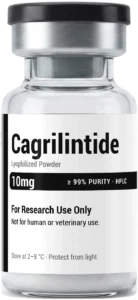
It is worth separating cagrilintide itself from CagriSema, the combination of cagrilintide and semaglutide. A significant deal of the recent clinical discussion has focused on the combination, but cagrilintide is also being studied as a standalone treatment. As of 2026, it remains a development-stage medicine rather than something that should be treated as an established UK treatment option. The MHRA has published paediatric investigation-plan records for cagrilintide in obesity, which reflect ongoing development rather than a marketing authorisation.
What is cagrilintide?
Cagrilintide is a long-acting analogue of amylin, a hormone produced by pancreatic beta cells alongside insulin. Amylin has several roles in controlling food intake and digestion. Among other effects, it is involved in signalling fullness after eating and slowing gastric emptying.
The research interest in cagrilintide comes partly from the attempt to make use of these pathways in a longer-acting form. Rather than directly targeting the GLP-1 receptor, as semaglutide does, cagrilintide acts through amylin-related receptor pathways.
That difference matters when looking at the research. Cagrilintide is not simply another version of a GLP-1 medicine. It represents a separate biological approach, although it has also been investigated alongside GLP-1 receptor agonism.
Early clinical research
Some of the first useful clinical evidence came from a phase 2 trial published in The Lancet in 2021. The study was a multicentre, randomised, double-blind, placebo-controlled and active-controlled dose-finding trial involving adults with overweight or obesity. Researchers assessed several once-weekly doses of cagrilintide over 26 weeks.
The study helped establish that cagrilintide could produce measurable changes in body weight while also providing researchers with information about dose selection and tolerability.
Researchers emphasised the importance of contextualising the phase 2 results, despite their significance. It was a big step, but the phase 2 results need to be put in context, researchers said. They are useful for proof of concept and dose finding for subsequent studies but are less informative than larger phase 3 programs.
What is the effect of cagrilintide in combination with semaglutide?
Here the research becomes really interesting.
Cagrilintide and semaglutide have been investigated together as CagriSema. The reasoning is fairly straightforward: the two compounds act through different but potentially complementary biological pathways involved in appetite and energy balance.
The phase 3 REDEFINE 1 trial enrolled adults with overweight or obesity who did not have diabetes. After 68 weeks, the estimated mean change in body weight was −20.4% with the cagrilintide–semaglutide combination, compared with −3.0% with placebo. Gastrointestinal adverse events were common, with nausea, vomiting, diarrhoea, constipation and abdominal pain among the reported effects. Most were described as transient and mild to moderate.
A separate phase 3 study, REDEFINE 2, looked at adults with obesity or overweight and type 2 diabetes. The combination again produced significantly greater weight reduction than placebo, while gastrointestinal events were more frequent in the active-treatment group.
These studies are about the combination, though. They should not automatically be used to claim that cagrilintide alone produces the same degree of weight loss.
Cagrilintide as a standalone research candidate
More recent analysis has provided a clearer look at cagrilintide without semaglutide.
According to Novo Nordisk’s 2025 annual report, a sub-analysis of REDEFINE 1 found that once-weekly cagrilintide at 2.4 mg produced an average 11.8% reduction in body weight after 68 weeks, compared with 2.3% with placebo, using the treatment-product estimated. More than 30% of participants achieved at least 15% weight loss, compared with less than 5% in the placebo group.
These findings have helped move standalone cagrilintide into the phase 3 RENEW programme. In other words, research has progressed beyond the earlier dose-finding work and into larger studies intended to provide more definitive evidence.
That progression is probably one of the more important things to watch when assessing cagrilintide. The question is no longer simply whether an amylin analogue can influence body weight. Researchers are now looking more closely at the scale of the effect, longer-term tolerability and where the treatment might fit within obesity research.
Tolerability and research considerations
Gastrointestinal effects are a recurring feature of cagrilintide research. Clinical studies have reported nausea, vomiting, diarrhoea, and constipation, especially at higher doses. In the phase 3 combination trial, these events were generally described as mild to moderate and transient, although that does not mean they are irrelevant when considering the overall treatment profile.
Another point worth keeping in mind is that clinical trial populations are selected according to specific inclusion and exclusion criteria. Results from a controlled study cannot simply be transferred to every individual or every possible research setting.
There is also an important distinction between research-grade peptide material and an authorised pharmaceutical product. A research profile can describe the molecule, its biological target and published findings, but that should not be confused with evidence that an unapproved product is suitable for human use.
Where does cagrilintide research stand?
Cagrilintide has moved considerably further than an early-stage experimental peptide. It has progressed from phase 2 dose-finding studies into phase 3 development, with both standalone cagrilintide and the cagrilintide–semaglutide combination being investigated.
At the same time, the research story is still developing. CagriSema has generated substantial phase 3 data, while standalone cagrilintide is now being studied in the RENEW programme. Novo Nordisk’s 2025 report lists cagrilintide as a phase 3 obesity program.
For researchers, the main interest lies in the amylin pathway itself and how it differs from, or complements, established incretin-based approaches. Future trial results should help clarify questions around durability, tolerability, patient selection and the potential role of cagrilintide as a standalone approach.
For now, cagrilintide is best understood as an investigational long-acting amylin analogue with a growing clinical evidence base, rather than as a conventional, established medicine.
Published batch records
Every batch of Cagrilintide we have sold, each with its published Certificate of Analysis.
Research Use Only. Cagrilintide is supplied strictly for laboratory research. Nothing on this page is dosing guidance, medical advice, or a suggestion of human or veterinary use.