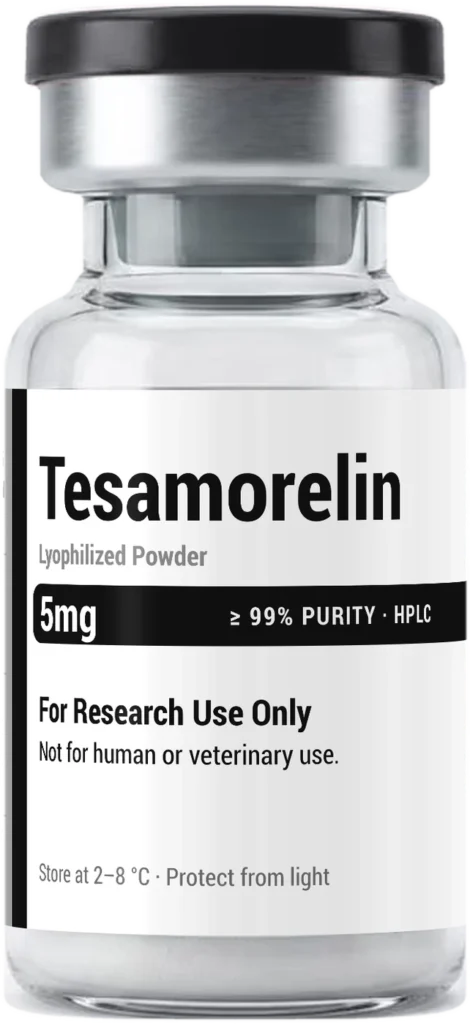
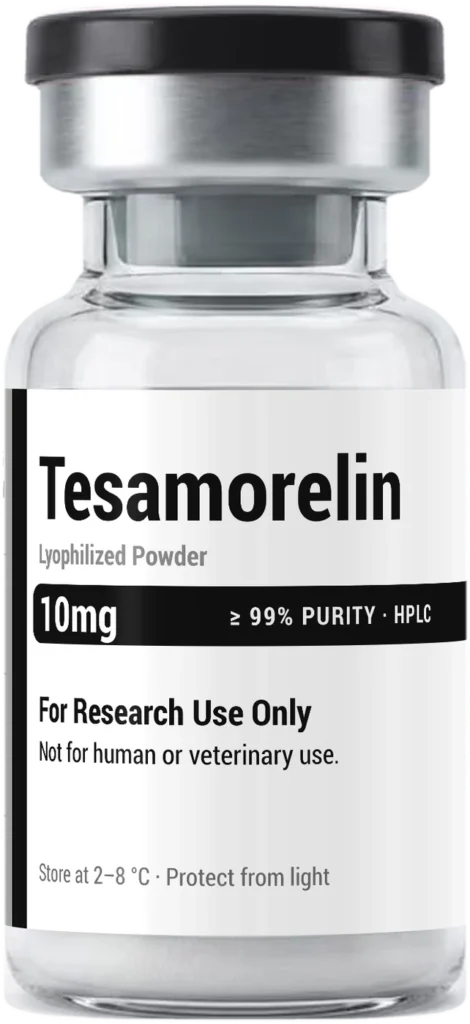
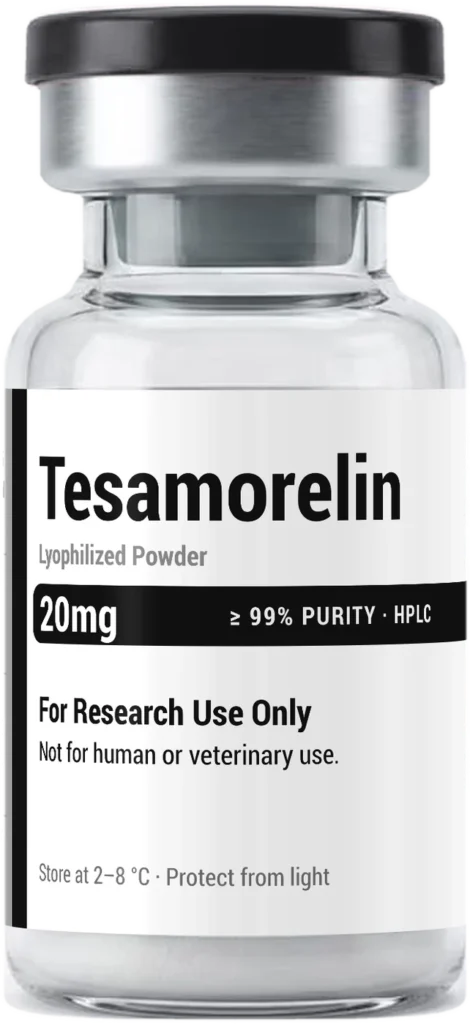
Vial label design and print may vary between batches. Product specifications remain unchanged.
At a glance
Strength
10mg per vial
Form
Lyophilised powder
Purity
≥ 99% (HPLC)
CAS number
218949-48-5
Molecular weight
5135.9 g/mol
Certificate of Analysis
Batch TSM-10-31 · Prime Peptides UK
Storage
Follow the product label, supplier documentation and institutional laboratory SOPs
Growth hormone secretagogues
Tesamorelin
Synthetic research peptide · 10mg · CAS 218949-48-5
£49.95 In stock · ready to shipper vial · £5.00 per mg
Choose strengthPrice per vial
Tesamorelin 10mg is coming soon. It goes on sale as soon as its batch certificate is published - every vial we sell has a matching CoA.
Bank transferBitcoin Encrypted checkout · card details are never taken on this site
Multi-item discount. Add any 2 items for 4% off the whole order, 7% at 3, 10% at 4. Applied automatically at checkout.
Free
Free lab add-on. Bacteriostatic water is included with every peptide order at no extra cost.
Lab essentials tap to add to this order
RUOResearch Use Only. Not for human or veterinary use. By purchasing you confirm you are a qualified researcher and accept responsibility for safe, lawful handling.
Same-day dispatch
Orders before 3:00 PM leave the same working day, tracked, in plain packaging. Free UK delivery over £200.
Secure payment
Bank transfer or Bitcoin over an encrypted checkout. No card details are stored or handled on this site.
Batch tested
Every batch is HPLC and mass spectrometry tested, and its certificate is published before it ships.
Tesamorelin 10mg≥99% HPLC · In stock
£49.95
Compound Overview
What Is Tesamorelin 10mg?
Tesamorelin 10mg is a research format containing a synthetic analogue of growth hormone-releasing hormone (GHRH). The compound is investigated for its interactions with the GHRH receptor and its impact on the growth hormone–IGF-1 signalling axis. The 10mg format applies to the amount of research material provided, and is not a recommended dose. In the UK, Prime Peptides UK places great importance on responsible sourcing, including product documentation and batch information, which guide laboratory and scientific research.
Tesamorelin is a synthetic peptide analogue of human GHRH (also referred to as a stabilised GHRH(1-44) analogue). It is used by researchers to study GHRH-receptor signalling, endogenous growth hormone secretion and downstream effects on insulin-like growth factor 1 (IGF-1). Research published has explored the physiological GH/IGF-1 pathway and associated biological functions of tesamorelin.
Tesamorelin 10 mg is labelled as containing 10 mg of research material. It is not a clinical dose or guidance on prescribing or administration. The amount needed for an analysis may vary depending on the assay design, analytical method, number of experimental runs, and goals of a specific assay.
This distinction is particularly important when comparing different tesamorelin quantities. The 10mg research dosage refers to the amount of drug in the study, not its therapeutic efficacy, or safety.
Sizes & Prices
Tesamorelin sizes and prices
Each size is supplied from its own tested batch with its own Certificate of Analysis. The size is the amount of research material in the vial; larger vials cost less per mg.
Size
Price
Per mg
Batch certificate
Choose
5mg
£29.95
£5.99
TSM-05-31
10mg
£49.95
£5.00
TSM-10-31
20mg
£89.95
£4.50
TSM-20-31
Technical Data
Tesamorelin Product Specifications
Technical Specification Sheet
TESAMORELIN · RUO
Product name
Tesamorelin
Compound
Tesamorelin
Alternative research identifier
TH9507
Research class
Synthetic GHRH analogue
Quantity
5mg, 10mg, 20mg per vial
Primary research context
GHRH-receptor, growth hormone and IGF-1 signalling research
Intended use
Laboratory and scientific research only
Documentation
Researchers should consult the batch-specific Certificate of Analysis and product documentation supplied for the lot
Testing
Review the stated analytical methods and reported results for the individual batch rather than assuming a fixed purity value
Storage
Follow the product label, supplier documentation and institutional laboratory SOPs
CAS Number
218949-48-5
Amino-Acid Sequence
Trans-3-hexenoyl-GHRH(1-44)-NH2
Molecular Formula
C221H366N72O67S
Molecular Weight
5135.9 g/mol
Purity
≥99% by HPLC
Public chemical databases identify tesamorelin under CAS number 218949-48-5 and describe it as a synthetic GHRH analogue.
The Science
Scientific Background and Mechanistic Research
GHRH is produced in the hypothalamus and is involved in the physiological regulation of growth hormone secretion by the pituitary gland. Tesamorelin was designed to be a stabilised analogue that could act on this biological pathway.
In healthy adults, studies have demonstrated that treatment with tesamorelin can enhance basal growth hormone and pulsatile growth hormone levels and IGF-1. The results obtained here are important to the study of the GHRH-GH-IGF-1 axis and the endocrine regulation of GH secretion.
Clinical trials have also evaluated tesamorelin in patients with specific metabolic profiles, including those with HIV-associated excess abdominal fat. Various endpoints have been measured during trials, such as visceral adipose tissue, IGF-1, lipid parameters and glucose-related markers.
Research Context
The results of those studies are to be understood in the context of the original populations and protocols. They cannot automatically be extrapolated to other settings or turned into claims of therapeutic benefit for a lab-available research-based product.
Laboratory Focus
Scientific and UK Regulatory Context
Tesamorelin has been investigated in controlled human studies, but those publications concern defined investigational or medicinal preparations, study populations and protocols; they do not establish the quality, suitability or therapeutic status of a separately sold research product.
Growth Hormone Axis
In the UK, medicinal-product information and marketing-authorisation records are handled through the MHRA's official product information services. Researchers should therefore keep published clinical evidence, UK medicines regulation and laboratory-product documentation as separate questions when evaluating Tesamorelin 10mg.
Receptor Signalling
Tesamorelin is seen in research in a variety of related fields. The best studied relates to the activation of the GHRH receptor, and subsequent growth hormone and IGF-1 signals. This is used to aid investigations of endocrine regulation, receptor-mediated signalling and physiological feedback mechanisms.
Inflammatory Signalling
Other studies have assessed variations in visceral fat, lipid-related outcomes, glucose control, inflammatory markers and body-composition measures within pre-specified research cohorts. A controlled study, for instance, of type 2 diabetic patients, studied insulin sensitivity and glycaemic parameters along with IGF-1 and lipid parameters.
Mitochondrial Function
Other less developed fields have also been studied. Magnetic resonance spectroscopy has been studied to evaluate mitochondrial function, and other studies have looked at neurochemical and cognitive endpoints in older adults. It is not to be assumed that a wide research history means that a drug is generally beneficial for therapy purposes. Some results are specific to the population studied, sample sizes are limited, and there are questions that have not been answered about generalisability and long-term results. A good Tesamorelin 10mg UK product page should differentiate between observation and conclusions that have yet to be proved.
Product Format
Understanding the 10mg Research Format
10mg
Nominal Research Quantity
The 10mg presentation is best understood as an inventory and experimental-planning quantity. It tells a laboratory how much tesamorelin research material is associated with the product, not how much should be administered to a person or animal.
A laboratory may select a particular material quantity for practical reasons. A project involving repeated analytical runs may require a different amount from a limited proof-of-concept assay. Requirements can also vary according to the number of replicates, sample preparation, calibration work, stability testing or the analytical sensitivity of the chosen methodology.
This makes the 10mg specification relevant when comparing laboratory materials. Researchers can evaluate whether the supplied quantity corresponds with projected analytical requirements without treating different product quantities as clinical “strengths”.
The appropriate amount of material required for any investigation should be determined by the approved experimental protocol, institutional procedures and validated methodology. No human or veterinary dosing inference should be made from the 10mg product label.
Verification
Quality Testing, Purity and Certificate of Analysis
For research peptides, a product name alone is not sufficient to establish suitability for an experiment. Researchers should review analytical documentation connected with the specific batch being supplied.
Batch-Specific CoA
A Certificate of Analysis (COA) can provide information such as batch identification, reported analytical results and the techniques used to evaluate the material. High-performance liquid chromatography (HPLC) is frequently used for assessing peptide purity profiles, although an HPLC result alone does not necessarily answer every question concerning molecular identity.
HPLC Analysis
The key consideration is traceability. A useful batch-specific COA should correspond to a batch or lot number associated with the supplied research material. Researchers evaluating HPLC-tested peptides should also determine whether testing was conducted internally or independently and whether the documentation identifies the analytical method clearly.
Identity vs Purity
Prime Peptides UK product claims should therefore be assessed against current batch documentation. Researchers should not assume a particular purity percentage, test result or analytical specification unless it is documented for the relevant lot.
Handling
Storage and Laboratory Handling
Environmental Conditions
Peptide research materials may be vulnerable to environmental factors such as repeated handling, light, moisture and temperature. Therefore, Tesamorelin 10mg should be stored in accordance with the conditions specified on the product label and in the accompanying documentation and in line with the laboratory's standard operating procedures.
Contamination Control
Store and preserve batch identification for research material in clearly labelled containers. The use of unnecessary environmental exposures should be minimized and contamination-control procedures used for peptide research should be considered in the laboratory.
Documentation First
Requirements for storage may differ depending on the physical presentation, and depending on the supplier specification, a universal temperature cannot be used as a criterion in lieu of the instructions of the specific product. Sampling and analytical manipulation should be done under a known protocol.
Reconstitution Practice
This information does not constitute instructions for human preparation, injection or administration.
Researchers evaluating UK suppliers of Tesamorelin 10 mg should consider more than price or product naming. Relevant criteria include clear compound identification, accessible testing documentation, batch traceability, appropriate packaging, storage information and transparent Research Use Only terms.
Before purchasing laboratory peptides, verify that the 10mg quantity shown on the product listing corresponds with the requirements of the planned research protocol. Where a Certificate of Analysis is available, researchers should review the stated analytical method, batch number and reported findings instead of depending exclusively on broad statements such as “high purity”.
A UK-based peptide supplier may provide practical advantages for domestic laboratory procurement, but dispatch location alone does not demonstrate product identity or analytical quality. Those factors should be evaluated through supporting documentation.
Analytical Records
Batch certificates for Tesamorelin
Every order ships with the CoA matched to its batch number, and the analytical records
are published here - open the certificate before you order, or cross-check the one in
your parcel.
Tesamorelin 10mg means that the product provides a stated total quantity of 10 milligrams of tesamorelin research material. The figure identifies the research product format. It is not a recommended human dose, treatment schedule or administration instruction.
Why might a laboratory select a 10mg tesamorelin format?
Material requirements differ between experiments. Researchers may consider the number of assays, analytical runs, replicates, stability studies and anticipated material requirements when planning laboratory procurement. Selection should be based on the experimental protocol rather than clinical dosing concepts.
What biological pathway is associated with tesamorelin research?
Tesamorelin is principally studied as an analogue of GHRH. Published research shows effects on endogenous growth hormone secretion and downstream IGF-1, making the GHRH–GH–IGF-1 axis an important area of tesamorelin investigation.
Is Tesamorelin 10mg intended for human use in the UK?
No. Tesamorelin 10mg product described here is positioned strictly as research material for laboratory and scientific investigation. It is not supplied for human consumption, self-administration or veterinary or therapeutic use.
What should researchers check on a Tesamorelin Certificate of Analysis?
Check that the COA identifies the compound and relevant batch, describes the analytical method and reports the applicable test findings. Where independent laboratory testing is claimed, supporting documentation should make the testing source clear. The batch reference should correspond with the research material supplied.
Is tesamorelin research limited to body-composition studies?
No. The literature published includes studies using GH/IGF-1 signalling, metabolic endpoints, mitochondrial function and some neurochemical and cognitive outcomes. The rigor and utility of evidence is very variable across research areas and outcomes should not be generalized from one population or one protocol.
PG
Medically & Scientifically Reviewed By
Dr. Priyanka Goel
Scientific & Medical Content Reviewer
Reviews research content against current published literature and UK regulatory guidance, ensuring compound information is accurate, referenced and presented for research use only.
Tesamorelin 10mg provided by Prime Peptides UK is intended only for legitimate laboratory and scientific research. It is not for human consumption, self-administration, veterinary use, diagnosis, prevention or treatment of any medical condition. The 10 mg designation refers to the amount of research material provided, and should not be interpreted as a dose recommendation. No medical advice is given here. Scientific information is given to describe the compound, and published research context. Academic researchers should adhere to relevant institutional practices, product document requirements and lab safety protocols.