
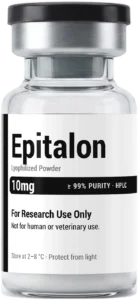
Separating the science from some of the stronger claims found online is worthwhile. Epitalon has been studied for various biological effects, but it is not yet an established anti-ageing treatment. A 2025 review of the available literature describes work across cell, animal and computational studies, while also pointing out that important questions around the peptide’s structure and pharmacology remain open.
What is Epitalon?
Epitalon was developed from research into epithalin, a peptide preparation associated with the pineal gland. The synthetic peptide was designed around the amino acid composition of this preparation. Because of its connection with pineal research, Epitalon has mainly been studied in areas involving biological ageing, melatonin and circadian regulation.
The molecule itself is very small. That makes it useful as a research subject when looking at how short peptide sequences may interact with cellular processes. Researchers have examined several possible mechanisms, including effects on gene expression, antioxidant processes, melatonin production and telomerase activity.
This conclusion is not to say that suggested mechanisms have been proved. The 2025 review points out that scientists have not yet determined how Epitalon creates some of the biological effects it is said to have.
Epitalon and telomere research
Telomeres are protective sections found at the ends of chromosomes. They naturally become shorter as cells divide, although the relationship between telomere length and ageing is more complicated than simply treating telomere length as an ageing clock.
Epitalon became particularly intriguing to researchers because of experiments involving telomerase. An earlier study reported that Epitalon treatment of human foetal fibroblast cultures induced telomerase activity and was associated with telomere elongation. Another experiment reported that treated cells continued dividing beyond the point at which untreated cells showed a loss of proliferative capacity.
More recently, research published in 2025 looked at epitalon in several human cell types. The researchers reported dose-dependent telomere length increases in normal cells and associated these findings with increased hTERT expression and telomerase activity. The same study also observed alternative lengthening of telomeres, or ALT, in the cancer cell lines examined.
That last point is important. Cellular telomere research is not automatically evidence that epitalon extends lifespan in humans. Telomere biology is complex, and effects observed in cultured cells cannot simply be transferred to people.
Pineal gland and melatonin research
Another area of interest is the relationship between the epithelium and the pineal gland.
Melatonin is a hormone strongly involved in the body’s sleep-wake and circadian systems. As people age, changes in melatonin production and daily rhythm have been reported. Earlier studies explored the potential influence of epitalon and related pineal preparations on these changes.
In an animal study involving older rhesus monkeys, epitalon was reported to increase evening melatonin production and alter the cortisol rhythm.
Research involving older people has also investigated pineal peptide preparations and melatonin rhythms. One published study reported changes in nighttime melatonin levels following treatment with Epithalamin or Epitalon in people with reduced pineal function.
These findings help explain why epitalon continues to appear in research surrounding circadian biology. They should not, however, be read as proof that Epitalon is an established treatment for sleep problems or age-related hormonal changes.
Antioxidant and cellular ageing research
Oxidative stress is another recurring theme in Epitalon research. Researchers have investigated whether pineal-derived peptides can influence antioxidant systems and markers associated with oxidative processes.
Some of the earlier work focused on Epithalamin rather than Epitalon itself, including studies of antioxidant enzymes and free-radical processes in ageing animals.
Reviews of Epitalon research have subsequently discussed antioxidant and potentially protective cellular effects as possible parts of its biological activity. The evidence is still largely experimental, though, and different studies use different models, making broad conclusions difficult.
For researchers, this makes Epitalon particularly intriguing as a compound for studying how short peptides may influence several interconnected cellular pathways rather than acting through one simple target.
Research into the retina
Epitalon has also been examined in retinal research. Earlier work investigated its effects in models of inherited retinal degeneration, including Campbell rats. The researchers reported preservation of retinal structure and improvements in functional measurements.
A clinical report from the same research group also described positive effects in patients with retinal degeneration. However, the report is an older and relatively limited body of evidence, so it should be viewed in that context rather than treated as confirmation of a modern clinical treatment.
This part of the research is nevertheless useful, as it demonstrates the investigation of Epitalon beyond the more familiar discussions of ageing and longevity.
Why Epitalon remains a research interest
There is no single reason researchers continue to look at Epitalon. Its small structure, connection with pineal biology and reported effects across several experimental systems make it an interesting compound for laboratory investigation.
Current research has explored areas including:
- telomerase activity and telomere biology
- cellular ageing and replicative capacity
- melatonin production
- circadian regulation
- oxidative stress and antioxidant processes
- gene expression
- retinal biology
- neuroendocrine function
The recent literature also shows that Epitalon research is still developing. A 2025 review emphasised the large body of biological research already performed, and the gaps that remain in knowledge of its precise mechanisms and physicochemical properties.
Epitalon research: what the evidence actually shows
Epitalon is an interesting research peptide, particularly in studies looking at ageing-related cellular processes and pineal biology. There are published laboratory and animal findings, alongside older human studies, that provide a basis for continued investigation.
At the same time, the evidence should be kept in proportion. Results from cultured cells, animals or small clinical studies do not establish that Epitalon increases human lifespan, reverses ageing or treats a particular disease. Those questions require well-designed, adequately powered human clinical research.
For research purposes, Epitalon is best considered a compound being investigated for its potential influence on cellular ageing, telomere biology, melatonin regulation and related biological pathways. Its effects, mechanisms and longer-term implications remain areas for further study rather than settled scientific conclusions.
Published batch records
Every batch of Epitalon we have sold, each with its published Certificate of Analysis.
| Batch | Size | Purity (HPLC) | Tested | Certificate |
|---|---|---|---|---|
| ET-10-11 Current stock | 10mg | ≥99.0% | Oct 2026 | View CoA |
Research Use Only. Epitalon is supplied strictly for laboratory research. Nothing on this page is dosing guidance, medical advice, or a suggestion of human or veterinary use.