
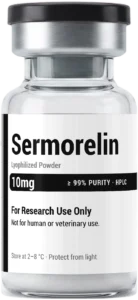
That distinction matters when looking at sermorelin research. It belongs to the GHRH side of the growth hormone pathway, so its activity is different from peptides that work through the ghrelin receptor or from recombinant human growth hormone.
What is Sermorelin?
Sermorelin is a 29-amino-acid peptide derived from the biologically active N-terminal region of human GHRH. Research identified this short sequence as capable of retaining GHRH activity, despite being considerably smaller than the naturally occurring hormone.
The peptide has been studied for its ability to stimulate growth hormone secretion, including research involving children with growth hormone deficiency and studies examining pituitary function. Historically, sermorelin acetate was marketed in the United States as Geref. The FDA records show an original approval for sermorelin acetate, with the product later discontinued; FDA documentation records the approval history rather than suggesting that discontinuation was caused by a newly identified safety problem.
Today, sermorelin also appears in research discussions around the wider GH–IGF-1 axis. However, evidence from historical clinical use should not automatically be treated as evidence for every modern claim made about sermorelin, particularly claims involving healthy adults, body composition or physical performance.
How Does Sermorelin Work?
The basic mechanism is fairly straightforward.
Sermorelin acts on GHRH receptors on somatotroph cells of the anterior pituitary. Activation of this receptor leads to intracellular signalling and stimulates the release of growth hormone. Growth hormone can then influence the production of insulin-like growth factor-1 (IGF-1), mainly through the liver and other tissues.
This makes sermorelin different from taking growth hormone directly. The peptide is working further upstream in the physiological pathway and relies on the pituitary’s ability to respond.
The wider GHRH system is more complicated than a simple on-and-off mechanism. Natural GHRH secretion is pulsatile, while somatostatin acts as an important inhibitory signal. Growth hormone and IGF-1 also participate in feedback regulation. More recent reviews continue to describe GHRH as an active area of research, including effects extending beyond its traditional role in regulating GH secretion.
Why Has Sermorelin Been Studied?
Much of the established research interest in sermorelin comes from growth hormone deficiency and the assessment of pituitary GH reserve.
Older clinical studies investigated whether sermorelin could increase growth velocity in children with idiopathic growth hormone deficiency. A published review reported increased height velocity during treatment in some children and described sermorelin as useful for investigating GH secretory capacity. At the same time, the authors noted that the available data were limited and that final adult-height outcomes had not been established.
This is useful context because sermorelin is sometimes discussed online as though its research history began with modern peptide use. It did not. Its development is closely tied to decades of work on GHRH, pituitary physiology and growth hormone secretion.
The peptide has also been investigated in adults. Studies have looked at whether stimulating endogenous GH secretion could alter GH and IGF-1 patterns, including in older adults. Results have varied according to factors such as treatment duration and dosing schedule, which is one reason broad claims about sermorelin need to be treated carefully.
Sermorelin and the GH–IGF-1 Axis
One of the more interesting aspects of sermorelin research is that it sits relatively close to the body’s normal GH regulatory pathway.
After GHRH receptor stimulation, the pituitary releases growth hormone. GH then contributes to downstream IGF-1 signalling. Researchers therefore study sermorelin not simply as an isolated peptide, but as a way of examining interactions across the GH–IGF-1 axis.
There is considerable interest in this biological pathway beyond growth itself. Contemporary GHRH research is exploring possible relationships with metabolism, inflammation, tissue repair, cardiovascular biology and other processes. Much of this broader work remains preclinical or investigational, however, so findings from laboratory and animal models should not be presented as established human therapeutic effects.
Pharmacokinetic Considerations
A practical limitation of sermorelin is its relatively short duration in circulation. Earlier pharmacological research reported a human plasma half-life of roughly 10–20 minutes, with enzymatic degradation and renal clearance contributing to its rapid disappearance.
This short half-life is relevant when interpreting studies. A brief exposure does not necessarily mean the biological response is equally brief, because sermorelin can stimulate endogenous hormone release through receptor activation. Researchers therefore need to distinguish between the time the peptide remains measurable in circulation and the downstream hormonal response.
The formulation, route of administration and study design can all influence observed results.
Research Safety Considerations
Historical clinical research described sermorelin as generally well tolerated in the populations and dosing conditions studied. Reported effects included injection-site discomfort and transient reactions such as facial flushing.
That does not mean sermorelin should be assumed to be risk-free. Manipulating the GH–IGF-1 system can have wider endocrine and metabolic consequences, and the quality of evidence varies considerably between different proposed uses.
This information becomes particularly important for “products sold online” as “research peptides.” A compound being described as a research material does not establish its purity, sterility, identity or suitability for administration. Recent literature examining performance-enhancing peptides has also highlighted injection-site reactions and endocrine or metabolic concerns across compounds affecting the GH–IGF-1 pathway.
Sermorelin in Current Research
Sermorelin remains relevant as a research tool for understanding GHRH signalling and endogenous GH release. Its history also provides a useful reference point when comparing newer GHRH analogues and other compounds that target the GH–IGF-1 axis.
Researchers should keep the evidence separated by context. Data from children with diagnosed growth disorders cannot simply be transferred to healthy adults. Likewise, a change in circulating GH or IGF-1 does not automatically demonstrate a meaningful improvement in body composition, physical performance or general wellbeing.
For that reason, sermorelin should be evaluated based on the evidence specific to the population, endpoint, and study design under consideration. Its mechanism is well characterised, while some of the broader applications discussed around peptide research remain areas for further investigation.
Sermorelin therefore occupies an interesting position in peptide research: an older GHRH analogue with a substantial scientific history, but one that still requires careful interpretation when claims move beyond its established research background.
Published batch records
Every batch of Sermorelin we have sold, each with its published Certificate of Analysis.
| Batch | Size | Purity (HPLC) | Tested | Certificate |
|---|---|---|---|---|
| SER-10-28 Current stock | 10mg | ≥99.0% | Oct 2026 | View CoA |
Research Use Only. Sermorelin is supplied strictly for laboratory research. Nothing on this page is dosing guidance, medical advice, or a suggestion of human or veterinary use.