
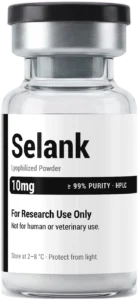
Much of the interest around Selank comes from Russian research, where the peptide has been studied in both laboratory models and relatively small human investigations. The situation outside of that research base is much less developed. Experimental exploration and larger, independently replicated clinical studies reveal a noticeable difference.
What is Selank?
Selank is sometimes described as a synthetic analogue of tuftsin, a short peptide associated with immune function. Researchers have investigated whether modifying this peptide structure can produce effects beyond those normally associated with tuftsin itself.
One area that has received particular attention is the relationship between Selank and the brain’s inhibitory signalling systems. Laboratory work has suggested that Selank can influence processes involving GABA, a neurotransmitter involved in regulating neuronal activity. Research has also examined its possible interaction with enzymes responsible for breaking down enkephalins, naturally occurring signalling peptides involved in pain, mood and stress regulation.
That does not mean a single mechanism has been established. Selank’s research is still dealing with several proposed pathways, rather than one universally accepted explanation for its biological activity.
Selank and anxiety research
Anxiety is probably the area most closely associated with Selank research.
A 2008 paper indexed by PubMed reported a study involving 62 people with generalised anxiety disorder and neurasthenia. Thirty participants received Selank, and 32 received medazepam, with researchers assessing symptoms using several psychiatric rating scales. The authors reported anxiolytic effects in both groups and described additional effects associated with Selank.
It is an interesting finding, but it needs to be kept in proportion. The study was a relatively small study, published in a Russian-language journal, and it does not provide the sort of broad clinical evidence that would normally be needed before drawing strong conclusions about a medicine’s effectiveness.
Other Russian research has looked at Selank in people with anxiety-asthenic disorders, including changes in immune-related markers such as cytokines. One study reported changes in the Th1/Th2 cytokine balance following treatment and suggested that Selank may have immunomodulatory effects.
These findings help explain why Selank continues to appear in research discussions, but they should not be confused with proof that the peptide can treat anxiety in the general population.
Possible effects on GABA and enkephalin signalling
There are several strands of laboratory research behind the interest in Selank.
Earlier work investigated whether the peptide could inhibit enzymes involved in the breakdown of enkephalins. In laboratory experiments, Selank inhibited enkephalin-degrading activity, leading researchers to propose that the peptide could contribute to its reported behavioural effects.
Separate research has examined its relationship with GABA-related signalling. A molecular study reported effects on GABA receptor binding and proposed that Selank could act as a positive allosteric modulator within this system.
These mechanisms are worth investigating because GABA signalling is important for the regulation of neuronal excitability. Still, laboratory evidence is one step removed from demonstrating a meaningful effect in humans. A biochemical interaction does not automatically translate into a clinically useful outcome.
Cognitive and memory research
Selank has also appeared in experimental research concerning learning and memory.
Animal studies have investigated whether the peptide influences conditioned learning, cognitive performance and responses to stress. One rat study, for example, examined its effects on an active avoidance learning task.
Another study looked at memory impairment in rats exposed to long-term alcohol and reported changes involving brain-derived neurotrophic factor (BDNF) alongside behavioural findings.
These studies give researchers potential directions to investigate, particularly around the interaction between stress, cognition and neurobiology. They are not, however, evidence that Selank improves memory or cognitive performance in healthy people.
What the evidence actually tells us
This situation is where a Selank research profile needs a little caution.
There are published human studies, so it would be inaccurate to describe Selank as having no human research whatsoever. At the same time, the available clinical literature is relatively limited and is concentrated heavily in Russian research. The largest commonly cited human study identified in PubMed involved just 62 participants.
There is also a lack of the large, independently replicated clinical programme that would normally provide much stronger evidence about effectiveness, adverse effects and longer-term safety.
That distinction matters. A peptide can have an intriguing mechanism, promising animal data and small human studies, without having enough evidence to establish a medical use.
Selank in UK research
For UK readers, regulatory status is another important part of the picture.
The Medicines and Healthcare Products Regulatory Agency (MHRA) is responsible for regulating medicines in the UK. Whether a particular peptide product is regarded as a medicinal product can depend partly on what it contains and, importantly, the claims made about it. The MHRA specifically considers the claims made about a product alongside its pharmacological, metabolic or immunological properties when determining whether it falls within the definition of a medicine.
This is particularly relevant to research peptides. Calling a substance “research use only” does not by itself determine its legal status, and marketing claims can be an important part of how a product is assessed.
Selank therefore remains much better described as an experimental research compound than as an established UK medicine. Anyone researching its regulatory position should verify current MHRA information rather than relying on claims made by peptide suppliers or online forums.
Why researchers continue to investigate it
Selank remains interesting because several areas of research overlap around the same molecule: anxiety-related behaviour, GABA signalling, enkephalin metabolism, immune signalling and cognitive processes.
The evidence is not all pointing in one neat direction, and that is arguably what makes the peptide worth studying. There are mechanistic questions still to answer, along with questions about how reproducible the reported human findings are.
For now, Selank is best viewed through that research lens. The existing literature provides some useful clues about its biological activity, but there are still significant gaps between early experimental findings and the level of evidence normally expected for an established therapeutic product.
Published batch records
Every batch of Selank we have sold, each with its published Certificate of Analysis.
| Batch | Size | Purity (HPLC) | Tested | Certificate |
|---|---|---|---|---|
| SK-10-25 Current stock | 10mg | ≥99.0% | Oct 2026 | View CoA |
Research Use Only. Selank is supplied strictly for laboratory research. Nothing on this page is dosing guidance, medical advice, or a suggestion of human or veterinary use.