
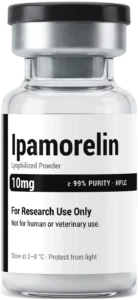
For researchers, that distinction matters. Ipamorelin is not simply another version of recombinant growth hormone. Its activity is mediated by the ghrelin receptor, also known as the growth hormone secretagogue receptor (GHS-R), and its effects have been investigated under different experimental conditions.
Interest in ipamorelin has increased over time, especially in research investigating growth hormone signalling, endocrine pathways and peptide receptor activity. However, the evidence base continues to evolve, and the results of laboratory or animal research should not be interpreted as evidence of a clinical effect in humans.
What is Ipamorelin?
IIpamorelin is a synthetic pentapeptide, meaning that it is made up of five amino acids. It was designed as a selective growth hormone secretagogue and ipamorelin has been evaluated in preclinical and experimental studies with a focus on it especially due to its effects on growth hormone release.
One feature that makes ipamorelin interesting to researchers is its relative selectivity. Earlier growth hormone secretagogues could influence several hormonal pathways, including the release of other pituitary hormones. Ipamorelin was investigated partly because researchers wanted a compound that could stimulate growth hormone release with less activity at some of these other pathways.
That selectivity is one reason it continues to appear in experimental research.
It is also worth separating the compound itself from the many claims that appear online around peptides. Ipamorelin has been discussed in connection with areas such as body composition, recovery and physical performance, but research findings do not automatically support these uses. The quality, design and purpose of individual studies need to be considered before drawing conclusions.
How does ipamorelin work?
The primary research focus on ipamorelin relates to its action on the growth hormone secretagogue receptor.
Signalling triggered by the activation of this receptor might lead to the release of growth hormone from the pituitary gland. Ipamorelin is not the equivalent of taking growth hormone. Instead of the hormone itself, researchers are studying ipamorelin to see if it can influence one part of the body’s own regulatory system.
Growth hormone release is inherently pulsatile. The level of hormones can vary throughout the day, depending on sleep, age, nutrition and other hormonal signals. For this reason, studies using secretagogues like ipamorelin often have to take into account the timing and baseline hormone levels, rather than relying on a single data point.
The relationship between ghrelin signalling, growth hormone secretion and downstream pathways is also more complex than a simple on-or-off mechanism. Therefore, scientists investigate the effect of various compounds on these systems in controlled experimental models.
What researchers are studying
Researchers have studied Ipamorelin in preclinical and experimental studies of growth hormone secretion and physiologic processes.
Several studies have investigated pharmacological properties such as receptor activity and alterations in hormone release. Other work has explored the behaviour of growth hormone secretagogues in animal models and compared their effects to those of other agents in the same general category.
There has also been interest in the wider biological consequences of stimulating growth hormone pathways. Growth hormone can influence several downstream processes, including insulin-like growth factor 1 (IGF-1) signalling, protein metabolism and tissue growth. That makes the pathway relevant to a much wider field of endocrine research.
However, this area is where careful interpretation becomes important. A biological pathway’s alteration does not guarantee that a specific peptide will yield a proven therapeutic outcome. Researchers have to distinguish between receptor-level activity, changes in circulating hormones and meaningful physiological or clinical outcomes.
Ipamorelin and growth hormone research
The growth hormone axis is a complex system involving the hypothalamus, pituitary gland and peripheral tissues.
The hypothalamus sends signals that control the secretion of growth hormone. Growth hormone is secreted by the pituitary into the bloodstream. Then growth hormone can act on tissues, both directly and indirectly, through IGF-1 and other signalling pathways.
Ipamorelin is a tool for researchers to study one aspect of this system by pharmacologically stimulating the growth hormone secretagogue receptor.
This tool could be useful for addressing questions such as how receptor activation impacts hormone secretion, how secretagogues compare with each other and how changes in growth hormone signalling may impact downstream biological processes.
The compound is therefore of interest not because it represents a complete solution to growth hormone research, but because it offers a specific experimental tool for studying a defined part of the endocrine pathway.
Why selectivity matters
Selectivity is an important consideration when studying receptor-active peptides.
A compound that interacts with several receptors can produce a wider range of biological effects, making it harder to determine which response comes from the intended pathway. A more selective compound can, in some research settings, make the experimental picture easier to interpret.
Ipamorelin has historically been investigated for its comparatively selective activity at the receptor for growth hormone secretagogues. This characteristic is one of the reasons it remains relevant in laboratory research involving secretagogue signalling.
That does not mean that selectivity removes all uncertainty. Biological systems rarely behave in isolation, and downstream effects can involve several interconnected pathways. Researchers still need proper controls, validated analytical methods and carefully designed study protocols.
Research considerations
Anyone using ipamorelin as a research chemical should be very concerned with identity, purity, storage conditions and analytical verification.
Handling requirements for peptides are dependent on the specific material and experimental application. Peptides may be sensitive to environmental conditions. Methods such as liquid chromatography and mass spectrometry can be used to help assess peptide identity and purity.
It’s also necessary to keep the intended usage clear. Research-grade ipamorelin should not be presented as an approved medicine or as a substitute for clinically prescribed treatment. Experimental findings, particularly those obtained from cell or animal models, cannot simply be transferred to human health claims.
For researchers, keeping these distinctions clear helps maintain the usefulness of the data and avoids overstating what a study actually demonstrates.
The current research picture
Ipamorelin remains a compound of interest within peptide and endocrine research, particularly where the focus is on receptors for growth hormone secretagogues and regulation of growth hormone release.
Its relatively selective pharmacological profile has helped distinguish it from some earlier secretagogues, while research into the broader growth hormone axis continues to examine how receptor activation connects with downstream biological effects.
There are still important questions around long-term effects, clinical relevance and how experimental findings translate across different research models. Those questions are part of the reason controlled studies remain important.
For research purposes, ipamorelin is best viewed as a tool for investigating growth hormone secretagogue signalling rather than as a compound with established benefits for every purpose claimed online. Looking at the underlying mechanism, study design and quality of evidence give a much clearer picture of what the peptide can—and cannot—tell researchers.
Published batch records
Every batch of Ipamorelin we have sold, each with its published Certificate of Analysis.
| Batch | Size | Purity (HPLC) | Tested | Certificate |
|---|---|---|---|---|
| IP-10-15 Current stock | 10mg | ≥99.0% | Oct 2026 | View CoA |
Research Use Only. Ipamorelin is supplied strictly for laboratory research. Nothing on this page is dosing guidance, medical advice, or a suggestion of human or veterinary use.